1 - Getting Started ~5 mins
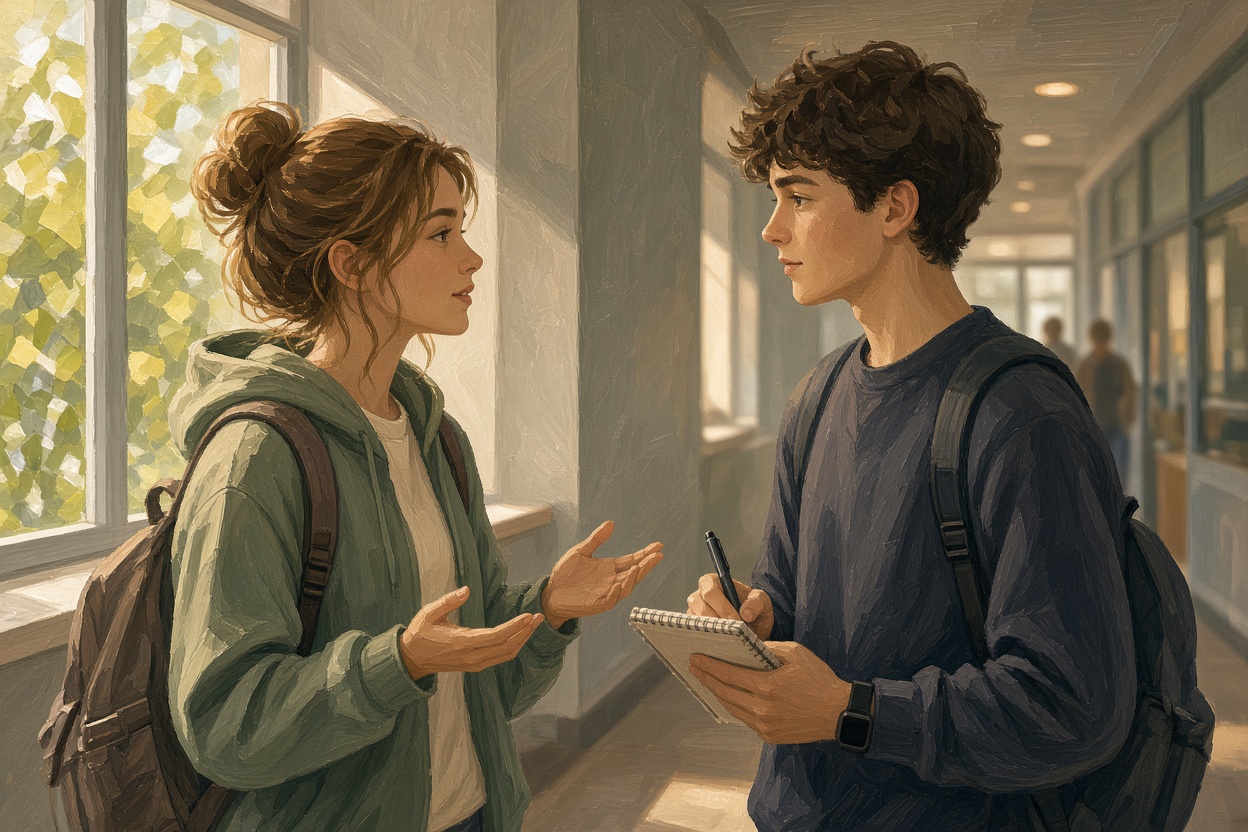 Your personal statement lives on a page. The version you will need first does not. At an interview, on a work-experience doorstep, at an open day, or across a counter, nobody hands you a script. You get about sixty seconds, and you say it.
Today you are applying what you already wrote. You will cut your statement to a spoken introduction, deliver it without reading, then re-cut it after hearing yourself and hearing what your partner did not follow. The re-cut is the lesson.
2 - What Sixty Seconds Can Hold ~8 mins
Before you cut your own statement, study one first attempt and the re-cut that followed. Version A still sounds like writing. Version B is what the same student said after a partner named one stretch they could not follow.
Go through the numbered notes one at a time as they appear. Notice the three moves that matter for a listener: drop the list opening, lead with a concrete moment, and cut the clause that only worked on the page.
You will make those same moves on your draft when you deliver and re-cut later this lesson.
Spoken introduction: first cut and re-cut
3 - Spot What Breaks Out Loud ~10 mins
Oisín (example student) cut his personal statement into a first spoken draft for an ICT apprenticeship open evening. It still sounds like writing. Label each highlighted stretch: runs long, list opening, written clause (fine on a page, hard to say), or lands better spoken (keep and lead with this).
When the class is ready, reveal the model labels and notice where you disagreed. Those disagreements are the cuts you will make on your own draft next.
Oisín's first spoken draft
4 - Aoife's Re-cut ~10 mins
Aoife (example student) cut a spoken introduction for a community childcare apprenticeship information evening. Draft 1 still sounded like an essay. Her partner, Mark, lost her in the second sentence and remembered only the six-year-old and the chapter book. Draft 2 is the re-cut she took to the evening.
Read both versions. Show each step and notice the order change, not only the shorter length.
Discuss aloud (no writing on this page): What did Mark's two notes give Aoife that reading the page alone could not? Which change in the first ten seconds matters most for a listener?
Next you will run the same cut, deliver, and re-cut sequence on your own material.
Spoken introduction: draft 1 and draft 2
5 - Deliver, Hear It, Re-cut ~22 mins
Pair delivery is ordinary practice for a real door (interview, open day, work-experience doorstep). It is not a performance for marks.
Your turn (portfolio build for ALT 1):
- Open your current personal statement draft. If you do not have it to hand, start from three bullet beats: one concrete moment, one route reason, one modest strength.
- Cut a first spoken introduction of about 140 to 160 words (roughly sixty seconds). Time it once at a natural pace. Use three bullet beats on a card rather than memorising a full paragraph.
- Deliver it to a partner without reading from the page. Your partner notes one stretch they could not follow and one line that landed.
- Re-cut on the spot. Say the new version once more.
- Save the final version in your Digital Portfolio as S1.1/Spoken Introduction (with your other ALT 1 personal-statement work), plus two lines: what you cut after hearing it, and what your partner did not follow.
If you are working alone, record yourself once, listen back, re-cut, and note what you changed and why.
The only written capture for this step is that portfolio file.
Three beats and two partner lines
Unlock the full learning experience
You're previewing this lesson. Get full access to this lesson and hundreds more — each one ready to teach, with interactive activities, printable resources and pupil progress tracking built in.
This lesson is copyright of Coding Ireland 2017 - 2026. Unauthorised use, copying or distribution is not allowed.