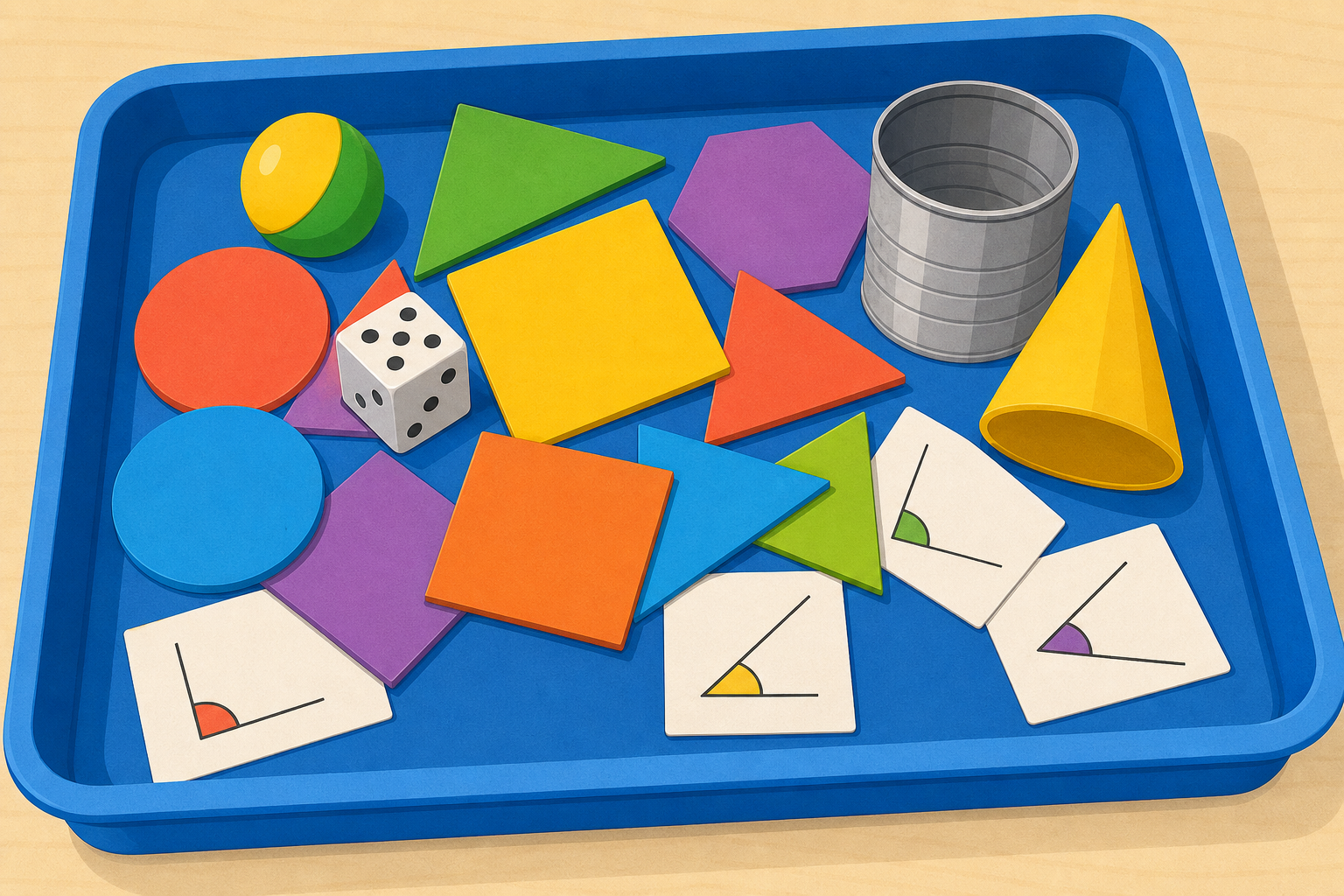
Here is a tray of mixed shapes: flat shape cards, solid objects and angle cards all jumbled together.
If you had to put all of these into just a few groups, what groups would you choose? What would your rule be?
Lay out the mixed tray as pupils settle so they can see the real objects too. Take two or three hands-up answers, not open call-outs — you are just surfacing that there is more than one way to sort. Do not settle on a "right" grouping; that is the whole lesson.
Your teacher will show two finished sorts using the real cards. Someone has already sorted the cards into groups. Your job is to check whether every card really obeys the rule.
The first sort answers: which of our shapes have right-angle corners? Look at each finished group and decide if every card is in the right place. Then the second sort answers: which of our solids roll? Read each group the same way.
Look carefully at the group a card was put into. Can you find the card that does not belong in its group?
Lay out two finished sorts with the real cards before the class, and plant one card in the wrong group in each sort. Invite the class to read each group and check it. Test a card live with the real cards: hold the paper right-angle corner into a square's corner (fits), then into the triangle's pointy corner (does not fit), so pupils see the check happen in your hand.
The key move to name: a fair sort tests every card against the same rule. Head off the slip of sorting by "what it looks like" instead of by the stated rule.
Today we sort these shapes together on the board. We sort by one rule at a time. Before each card moves, say which group it belongs in, and why.
Talk this one through together — pupils take turns at the board and the class agrees or corrects out loud.
Set one clear rule at a time and say it aloud before any card moves. The three rounds are the three drag-sort banks on screen: sides, then rolling solids, then angles. Listen for pupils justifying with the property ("it has four sides") rather than the look ("it's a box shape"). Revoice a strong justification: so you sorted it by counting the sides, not by how it looks. The paper right-angle tester stays on the desk for the angle round — hold it into the square corner card so pupils see it matches a right angle exactly.
In your maths copy, write your own sorting question about the shapes. Start it with "Which shapes have…?" or "Which shapes are…?", for example "which shapes have four sides?"
You can choose from these shapes: triangle, square, rectangle, pentagon, hexagon.
Then list two shapes that answer yes to your question.
Walk the room and glance that each question has a clear yes/no rule and that both listed shapes really fit it — no individual marking, this is whole-class copybook practice, not assessment.
Today we work through four sorting rounds on the board. Each round is a little harder than the last. A property is one feature of a shape, like how many sides it has, whether it rolls, or the size of an angle. Say your sorting rule out loud before you start each round, then keep to it.
This is the practice round — pupils take turns at the board, check each answer, and the class confirms before moving on. Keep the board work brisk rather than over-explaining.
For the angle round, keep the paper right-angle tester in hand — when an angle is close to a square corner, test it before deciding.
Learning outcome 4 (apply a chosen rule consistently) is assessed off-screen. After the four on-screen rounds, hand a pupil the physical mixed tray: they must state their own property rule aloud first, then sort every object by it while the class checks each one against the stated rule. The pupil must not change the rule partway through.
You're previewing this lesson. Get full access to this lesson and hundreds more — each one ready to teach, with interactive activities, printable resources and pupil progress tracking built in.