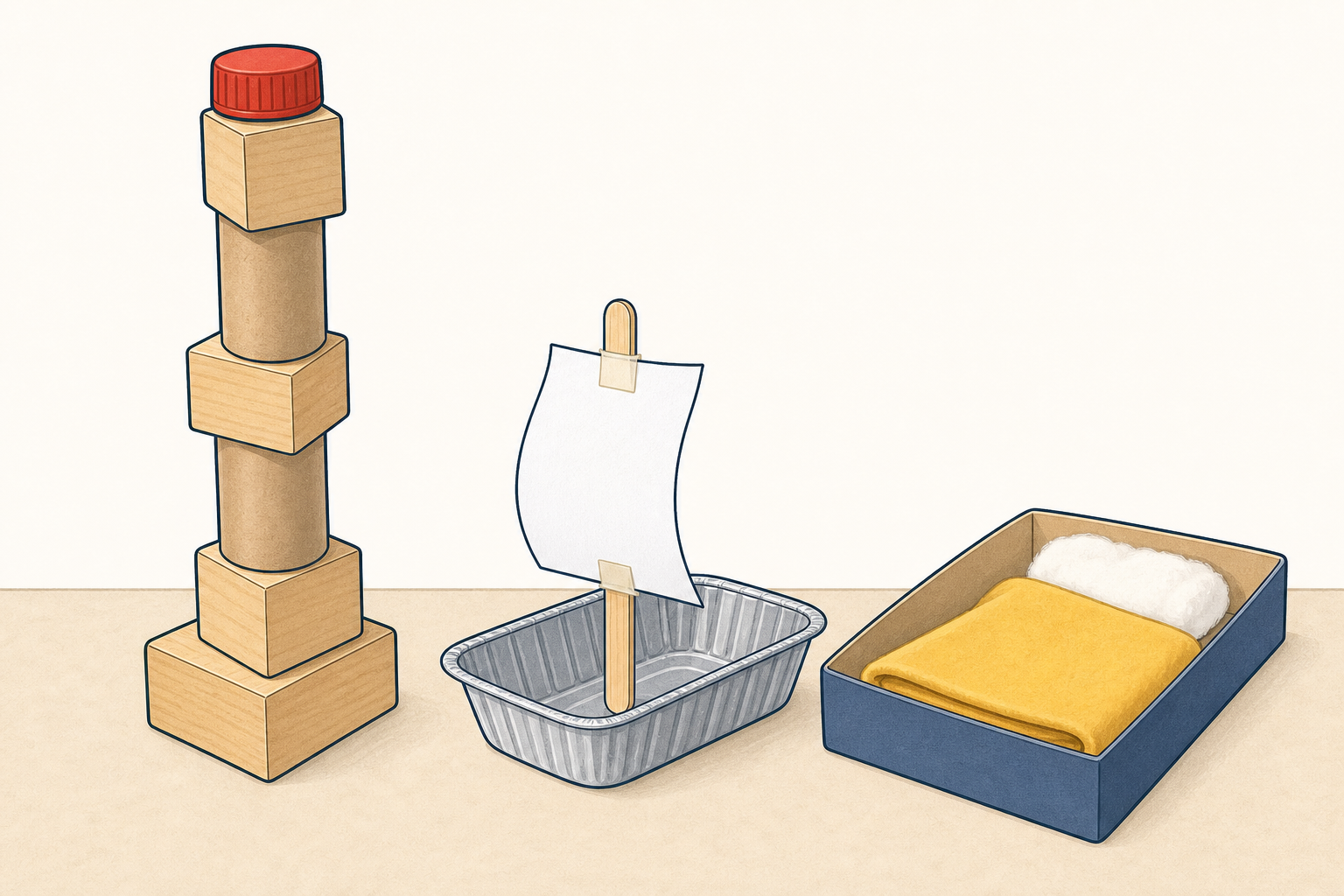
Look! We have made tall towers, little boats and cosy beds. Makers share their work. Who is ready to show something they made?
Gather the children on the circle mat with their makes nearby (on a low table or in a tray behind them, not piled in laps). Keep the hook light: name the three kinds of make from this module and spark excitement about sharing. Do not list rules or model the full share yet.
Before the lesson: gather each child's make from earlier in this module (tower, boat or teddy bed). If a make went home or came apart, a photo or the child's drawing of it is fine. Push back chairs and clear a safe circle space.
Key question: Who likes to show something they made?
Makers show what they made and tell the little job it helps with. What little problem did your make help with?
Keep the board to this one anchor idea only. Do not put three term–definition pairs on screen. Teach with your hands and one sample make: hold it up, name the little job it helps with, then sit it down. Save the kind-comment stem for the live share in the circle (step 4), said aloud when the first friend is invited to notice.
| Concept | Why it matters | Example |
|---|---|---|
| Share — show your make and tell about it in a clear, kind voice | Makers help each other when they show what they built and how it works | A child holds up a foil boat and says it helps teddy float across the water tray |
| Little problem — the small job your make was built to help with | Engineers make things because someone needs help with a real job | Teddy could not see over the wall, so we built a tall tower for him to sit on |
| Kind comment — a friendly thing you notice about a friend's make (teach live in the circle, not on this board) | Kind words help makers feel proud and spot what worked well | Saying "I like your wide bottom blocks — they stop the tower wobbling" |
Nature of STEM weave: makers and engineers share their work and listen to other people's ideas. That is how good ideas grow.
Misconception to head off: children may think sharing means giving the make away. Model that we show and tell, then keep our make.
Modelled share (do this live with one sample make): "I wonder if teddy can see over the wall. I made this tower. The little problem was that teddy was too short to see. A wide bottom helped it stand." Do not invite a kind comment yet — that stem comes in the sharing circle so children hear it at the moment they will use it.
Look at your make. Whisper to a partner: what is one thing that helped it work? Then we will share.
Each child should be holding or sitting beside their own make (or photo/drawing). Pair children who are ready; a few may whisper to you instead.
Ask the one prompt aloud. Give about thirty seconds of whisper time. Then invite two or three pairs to say their idea to the class so everyone hears strong examples: wide bottom, foil sides turned up, soft fabric, strong tape.
Look-fors:
Differentiation: offer sentence starters said aloud: My make helped with… and This part helped because… For a quieter child, let them point while you voice the words.
This is oral only. Nothing is written or typed.
Bring your make to the circle. Some friends will show their make and say the little problem it helps with. Everyone holds their make up so we can all see. After a friend shares, one of us will say one kind thing we notice.
Kind comments happen inside this circle, not as a later block. Sit in a circle. You hold a soft talking object (a small ball or beanbag) so only one child speaks at a time. After each full share, invite one friend to give a kind comment while the make is still held up. Model the stem aloud the first time: One kind thing I notice is…
What every child does:
Class size tip: you will not hear a long speech from every child in 15 minutes. Rotate longer turns another day if needed. Watching friends, holding up your own make, whispering the little problem to a partner, and listening for kind comments are all real parts of the share.
Prompts for the longer shares:
Kind-comment stem (say it live, not as a board definition): One kind thing I notice is… Nudge toward a real detail: shape, material, steadiness, cosiness. Keep tone warm; this is not fixing someone's work unless they ask. Noticing-only stems if needed: What part looks steady? What looks soft and cosy?
What good looks like: child holds the make so friends can see it, names a simple job ("so teddy can sleep", "so it can float", "so teddy can see"), and sits when finished. Celebrate effort and ideas, not perfect builds.
If a make has broken: welcome the photo or drawing. Say makers often fix and try again.
Safety: carry makes with two hands; taller towers stay low; clear space so nobody trips on blocks or boxes.
Nature of STEM (woven in, not a separate talk): briefly revoice that real makers share builds, listen to ideas, and learn from friends.
We showed our makes and said kind things we noticed. Makers share and listen, just like us.
This is a brief close of the same circle, not a second discussion block and not a time to comment on makes that have been put away. Keep it to about two minutes.
Revoice in child language: we showed our makes, we named the little jobs, and we said one kind thing we noticed. Thank the makers and the commenters.
Quick oral check (thumbs only): thumb up if you showed your make; thumb up if you heard or gave a kind comment. No written tick list.
Do not open abstract why/how-did-it-feel prompts. Stay concrete: we looked carefully, we named something real, we said thank you.
You're previewing this lesson. Get full access to this lesson and hundreds more — each one ready to teach, with interactive activities, printable resources and pupil progress tracking built in.