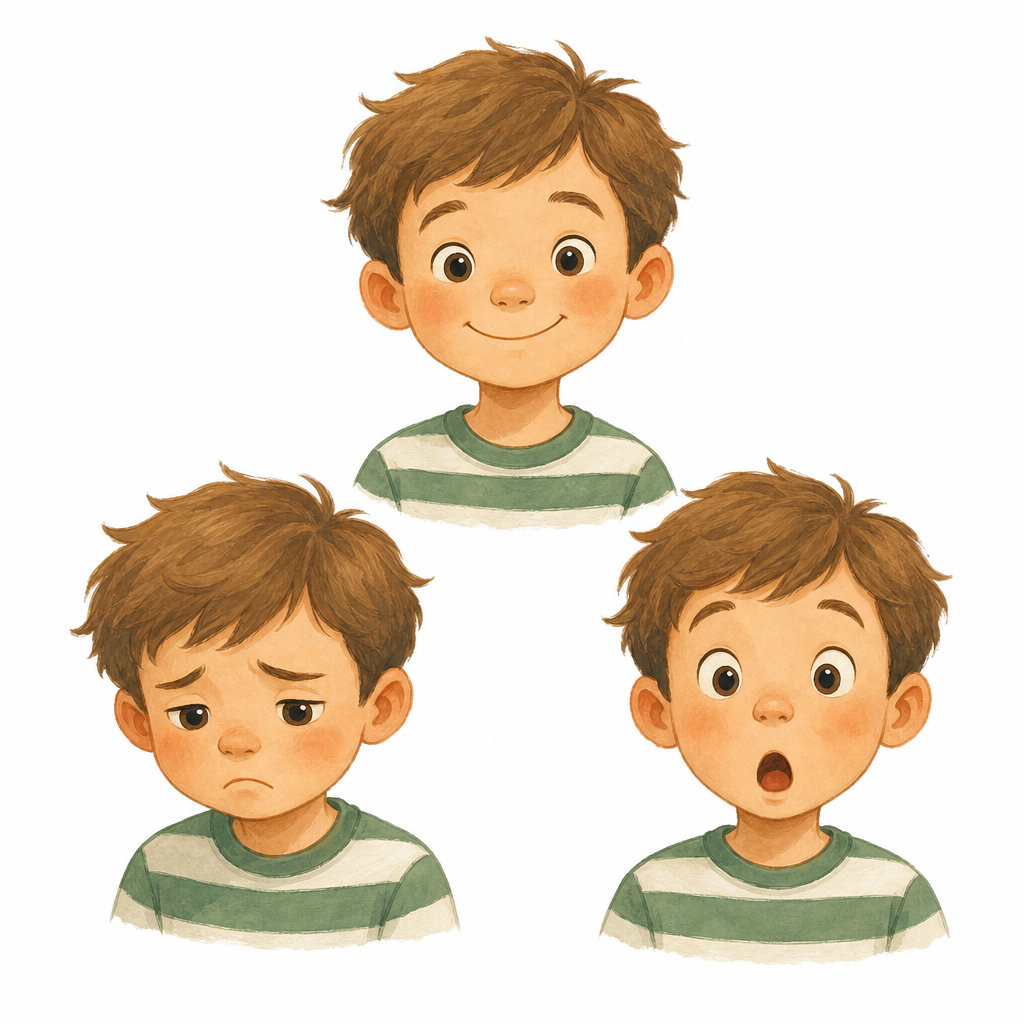
Show me happy without saying anything. Now sad. Now confused.
You already know how to show feelings with your face. Today you will learn eight French words so you can say how you feel as well.
Ask the class to mime happy, then sad, then confused. Keep it quick and playful; three or four volunteers is enough. Do not name the French words yet. The point is that feelings are already familiar, so the new words have something solid to stick to. Praise a bold face: "That sad face is perfect, hold on to that energy for the French words."
Listen to each French emotion word, then say it back together. We will meet them in two short groups so they stick.
Notice the frame you will use: Je suis plus the feeling, for example Je suis content (I am happy) and Je suis triste (I am sad).
Run this on the IWB. You tap each word so the class hears the audio; pupils listen, then repeat. Do not hand devices around for this step.
Group 1 first (about four minutes): content (kohn-TAHN), triste (TREEST), en colère (ahn koh-LAIR), fatigué (fah-tee-GAY). After the four, do a quick show-of-faces check: you say the French, they pull the matching face and whisper the word.
Group 2 next (about four minutes): nerveux (nehr-VUH), surpris (sewr-PREE, lips tightly rounded on the first syllable), effrayé (eh-fray-YAY), confus (kohn-FU — French u is like a tight "ee" with rounded lips, not English "oo"). Then leave all eight visible as a reference strip.
Model the full frame once: Je suis content (zhuh swee kohn-TAHN). Warmth tip: effrayé has a soft glide in the middle, eh-fray-YAY, give it a big scared face when you say it and the class will remember it. For confus, watch your mouth: lips forward and rounded on the final sound.
Gender: Masculine forms stay on the board as the default model. If a pupil is talking about a girl or about herself, add the extra e where it applies — contente, fatiguée, nerveuse, surprise, effrayée, confuse. Listen for the extra sound on fatiguée and effrayée. (triste and en colère stay the same.)
Natural usage aside: Native speakers often say j'ai peur for "I'm scared" — pupils will meet that soon. Today we stay with Je suis + feeling so the pattern holds for every word.
Picture a French schoolyard at la récré (break time): someone has just scored, someone has a test after break, someone got a surprise birthday song.
Volunteers flip two cards on the board and find each French emotion with its English meaning. Everyone else whispers the French word whenever a French card is turned.
Then, with a partner: Partner A asks Ça va ? (sah VAH). Partner B answers with a full sentence and a matching face — Je suis fatigué, Je suis content, or another feeling from today. Swap roles.
Default path (whole-class IWB): Volunteers take turns at the board. The rest of the class stays involved by whispering each French word as it appears. If a pair is missed twice, pause and say the French word together before moving on. Listen for clear attempts at the harder ones: nerveux (nehr-VUH) and effrayé (eh-fray-YAY).
Only if pupils already have shared devices may pairs run the same matching activity at seats, that is optional, not the expected setup.
Pair beat (about two minutes, after matching): Model once at the front: you ask Ça va ? (sah VAH), a volunteer answers Je suis nerveux with a nervous face. Then every pair does the same, one minute each way. Frame it as break-time chat after football, a test, or a surprise. Circulate and catch one strong sentence to share back: "I heard a brilliant Je suis surpris, say it again for us."
First, say two full sentences together from the models on the board. Then open your copy: write the sentence frame and change the feeling word to how you feel right now.
Pause the board. Keep the word-table on screen and write two large model sentences beside it, e.g. Je suis content and Je suis triste. Chorus both sentences as a class before anyone opens a copy. Prompt: "Copy the sentence frame, then change the feeling word."
Everyone writes a full sentence such as Je suis fatigué (zhuh swee fah-tee-GAY), not a bare word. Walk the room and check for the full frame plus accents. Do not collect these. A quick "I can see careful accents on this table, well spotted" keeps the writing warm.
Sketch a simple 3×3 grid in your copy and fill eight squares with today's French emotion words from the board (one square can be a free space). Listen carefully as each French word is called. Cross it off when you hear it. First full line calls out, then the class choruses your winning line in French!
How to Play Bingo:
Option 1: Students on Devices (Digital Version)
Option 2: Print Out the Bingo Cards
You're previewing this lesson. Get full access to this lesson and hundreds more — each one ready to teach, with interactive activities, printable resources and pupil progress tracking built in.