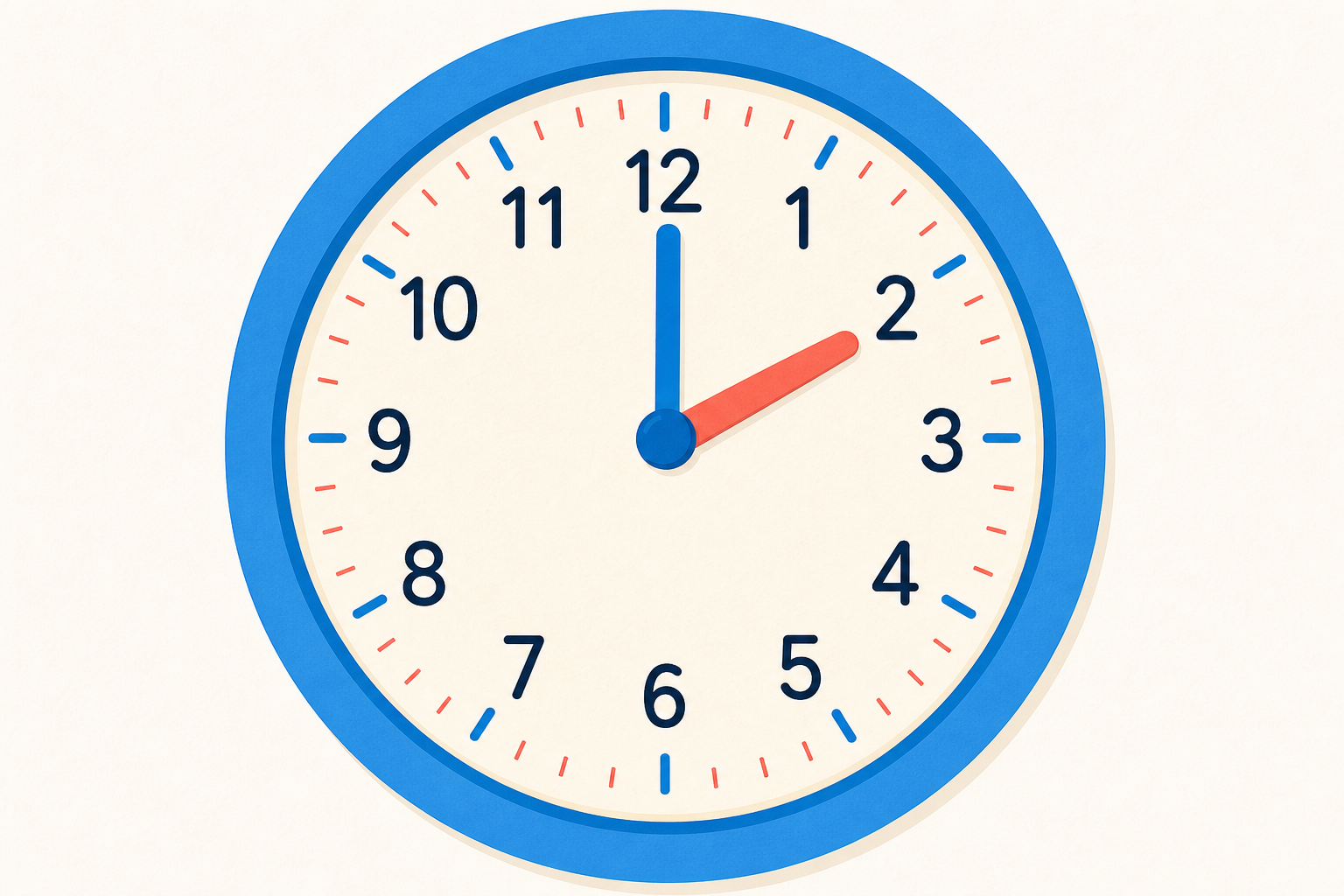
Here are two clocks. One shows 2 o'clock. The other shows 3 o'clock.
How long is it from the first clock to the second clock? How could you work it out?
Display the two clock faces (2 o'clock and 3 o'clock) as pupils settle. Take three hands-up answers, not open call-outs. Listen for pupils who say 'you go forward one hour' — that forward-stepping idea is exactly what the lesson builds on.
Watch as the teacher shows each start and finish pair on the board. We count on from the start hand to the finish hand to see how much time has passed.
Some finish times land on a whole hour, and some land on a half past or a quarter past. Notice how far the minute hand has moved on each one.
Discuss each pair on the board. For the whole-hour jump ask 'has the hour hand moved one whole number, or half a number?' Hold out for pupils to say the finish is a half past before you confirm it.
Do not announce the duration before the class predicts it.
Today we count on from the start hand to the finish hand and say how long has passed.
Talk this one through together — pupils take turns at the board and the class agrees or corrects out loud.
Set the start hands, then a pupil moves the finish hands and reads the elapsed time off the clock. Ask 'did the minute hand go all the way round, or only part way?' Watch for pupils who say the wrong finish hour when the minute hand is at the 6.
In your maths copy, write three "start time → finish time → time passed" lines for the examples the teacher displays. Fill in the time that has passed on each line.
Walk the room glancing at the arrow lines and the time-passed answer — this is whole-class copybook practice, not marking. Prompt any pupil who writes a finish time in the time-passed box.
Today we count on to find how long each activity lasts:
This is the practice round — pupils take turns at the board, check each answer, and the class confirms before moving on. Keep the board work brisk rather than over-explaining.
Every story stays inside one hour, just like the examples the class watched and tried. Each finish time is a half past or a quarter past, so the answer is how far the minute hand has moved: 30 minutes for a half past, 15 minutes for a quarter past. The word 'to' here signals adding time on, so the answer is the elapsed time, not a finish time.
You're previewing this lesson. Get full access to this lesson and hundreds more — each one ready to teach, with interactive activities, printable resources and pupil progress tracking built in.