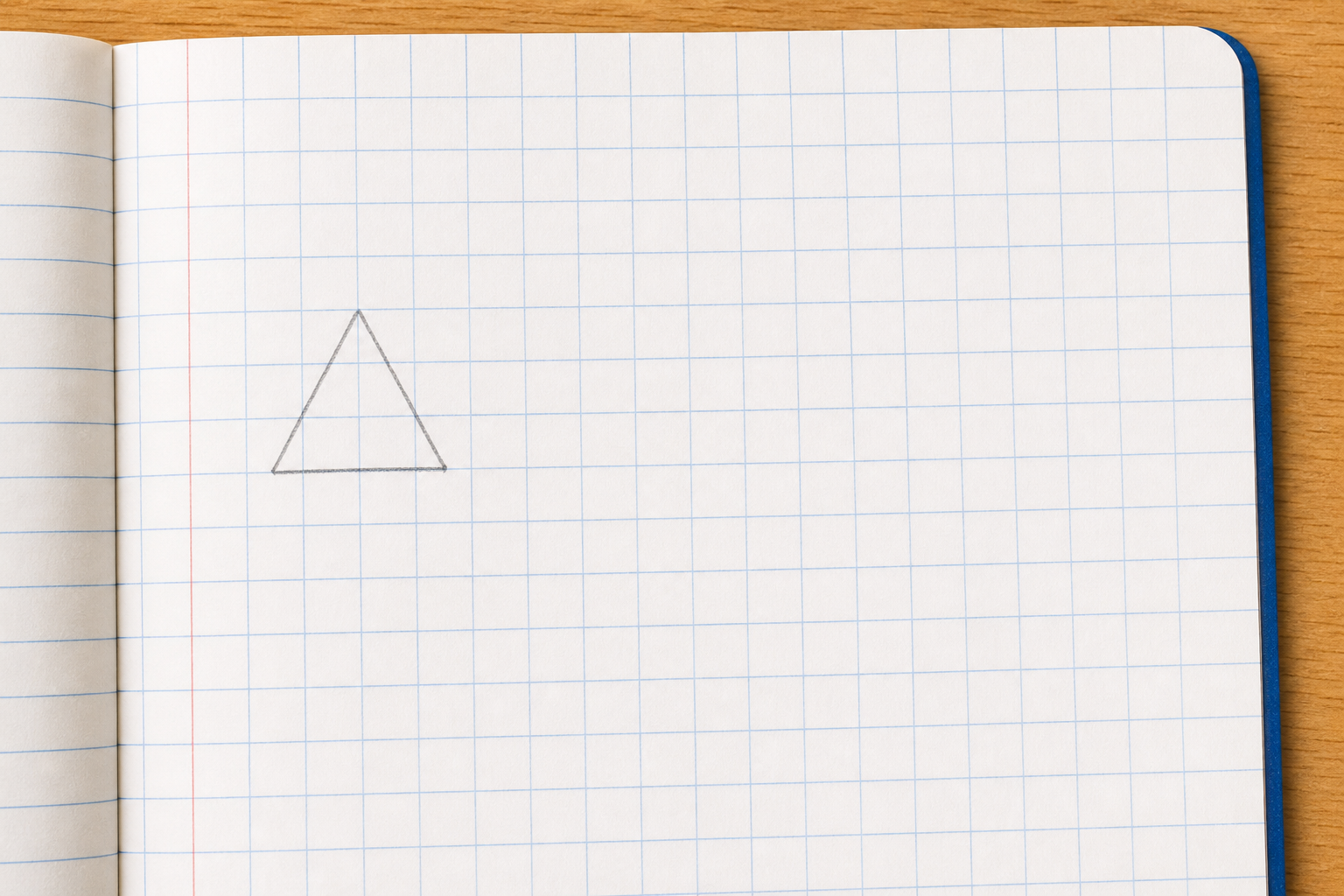
Watch the shape on the board carefully. It is about to move three squares across to a new spot.
Just watch this time. When it stops, tell me in your own words what you saw the shape do.
Slide a pattern-block shape (or a paper shape) a few squares across the board or visualiser. Take two or three hands-up answers in the pupils' own words. Do not name the word 'slide' yet and do not offer them the words 'turn' or 'flip' either — let pupils describe what they see first, then you'll name it in the next step.
When a shape slides, it moves to a new place but keeps facing the same way. It does not turn and it does not flip.
Each picture below shows a shape before and after a slide. Every corner has moved the same number of squares in the same direction.
A shape can slide in any direction, not only right and down. The next picture shows a shape that has slid to the left.
The picture after that shows a shape that has slid up.
In the last picture the shape has slid two ways at once. See where each corner has ended up.
Point to one corner in each picture and ask the class to find where that one corner has landed. Revoice: so every corner moved the same, and the shape is still pointing the same way.
On the left and up examples, stress that a slide works in every direction, not just right and down — pupils will need all four directions shortly.
Head off the common slip: pupils confuse a slide with a turn. Ask on the second example whether the triangle has spun at all — it has not.
Now we slide the shape together on the board. Take turns:
Name one slide at a time, then have an individual pupil drag the shape that many squares. Each prompt is a fresh slide named on its own, so pupils do not need to work out any total distance from earlier moves. Before a pupil lets go, ask the class to predict where one named corner will land. Keep it brisk — rotate four pupils. Watch for pupils who accidentally rotate the shape while dragging; the readout will show it faces the same way when done correctly.
The third and fourth prompts rehearse left and up, which the class just saw in Watch and Notice. For the fourth prompt, slide it 3 squares up, ask the class to picture the shape rising three squares before the pupil drags, so an upward slide is not new when they meet it in the challenge.
In your maths copy on squared paper, draw a small shape. Then draw it again after a slide of 4 squares to the right.
Check carefully: your new shape must face exactly the same way as the first one.
Walk the room and glance that each pupil's second shape faces the same way and every corner has moved 4 squares — no marking, this is whole-class copybook practice.
Now we slide shapes to hit a target outline on the grid. Take turns:
This is the practice round — pupils take turns at the board, check each answer, and the class confirms before moving on. Keep the board work brisk rather than over-explaining.
For each target, have a pupil slide the shape to match the dashed outline, then press Check. Ask the class to say the slide out loud first ("how many across, how many up or down?"). The last one slides up — the class met an upward slide in Watch and Notice and rehearsed one in Try It Together, so ask them to picture it going up before they drag.
You're previewing this lesson. Get full access to this lesson and hundreds more — each one ready to teach, with interactive activities, printable resources and pupil progress tracking built in.