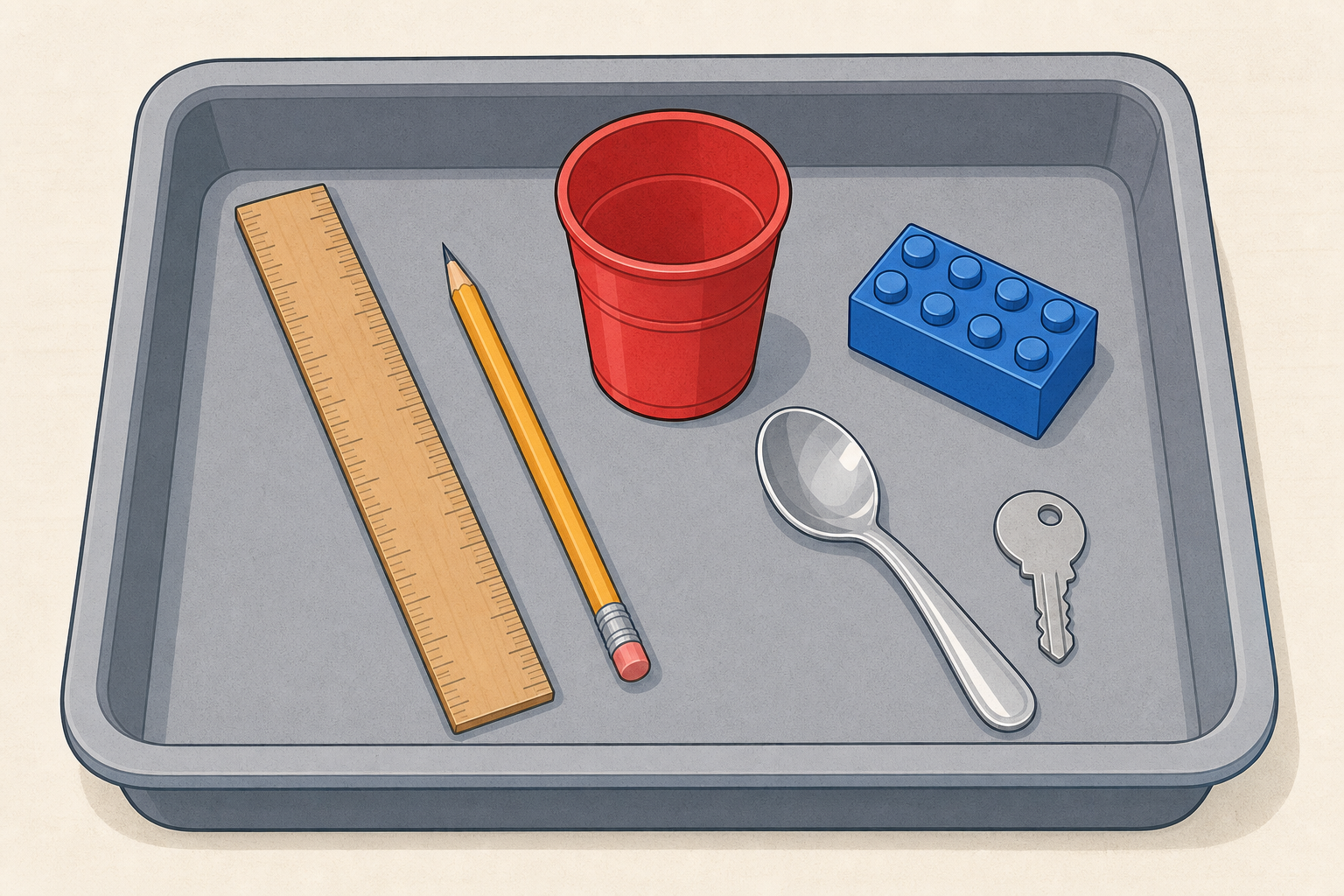
Your teacher is holding a tray of things from our classroom. Some feel hard and cold. Some feel light. Some look shiny.
Can we put the ones that are made of the same stuff together?
Hold up the physical tray so everyone can see a mix of wooden, plastic and metal objects. The board does not show the tray; the real tray in your hands is the hook. Do not name the three groups yet. Keep the hook light: one curiosity question only.
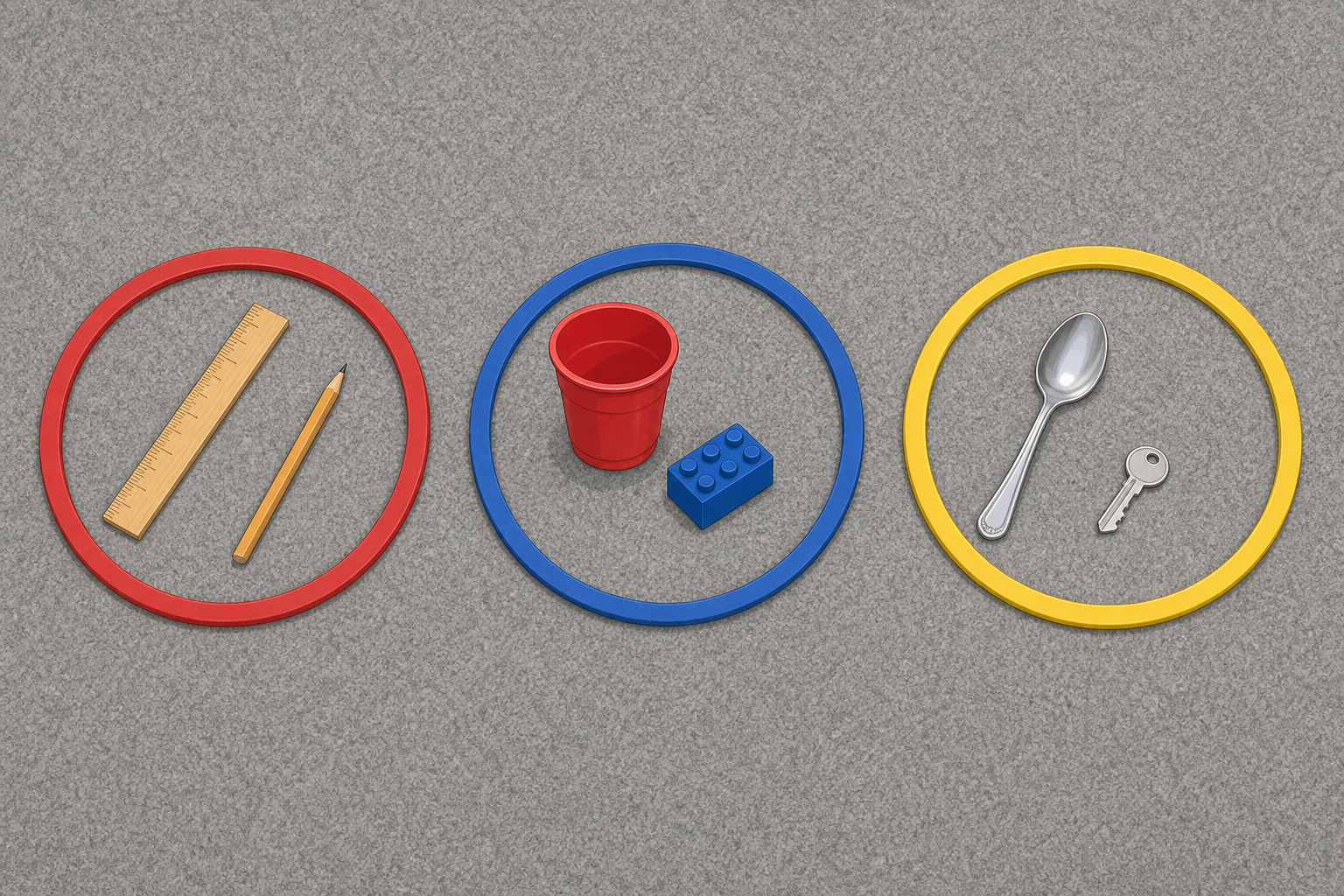
Have three sorting hoops ready on the carpet but leave them empty. Do not hand out objects yet.
Who helps us: later you may briefly mention that a recycling crew sorts waste by material. Leave that for the make-sense talk as an optional teacher line only.
Look closely. Touch gently if your teacher says you may.
What do you notice? What do you think each thing is made of?
This is a short whole-class notice, not a full pass of every object. Choose two or three objects from the tray and hold each one up (or pass one at a time around the circle). The class looks and feels together; not every child handles every object.
Ask: What does it feel like? What colour is it? What do you think it is made of?
Guesses are never wrong. Accept wood, plastic, metal and any everyday words children use (hard, shiny, soft). Revoice gently with the material name when it fits.
What to watch for: children may sort by colour or size instead of material. Smile and say we will check by looking and feeling what it is made of.
No drawing or diagram in this step; noticing is oral only.
| Concept | Why it matters | Example |
|---|---|---|
| Sort — put things that are the same kind together in a group | Sorting helps us tidy, find things and recycle | All the wooden blocks go in one hoop so we can build with them later |
| Material group — things made of the same stuff, such as wood, plastic or metal | Things in one material group are made of the same kind of stuff | A wooden spoon and a wooden block both go in the wood group |
Board version only (already in the description): keep it to noticing and guessing. Do not project this table.
We have three hoops on the carpet. One hoop is for wood, one is for plastic, and one is for metal.
When it is your turn, choose one object. Look at it and feel it gently. Then put it in the hoop for the material it is made of.
Work in short bursts. About 4–5 minutes sorting, a 1-minute regroup (hold up one object and ask the class which hoop), then another 4–5 minutes. Four- and five-year-olds need the break.
Model one object first with the full cycle out loud, using a stem children can copy: I wonder what this is made of. I think it is wood because it feels warm and I can see the grain. I put it in the wood hoop because it is made of wood. Invite pairs to try the same stem after a few sorts: I put it here because…
Suggested tray mix (per shared set): wooden block, wooden spoon or lolly stick, pencil; plastic cup, bottle top, plastic brick; metal spoon, key, clean coin or paperclip. Avoid glass. Keep the three sample marker objects beside the hoops so the remaining items are the ones children sort.
Misconception to head off: a metal spoon that looks silver is still metal, not "silver group". A wooden pencil with a metal band is mostly wood for this sort; if a child notices the band, praise the noticing and agree the main material is wood.
Differentiation: offer a second adult or older buddy at one hoop. Confident sorters can be the "checker" who asks why does it belong?
Keep magnets, water and glue away. This is a dry look-and-feel sort only.
Now we will sort pictures on the board.
Listen to the question: What is it made of? Help put each picture in the wood, plastic or metal hoop.
Drive the interactive on the IWB after the real tray sort. Children call out; you drag (or invite one child at a time to the board). Lean on the real tray sort they just finished as the reference: Think back to how the wooden things felt… rather than asking children to read item names.
What appears on screen: one question read aloud — What is it made of? — and three hoops labelled wood (wood emoji), plastic (cup emoji) and metal (key emoji). Picture cards start in the tray: wooden block, wooden spoon, pencil, plastic bottle, plastic brick, plastic cup, key, metal spoon, coin.
Where each belongs: wooden block, wooden spoon and pencil → wood; plastic bottle, plastic brick and plastic cup → plastic; key, metal spoon and coin → metal.
After every card, fold the watching class in before the next drag: Do you agree? How could we check? What did the real one feel like on the tray? This keeps row 3 judging along when feel is no longer available.
Nothing is scored. A card in the wrong hoop is a conversation: How could we check? What does wood feel like?
On your sorting page, draw one thing in the wood group, one in the plastic group and one in the metal group.
Hand out the Investigation Journal page (one per child). Children mostly draw. A few may attempt a letter or copy a simple mark from a hoop sample; that is a bonus, not required.
This step stays in class. Do not set it as homework. Circulate and ask each child to point to one drawing and say why it belongs: It is wood because…
If time is short, aim for one simple drawing per material group; a quick mark and a spoken reason still count. If a child has sorted by colour, gently invite them to choose one object from the real tray and check the material together, then draw that one.
Do not describe extra boxes or columns on the page. The page is generated from the lesson. Just say draw one thing for each material group.
You're previewing this lesson. Get full access to this lesson and hundreds more — each one ready to teach, with interactive activities, printable resources and pupil progress tracking built in.