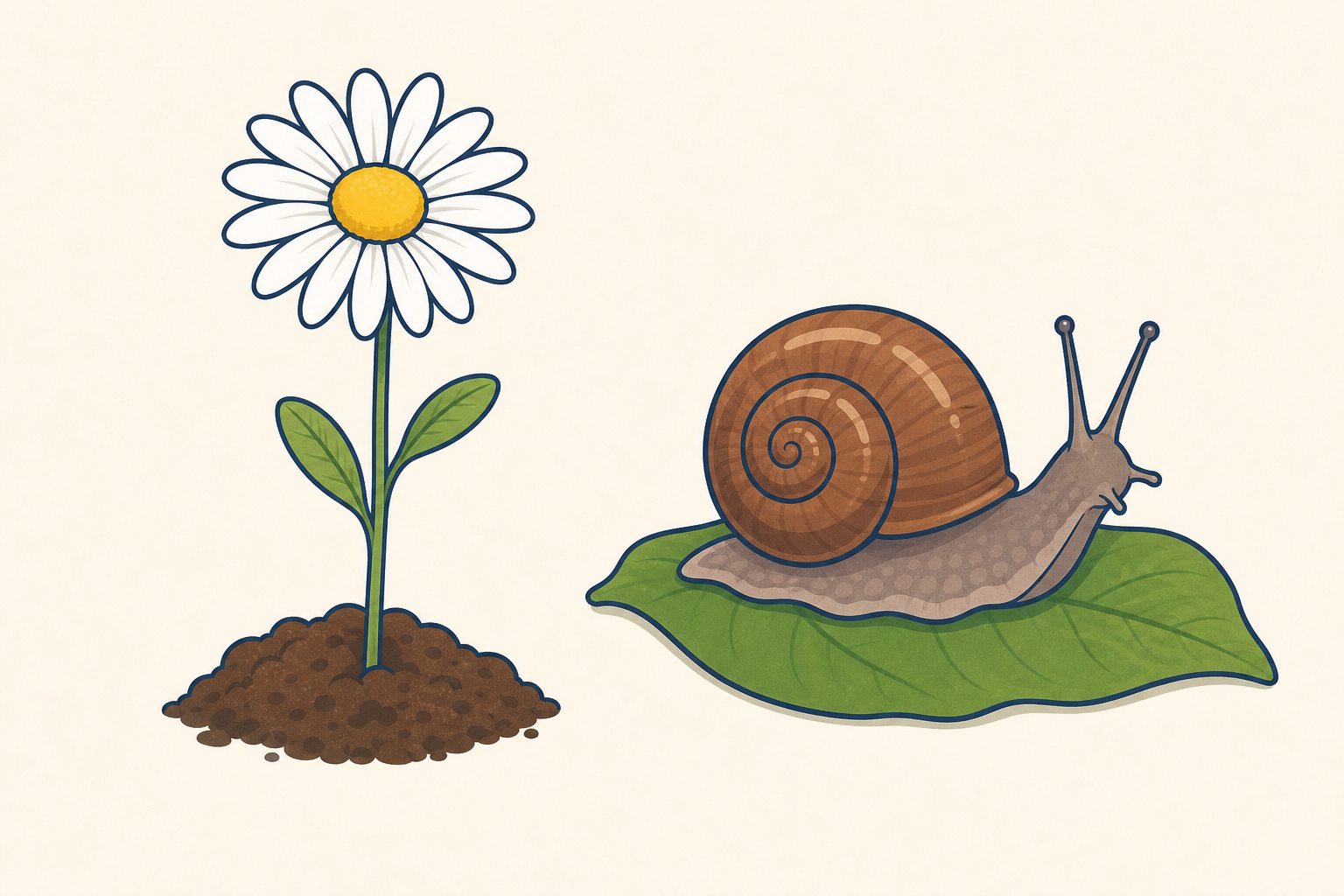
Look at this daisy and this snail. Which one grows in the ground? Which one can slide away?
Today we will sort things into two groups: plants and animals.
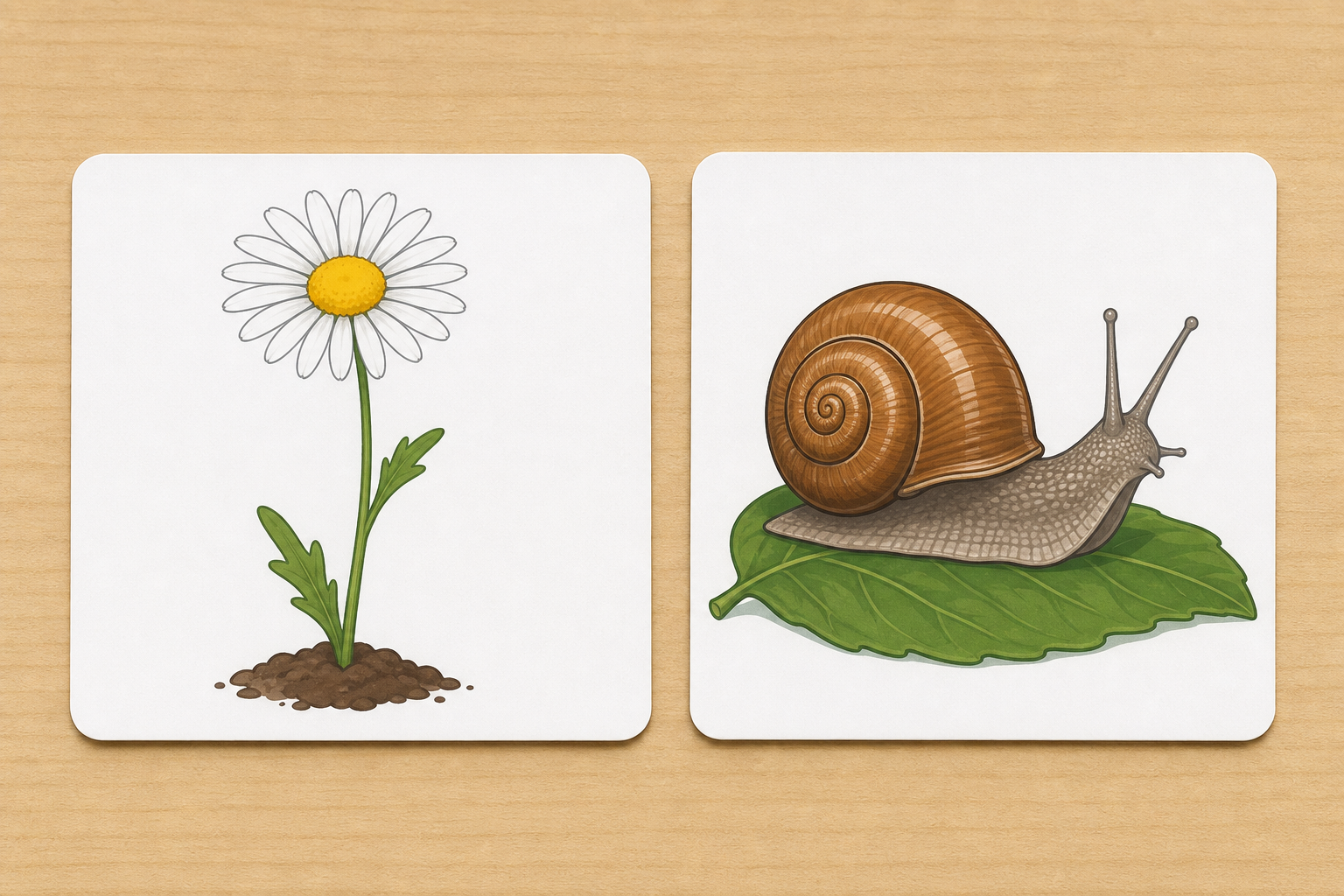
Hold up one clear plant picture (a daisy) and one clear animal picture (a snail). Keep the hook light: one contrast, one question, no sorting yet.
Key question: Which one grows in the ground? Which one can move away?
Accept every idea warmly. Guesses are the start of the fun, never wrong.
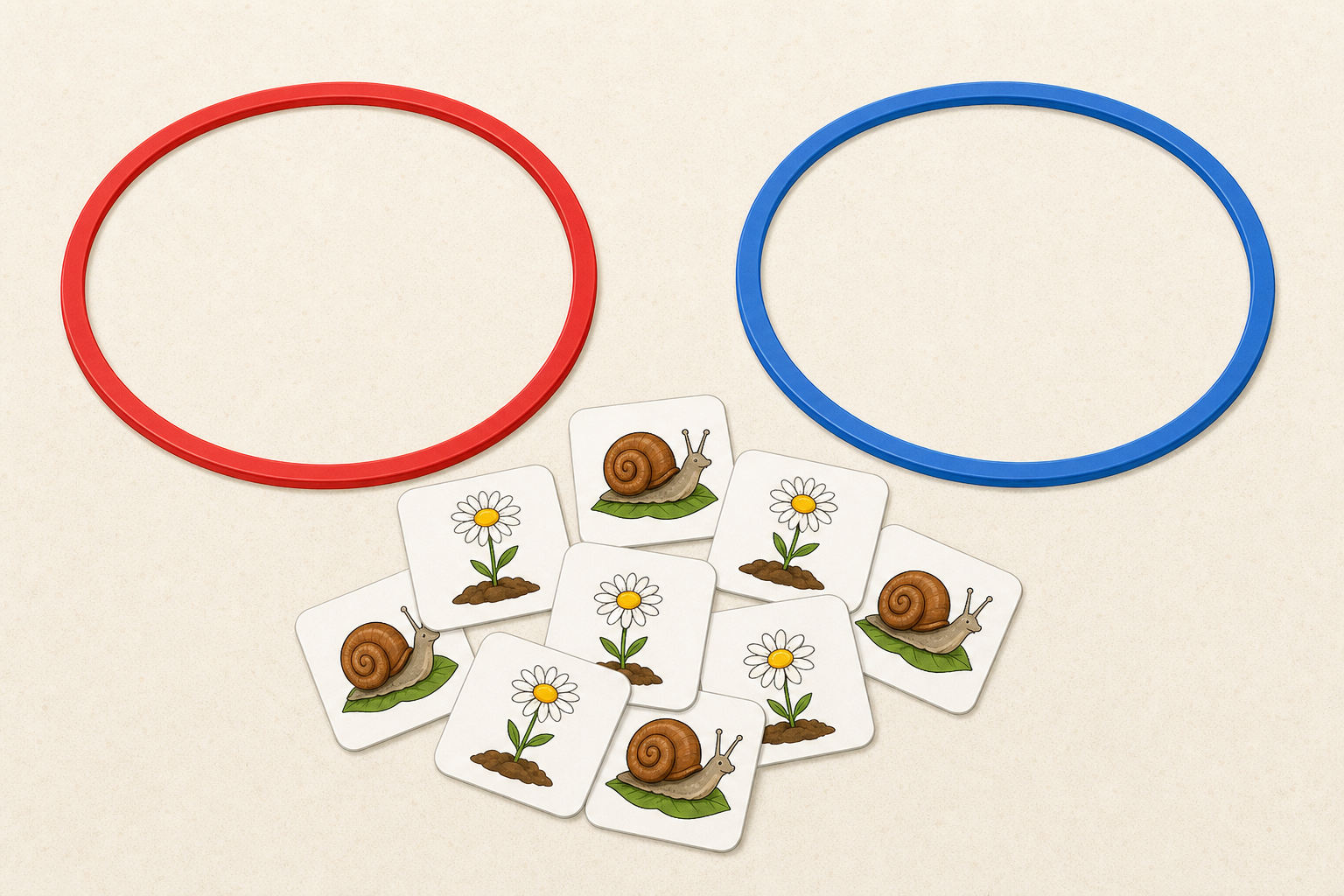
Have the two sorting hoops ready on the floor but do not set out the full card packs until the next step.
Plant or animal?
We look for clues. Does it grow in the ground and stay put, or can it move by itself?
| Concept | Why it matters | Example |
|---|---|---|
| Plant — a living thing that grows in the ground and stays put | When we sort pictures, plants go in one group because they grow from the ground | A daisy, grass or an apple tree in the school garden |
| Animal — a living thing that can move about on its own | Animals can crawl, hop, fly or wriggle, so we put them in a different group | A snail, a robin or a worm in the yard is an animal |
| Sort — put things that belong together into the same group | Sorting helps us notice how living things are the same and different | All plant pictures in one hoop, all animal pictures in the other |
Model one plant (worked example), holding the daisy card:
Model one animal (snail, then quick worm check): the snail can slide, so it is an animal. Hold the worm card and say: A worm lives in the soil, but it can wriggle away on its own, so it is an animal, not a plant.
Clues to keep saying: Does it move by itself? Does it grow in the ground and stay put?
Misconception to head off: some children put the worm with plants because it lives in the ground. Stress movement as the deciding animal clue. Keep this beat to the two oral clues and the two quick models only; do not dump glossary text on the board.
Ask: What is one way we can tell a plant from an animal?
We have two hoops: one for plants and one for animals.
Look at each picture. Does it grow in the ground and stay put, or can it move by itself? Put it in the hoop you choose, then tell a friend why.
Each card is a clear picture of a whole living thing with a short name. Plant cards: daisy, dandelion, grass, apple tree. Animal cards: snail, robin, worm, woodlouse, ladybird. Use whole plants and whole animals only so the grow-or-move clues work for every card.
Burst 1: groups sort five cards into the hoops while you circulate. Burst 2: add any leftover cards; regroup once to share one placement.
Key questions: Why did you put it there? Does it grow in the ground and stay put? Can it move by itself?
What good looks like: a child places a card and says one clue ("it crawls" / "it grows in the ground").
Differentiation: offer only four clear cards (daisy, grass, snail, robin) for children who need a smaller set; confident pairs can sort the full set and help a friend name a clue.
If a worm or woodlouse goes in the plant hoop: gently ask, Can it wriggle or crawl away on its own? and revoice the movement clue.
Now we will sort pictures on the board together.
Listen to the question: Is it a plant or an animal? Call out which hoop each picture should go in.
Open the picture-sort interactive on the IWB in explore mode after the hoop sort. This board sort consolidates the group work; it does not replace it and is not the first model (that was physical cards in Look for clues).
Read the one question aloud every time: Is it a plant or an animal?
Cards on screen: daisy, dandelion, grass, apple tree, snail, robin, worm, ladybird. Two hoops: a plant and an animal.
Invite different children to say where a card goes; the rest of the class show thumbs up if they agree. Wrong placements stay friendly: ask what clue are you using? and try again together.
After a few cards, ask: What are the plant ones doing that the animal ones are not?
Draw one plant you put in the hoops and one animal you put in the hoops.
Point to each drawing and tell your partner which is which.
Hand out the Investigation Journal page (plant and animal groups). Do not name internal sheet ids on the board. Children mostly draw; labels can be adult-scribed if needed.
Prompt: Draw one plant and one animal you sorted into the hoops. Walk the room and ask each child to point and say one clue: Why is that one a plant?
What good looks like: at least one clear plant drawing and one clear animal drawing, with the child able to say a simple reason (grows in the ground / can move).
If a child draws only animals, gently offer a plant card to copy from the hoop.
Keep this calm and short; tidy follows soon.
You're previewing this lesson. Get full access to this lesson and hundreds more — each one ready to teach, with interactive activities, printable resources and pupil progress tracking built in.