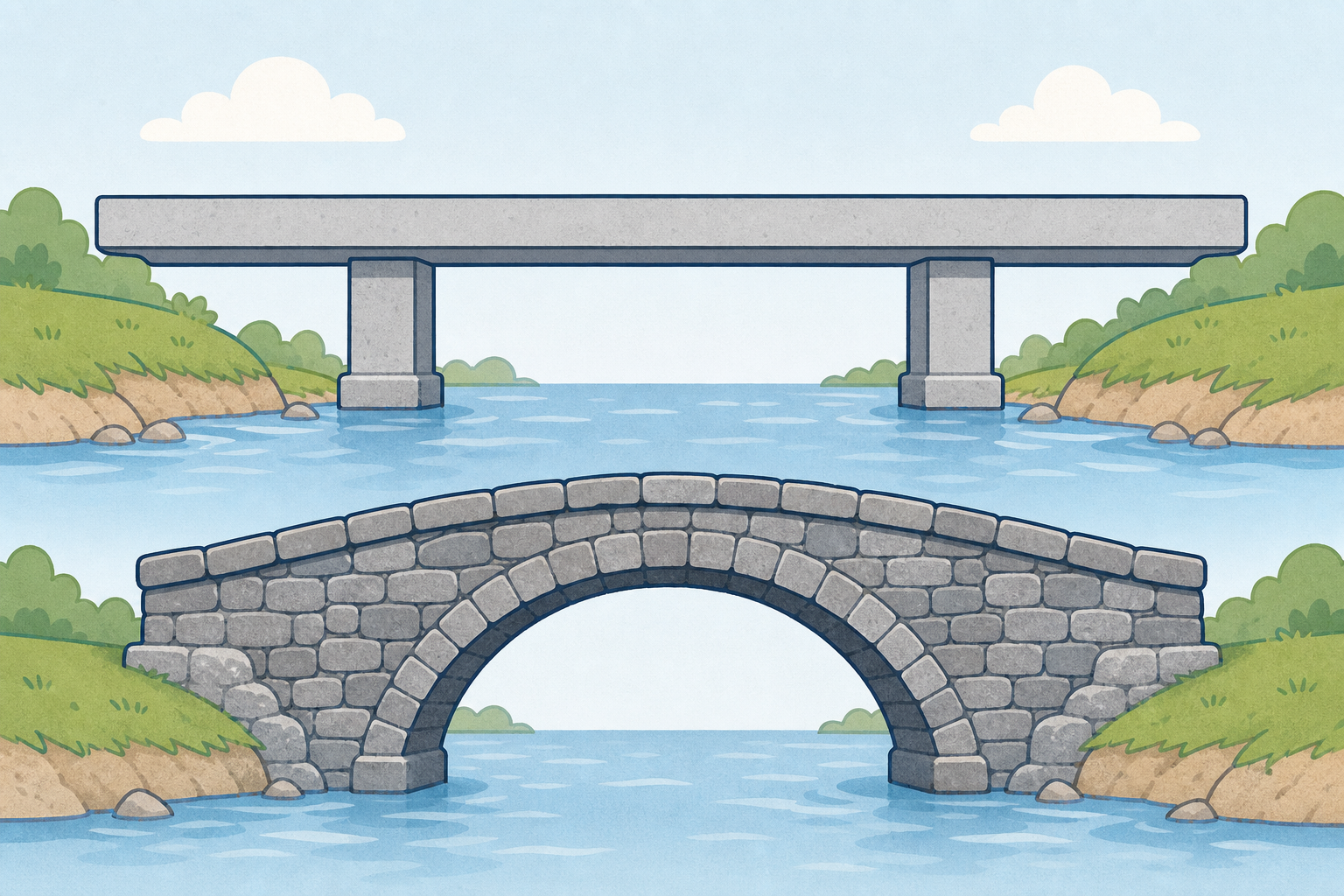
Look at these two bridges. One is a straight flat deck. The other is a stone arch. Which do you think would hold more weight across the same gap, and why?
Today we will bridge the same gap three ways, load each with 1c coins until it fails, and see what the evidence says.
Show two clear photos or simple sketches on the IWB: a flat beam footbridge and an arched stone bridge (Irish stone bridges work well). Do not hand out card yet. Take three or four quick predictions with reasons. Do not confirm which is stronger.
Key question: If the gap and the material stayed the same, would the shape still matter?
Misconception to head off later: children often think thicker material is the only answer. Today the card is equal; only the shape changes.
Three shapes can span a gap:
We keep the test fair: same gap, same card, both ends secured the same way. What is the one thing we are changing?
Board stays short: name each shape plus one image cue only. Full table is for you.
| Concept | Why it matters | Example |
|---|---|---|
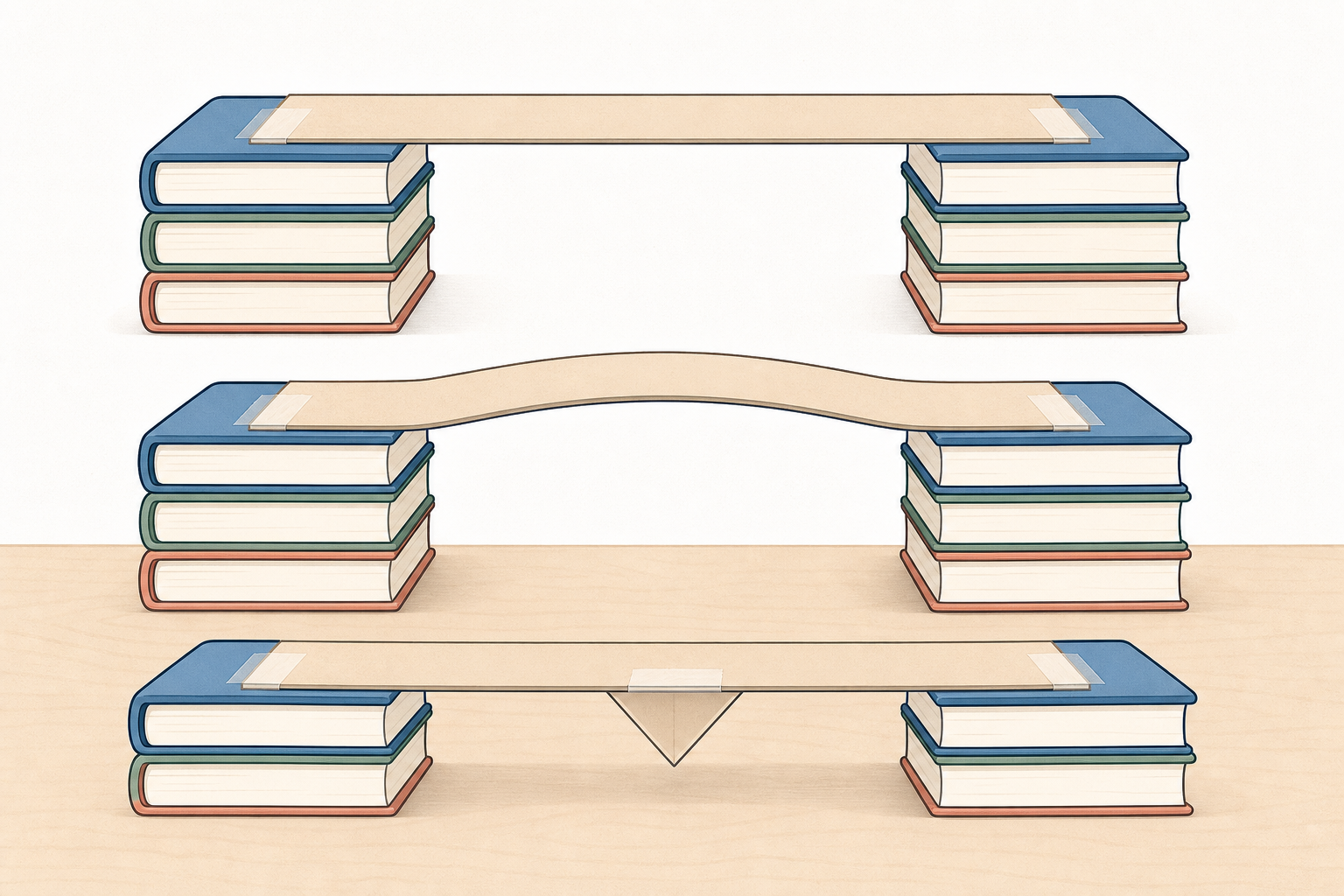
| Beam — a straight, flat strip laid across a gap | Beams are simple, but the middle has nothing underneath to help, so they often sag first | A flat card strip between two books dips in the middle as 1c coins stack on it |
| Arch — a curved span that pushes outward at its feet when loaded | The curve sends some of the load sideways into the supports, which is why many Irish stone bridges are arched. If the feet are free to slide, the arch never gets to push into the supports — that is why equal fixing with sticky tape matters most for the arch | A curved card strip spreads at the ends as coins pile on the crown |
| Braced beam — a beam strengthened underneath with triangles | Triangles hold their shape, so bracing stops the middle from sagging for longer | Folded card triangles under a beam help it carry more coins before a joint gives |
| Fair span test — same gap, same materials, both ends fixed the same way | If ends can slide, you measure slipping instead of strength | Securing both ends of every span to the books with sticky tape keeps the comparison fair |
Short live model only (do not run a full failure test here): show one flat strip across a 15 cm gap, secure both ends with sticky tape the same way, and add one or two 1c coins in the middle so the class sees the middle sag. Point out: same gap, same card, ends fixed the same way — only shape will change later. Save full coin-loading until groups test in the next steps.
Quick spoken stems while you model:
What to expect later: flat beam fails first (middle sag); arch often fails by spreading at the feet; braced beam usually holds longest until a joint peels or a brace folds. Exact coin counts vary with card thickness — compare ranks, not a magic number.
Ask: What must stay the same so we are testing shape, not slipping?
In your group, bridge the same 15 cm gap three ways with equal card strips.
Fair-test rule: fix both ends of every span to the books with sticky tape so nothing can slide. Use the same card for all three.

Circulate and check: gap still about 15 cm; both ends fixed with tape on every span; triangles really triangles, not loose flaps. If an arch flattens before loading, the curve is too shallow — re-form it and fix the feet firmly again.
Differentiation: less confident groups build beam and arch first, then add bracing with a pre-folded triangle. Confident groups may try two triangle braces under the beam.
Test one span at a time. Stack 1c coins in the middle, one coin at a time, until the span gives way. Count the coins it held. Watch where it fails.
As soon as each span fails, write on your Investigation Journal page: the span type, how many coins it held, and where it failed. Then move on to the next shape.
Do the beam, then the arch, then the braced beam. Keep the gap and the end-fixing the same each time.
One counter, one stacker, one watcher per group works well. Coins only — no heavier weights. Load slowly in the middle, not at the ends.
Record at once: after each failure, stop the group and have them write span type, coins held, and where it failed on the Investigation Journal page before starting the next span. Do not leave all three results until the end.
Look-fors when it fails:
If a span slips off because the tape was weak, that trial is unfair — re-fix the ends and repeat that span only. Remind groups: the number is useful only if the ends were fixed the same way.
If a braced beam is still holding near the end of the tub, send a runner for the shared coin (or washer) reserve so the maximum load is not capped by the tub size.
Safety: load low and slowly; hands clear as a span collapses; coins stay on the desk.
Check your Investigation Journal page has each span type, how many coins it held, and where it failed. That page is your only written record.
Your teacher will type one clear set of coin counts into the interactive activity on the board: one row for beam, one for arch, one for braced beam. Watch the bar chart together. Which bar is tallest?
Pupils keep the Investigation Journal page journal page as their only written record. Drive the data-recorder yourself on the IWB in explore mode — pupils do not type. Columns on screen are exactly Span type and Coins held. Enter three rows: Beam, Arch, Braced beam. Use one clear group's numbers first, or a class middle value if several groups share. Then show the bar chart.
Ask: Which shape held most? Did every group get the same rank order? If an arch beat a braced beam, check whether the brace was really triangular and fixed under the middle.
Nature of STEM: Irish stone bridges are often arched; many modern footbridges use triangles. Engineers choose shape on purpose, not by chance.
You're previewing this lesson. Get full access to this lesson and hundreds more — each one ready to teach, with interactive activities, printable resources and pupil progress tracking built in.