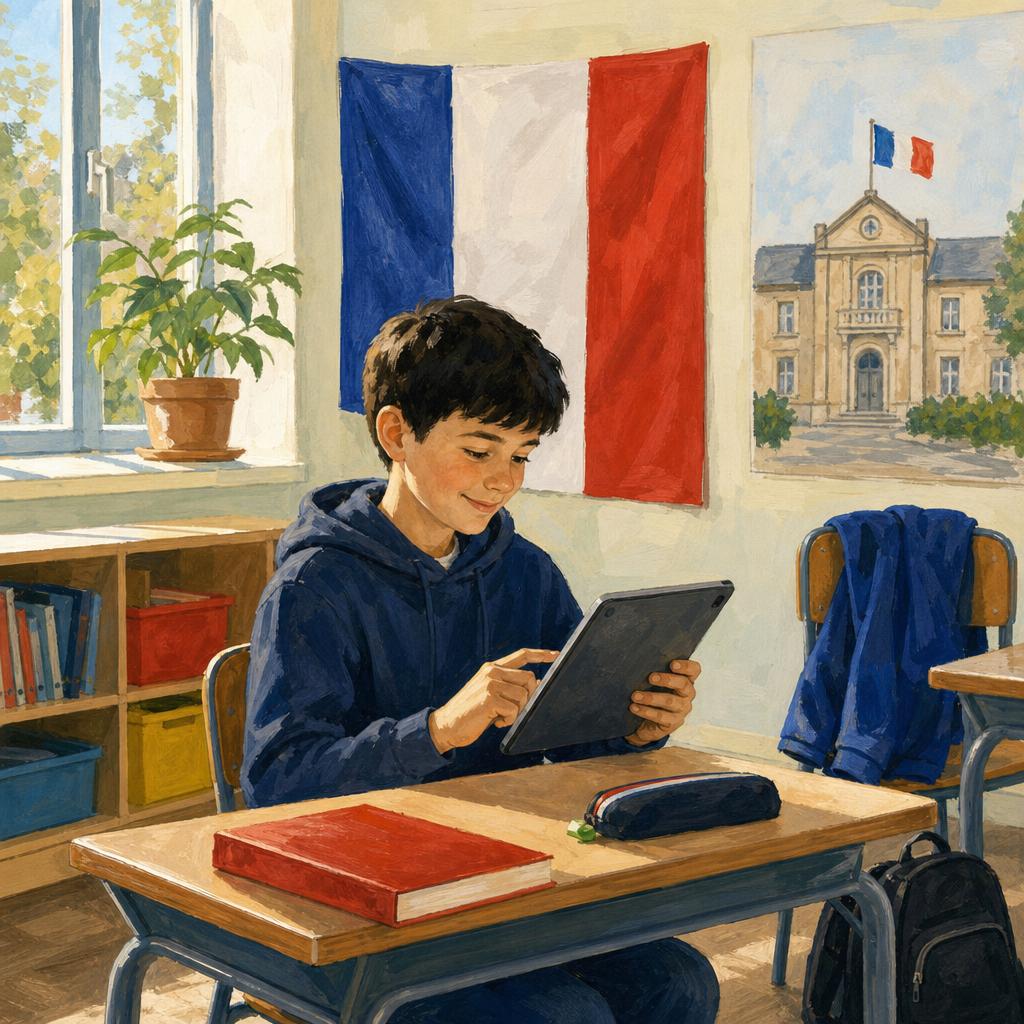
Look around the room. Your teacher will point at four things. Name each colour in English first.
Then listen: you will hear those same colours in French. Which ones already sound a bit familiar?
Watch for the French flag on the board too: bleu, blanc and rouge side by side. That is the tricolore.
Point at four clear classroom colours (for example a blue jumper, a green plant, a red book, a black bag). Take the English names first so every pupil is in, then say the French once only and leave the rest for the word-table. Do not confirm which words are cognates yet.
Gesture toward the tricolore in the opening image: "Those three stripes are bleu, blanc, rouge. You will meet them again when we label." Keep it to one sentence so curiosity leads, not a lecture.
Smile and build curiosity: "Some of these will feel like old friends; others are brand new. Your ears will tell you which."
Pronunciation quick-guide if you want to name any early: rouge (roozh), bleu (bluh), vert (vair), noir (nwahr).
Here are today's eight colours, in two groups of four.
Your teacher will tap each one. Listen, then say it back together. Listen for the soft zh sound in rouge and orange, like the s in treasure.
After the first four, freeze and point at something that colour in the room. You will also learn a tiny French phrase: C'est rouge! (It's red!).
Chunk 1 (about 4 minutes): Tap rouge, bleu, vert, jaune on the word-table. Class repeats twice each: once all together, once by table. Keep the audio model first so every pupil hears before they speak.
Freeze-frame (30 seconds): Call rouge / bleu / vert / jaune one at a time. Everyone points at something that colour. Cheer good spots: "Oui! Magnifique!"
Chunk 2 (about 4 minutes): Tap noir, blanc, orange, rose. Same repeat pattern.
Sticky frame: Model C'est + colour. Point at a red object: "C'est rouge!" Class echoes. Try two more colours so the chunk sticks.
Warmth: If rouge comes out like "roog", laugh and fix it together: "zh like treasure, try again!" Optional 20-second clap-chant before you start: rouge, jaune, rose, bleu (clap on each).
Pronunciation guide (say these beside the board if audio is slow): rouge (roozh), bleu (bluh), vert (vair), jaune (zhohn), noir (nwahr), blanc (blahn), orange (o-RAHNZH), rose (roz). Point out that orange looks almost like English, rose is a sneaky cousin (we say pink), and the others need a careful listen.
Watch the board. When a classmate flips a French card, whisper the word. When its English match is found, say the French aloud together.
Whole-class IWB only (no table devices). Volunteers take turns flipping. Model the first two flips yourself so the class knows the goal is French-to-English pairs, not two French cards.
On every French flip, the whole class whispers the word once. On every clean match, the whole class says the French colour aloud together, then cheer: "Magnifique!" If a pair is missed twice, pause and say the French word together before moving on.
Hearing and saying on every turn is half the practice: the volunteer flips; everyone produces.
Keep the colour words on the board. Copy all eight French colours carefully from the screen.
Beside four of them, write something in this room that is that colour. Your teacher will suggest easy anchors first (for example white paper, an orange folder, a pink rubber).
Pause other board work but keep the word-table visible the whole time so spellings stay accurate. This is the only stretch where every pupil's pen is moving.
Before pens move (30 seconds): point out easy classroom anchors for trickier colours: white board or paper for blanc, pink rubber or highlighter for rose, orange folder or book cover for orange, green plant for vert. English object words are fine.
Written load: all eight French colours look-and-copy from the board; a classroom object beside only four (steer less confident writers toward the four harder non-cognates: rouge, jaune, vert, blanc). Cognates orange, rose, bleu can be look-and-copy only if time is tight.
Walk the room and praise careful copying. Do not collect these.
Look at the picture on the board. Imagine the colours you would spot on a French street: a tricolore above a mairie (town hall), a blue café awning, a yellow Tour de France jersey.
A classmate chooses a French colour label for each part. Give a thumbs-up if you agree, or whisper the colour you think is right. When the label is correct, say together: C'est + the colour (for example C'est bleu!).
When bleu, blanc or rouge appear, those three together are the French flag, the tricolore.
Whole-class on the IWB: one volunteer at a time chooses a label while everyone else gives thumbs-up or whispers a challenge. If a wrong label is chosen, ask the class to say the correct French word, then the full frame C'est …!, before the next turn.
Culture hook (carry the vocabulary, not just a chat): Before the first label, spend 20 seconds framing the board image as colours you would meet in France. Point out: "The French flag is bleu, blanc, rouge, you see it on mairies (town halls) across France. Café awnings are often deep bleu or rouge; the Tour de France leader wears jaune." When a volunteer places bleu, blanc or rouge, pause for two seconds and link it back to the flag. That plants the tricolore inside the vocabulary game.
Production beat (2–3 minutes if labels finish early): quick Jacques a dit (Simon says). Pronunciation for you: Jacques a dit = zhahk ah dee. Call only that phrase plus a colour the class already knows, for example "Jacques a dit: vert!" (zhahk ah dee: vair). Class points at something green. Wrong colour, or moving without hearing Jacques a dit first, sits out one round with a smile. Do not attempt longer French commands; the colour word alone is the target. Keep it playful.
Celebrate clean labels: "Bravo! C'est exact."
You're previewing this lesson. Get full access to this lesson and hundreds more — each one ready to teach, with interactive activities, printable resources and pupil progress tracking built in.