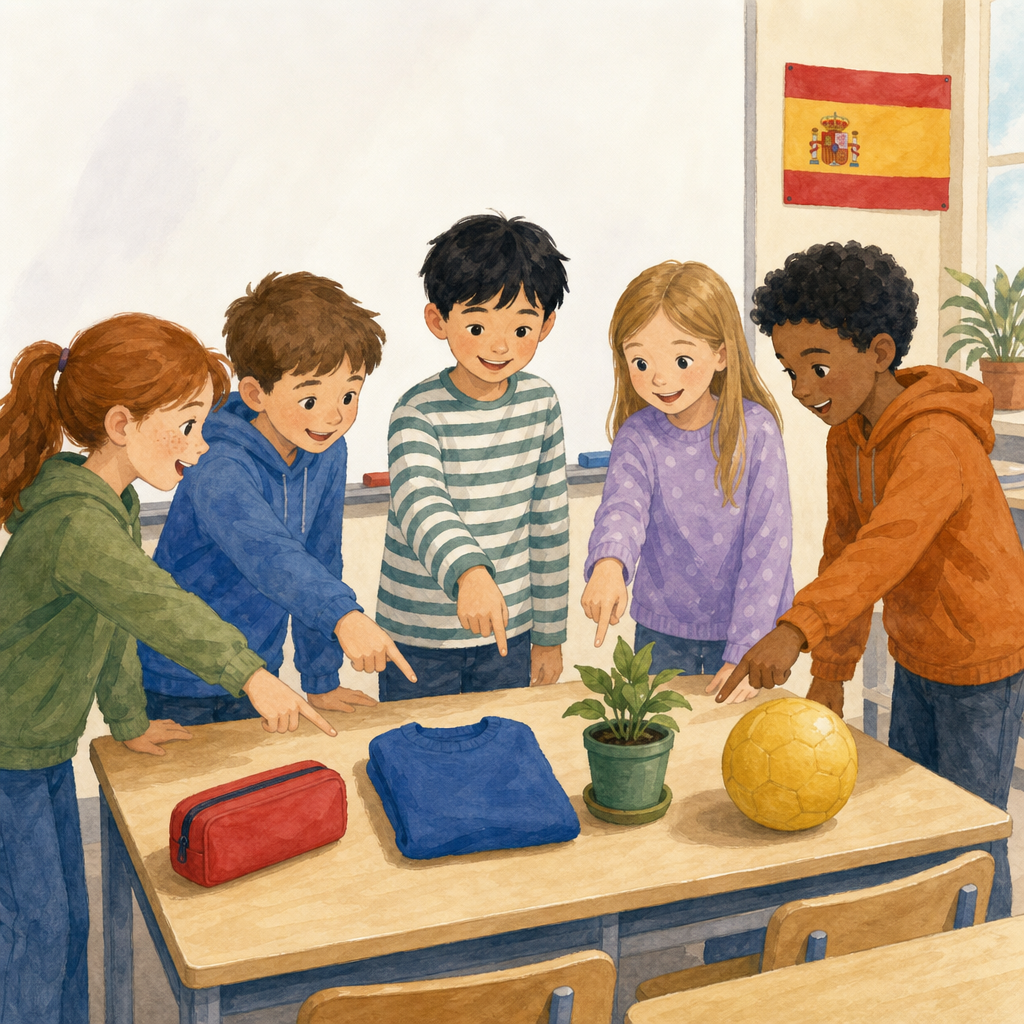
Look around the room. Your jumper, the board, the door, a pencil case. Spain's flag is full of colour too. Point at four things and name each colour in English first. How many colours can you spot before we start?
If you have a small Spanish flag, a photo of La Boqueria market, or Spain's flag on screen, hold it up for ten seconds and ask which colours pupils can already name in English. Then point at four things in the room (for example a blue jumper, a green plant, a black board, a red pencil case). Ask the class to name each colour in English first, then tell them they will hear the Spanish in a moment. Keep it brisk: three or four guesses is enough. Do not teach the Spanish words yet; the word-table in the next step does that job.
Here are today's eight colours, in two sets of four.
First set: tap each one, listen, then say it back together. Then we point at real things in the room and say those four Spanish colours out loud.
Second set: same again with the next four. Listen for the ones that sound almost like English, and the ones that give you no help at all.
Split the word-table into two mini-rounds so eight new forms do not land in one block.
Round 1 (about 4 minutes): tap rojo, azul, verde, amarillo. Class repeats twice: once all together, once by table. Pronunciation guides if audio is unclear: rojo (ROH-hoh), azul (ah-SOOL), verde (BEHR-deh), amarillo (ah-mah-REE-yoh). Point out that the soft Spanish j in rojo sounds a little like the ch in Scottish loch. Celebrate the first clean rojo: make a fuss of the soft j ("Yes — like Scottish loch!"). Then do a quick point-and-say: you point at three or four real classroom objects in those colours; the whole class chorally says the Spanish colour each time.
Round 2 (about 4 minutes): tap blanco, negro, naranja, rosa. Same choral pattern. Guides: blanco (BLAHN-koh), negro (NEH-groh), naranja (nah-RAHN-hah), rosa (ROH-sah). Soft j again in naranja. Another short point-and-say around the room for this set.
Cognates and brain-hooks (as you tap, not from the hook): pause on rosa (rose), azul (azure) and verde (verdant) and ask which ones give free clues from English. Bonus meaning hooks that stick for this age: naranja is also the fruit orange, and rosa is also a rose (same word, two jobs); blanco is cousin to English blank (a blank page is white). Contrast with rojo, amarillo and negro, which almost never help from everyday English. Name and praise any cognate detectives who spot links without being told.
Watch the board. When it is your turn, flip two cards and say the Spanish colour out loud before you claim a match. Everyone else: whisper the Spanish word from your seat as each card turns. After every match, the whole class whispers the Spanish word together once more like a secret code.
Run this as whole-class IWB only, with rotating volunteers. No pupil devices.
Pace script (fits 8 minutes): model the first pair yourself so the class sees how the game works. Invite about four volunteer pairs to take turns flipping. Before anyone claims a match, the volunteer says the Spanish aloud and the rest of the class whispers it from their seats. After every successful match, lead a quick choral whisper of the Spanish word three times like a secret code so every row speaks, not only the volunteer. Then chorus-reveal any remaining cards yourself: flip each leftover pair, class says the Spanish together, so every word is still heard aloud even if you do not play all eight as live volunteer turns.
If a pair is missed twice, stop and say it together before moving on. When someone finds amarillo, get the class to cheer the double-ll y-sound. Keep the pace lively. Optional no-device pair stretch only if you finish early: one pupil whispers a Spanish colour, partner points at something that colour in the room, then swap.
The word list stays on the board: copy the spellings from it. Open your copy and write all eight Spanish colours. Beside four of them, write the English name of something in this room that is that colour.
Pause the board but keep the word-table visible so spellings stay on screen. Before pens move, build a quick whole-class oral bank: point at four easy classroom objects and let the class call the English name (for example red pencil case, blue jumper, green plant, black board). Accept one shared object on the board for any harder colour that has no obvious match in the room (pink, orange, white). Then everyone writes: all eight Spanish colour words, plus an English classroom-object name beside four of them. Neat beats fast; use the word-table on screen; you will come round and tick as you go. Walk the room and check accents and spellings, especially the double l in amarillo and the j in rojo and naranja. Do not collect these. If anyone is still finishing, the home challenge at the end can cover unfinished rows.
These pictures are from a mercado in Valencia: fruit stalls with naranjas and tomates, bright awnings, football scarves. Volunteers click the labels on the board. Everyone else: when you know the colour, point at something that colour in the room (or hold up a matching colouring pencil) and say the Spanish word quietly. On three, we all say it together, then the volunteer clicks that label.
Run this on the IWB with rotating volunteers only. No pupil devices on desks.
Before anyone clicks, model one label yourself and say the Spanish aloud. Each round: count "uno, dos, tres" so the whole class says the Spanish colour together (while pointing at a room object or holding up a pencil), then a volunteer clicks the matching label. If a wrong label is chosen, pause and repeat the correct word with the class before continuing. Pronunciation guides if audio is unclear or you need them from notes alone: rojo (ROH-hoh), azul (ah-SOOL), verde (BEHR-deh), amarillo (ah-mah-REE-yoh), blanco (BLAHN-koh), negro (NEH-groh), naranja (nah-RAHN-hah), rosa (ROH-sah). Prefer images of tiles, market fruit, or club shirts over plain colour blobs where there is a choice. Celebrate clean choral answers with a quick "¡Muy bien!" to keep the win streak going.
Support: leave the word bank visible on screen. Extension: after a correct label, ask the volunteer to name a second object in the room that is the same colour (English object name is fine; the Spanish colour is the target). This is recognition practice, so keep the focus on hearing and choosing rather than spelling from memory.
You're previewing this lesson. Get full access to this lesson and hundreds more — each one ready to teach, with interactive activities, printable resources and pupil progress tracking built in.