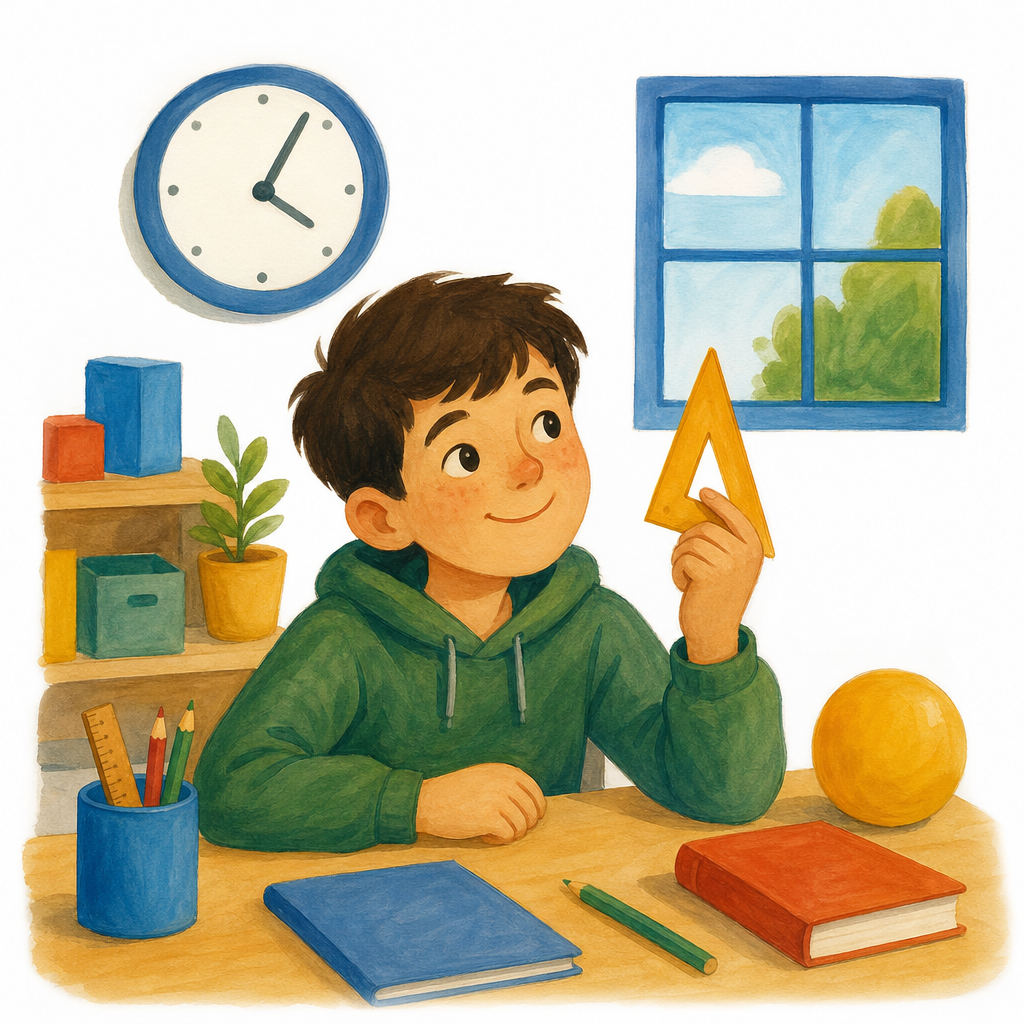
Look around the room and find a circle, a square and a triangle in ten seconds. When you spot one, be ready to share it with the class.
Give the class a genuine ten-second hunt around the room. Take three or four answers (clock face, window, book cover) and keep it light. Do not teach any Spanish yet; the flashcards in the next step carry the new words. A quick nod to how far they have come (greetings, goodbyes, colours, numbers, classroom) lands well here: "You already greet people, count and name colours in Spanish — today we add the shapes you see everywhere."
These eight shapes turn up all over Spain — on blue-and-white Spanish tiles called azulejos, on football crests and on street signs.
For each card: look at the picture and the English, listen to the Spanish, then say it with the class. Watch which ones take el and which take la.
One surprise: the diamond shape is el rombo, not diamante.
Run this whole-class on the IWB. Hear first, then say — never ask pupils to produce the Spanish before they have heard it. For each card: show the image and English → play the audio (or model yourself) → class repeats twice (once all together, once by table) → then flip to confirm the written form. Point at the article every time so the pair sticks.
Two mini-sets (keeps eight words manageable): Set 1 core maths shapes — el círculo, el cuadrado, el triángulo, el rectángulo. Quick choral pass back through set 1 before Set 2: el óvalo, la estrella, el corazón, el rombo.
Pronunciation crib: el círculo (el SEER-koo-loh), el cuadrado (el kwah-DRAH-doh), el triángulo (el tree-AHN-goo-loh), el rectángulo (el rek-TAHN-goo-loh), el óvalo (el OH-vah-loh), la estrella (lah es-TREH-yah), el corazón (el koh-rah-SOHN), el rombo (el ROHM-boh).
Big cheer when someone nails the stress on tri-ÁN-gu-lo or rec-TÁN-gu-lo — that accent mark is doing real work. On corazón, coach the final stressed syllable (koh-rah-SOHN). Pause on triángulo and círculo: pupils often spot the English cousins here. On the rombo card, name the mismatch out loud so nobody thinks they misheard: "This one is a surprise — the shape word is el rombo, not diamante."
Receptive beat before you leave this step (about 2 minutes): keep all eight images visible. You say a Spanish shape; the class points to the matching image on the board (or holds up fingers 1–8 if you number them). Run through all eight once. No one speaks alone yet — this is one more hear-and-match pass before the wheel.
Spin the wheel. When it stops, everyone whispers the Spanish shape (article and all). Then your teacher picks a table or a volunteer to say it aloud.
Challenge round: we hide the word list. The spin shows only the picture — whisper the full Spanish phrase (el/la + word). If you need a hand, we can play the audio once, then you try.
Run whole-class on the IWB. Do not cold-call a lone pupil on the first spin.
Round 1 (word bank up): leave a small on-screen list of the eight phrases visible. Spin → whole class whispers the answer → one table says it aloud. Repeat for several spins. If they get the article and the word, class gives a quick ¡bien!
Round 2 (shorter, bank hidden): hide the word bank. Same pattern: everyone whispers first, then you invite a volunteer or a confident table. Default recovery, said out loud so the class knows help is coming: "Play audio once, then you try."
Full phrase crib while the wheel runs: el círculo (el SEER-koo-loh), el cuadrado (el kwah-DRAH-doh), el triángulo (el tree-AHN-goo-loh), el rectángulo (el rek-TAHN-goo-loh), el óvalo (el OH-vah-loh), la estrella (lah es-TREH-yah), el corazón (el koh-rah-SOHN), el rombo (el ROHM-boh).
Keep praise light and frequent — this is still early production after one intro pass.
Open your copy. Pick any two shapes from the list on the board. Draw each one and write the full Spanish phrase underneath (article + word). Take care with the accents. If you finish early, add a third or fourth as a stretch.
Worked example on the board: a triangle sketch with el triángulo written under it.
Word bank (leave this up):
Pause the board interactives. Pin or display the full word bank above for the whole beat — do not rub it off or rely on memory. Sketch one worked example first (picture of a triangle + el triángulo) so every pupil sees article, spelling and accent before pens move.
Everyone writes at least two shapes; a third or fourth is optional stretch only. This is the only stretch where every pupil's pen is moving. Walk the room and check the article is going in with every word, and that accents are present on círculo, triángulo, rectángulo, óvalo and corazón. Quiet thumbs-up when you spot a clean accent. Do not collect these.
You each have a paper bingo card. Listen for the Spanish shape words and cross off each one you hear. First to a full line calls ¡bingo!
How to Play Bingo:
Option 1: Students on Devices (Digital Version)
Option 2: Print Out the Bingo Cards
You're previewing this lesson. Get full access to this lesson and hundreds more — each one ready to teach, with interactive activities, printable resources and pupil progress tracking built in.