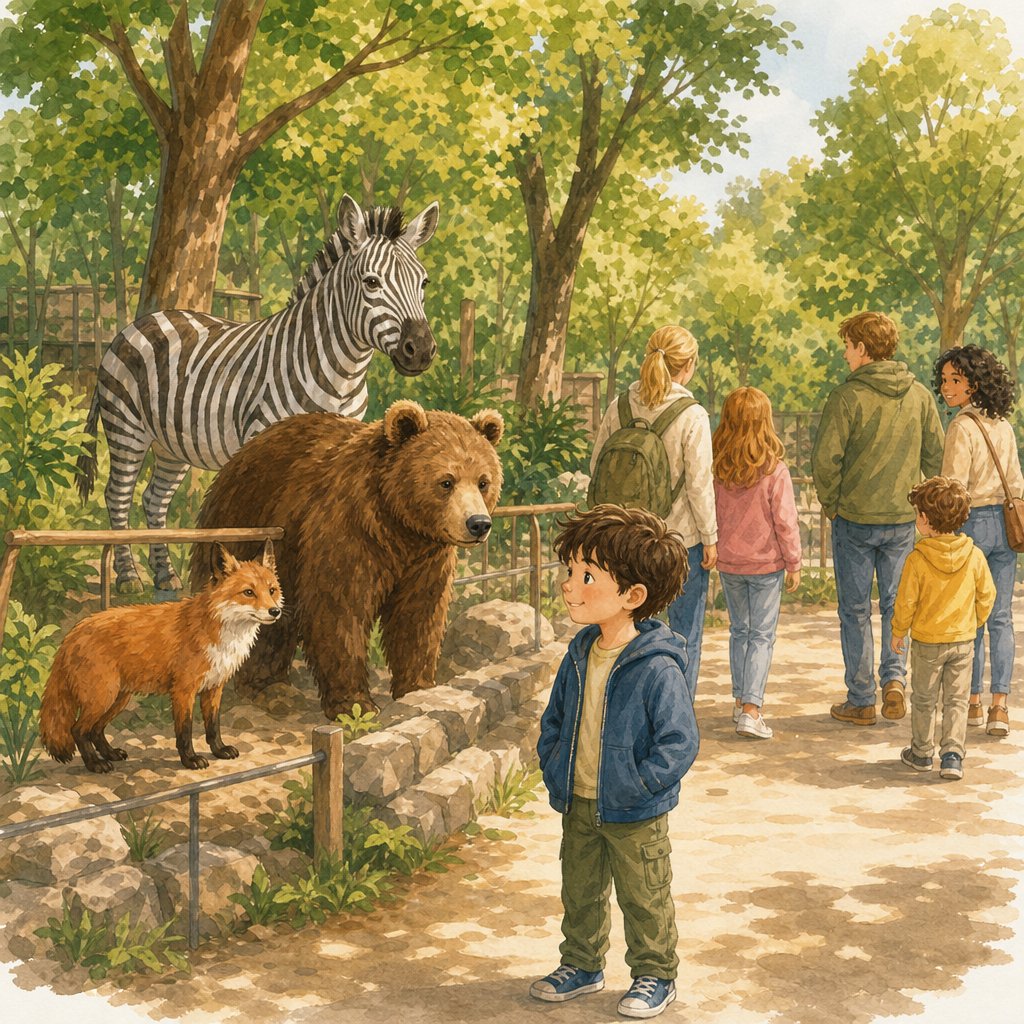
 Which wild animal would you least like to meet, and why? Tell a partner in English first.
Today we name eight wild animals in German. We lock in colour and size words, then join each animal to a colour and a size in one short sentence.
By the end of this lesson, you will be able to:
- Name eight wild animals in German
- Describe one with a colour and a size in a full sentence
- Talk about how a wild species can return to a country
We are walking a path through a German Tierpark, which is a wildlife park where you can see wild animals up close. For each animal you will see the picture, hear the German name with its article, and say it back twice with the class before the card flips over.
Next we learn size words and colour words, and build this pattern together: Der Bär ist groß und braun (The bear is big and brown). Size and colour come after ist.
groß (big), klein (small) · braun (brown), rot (red), grau (grey), schwarz (black), weiß (white), gelb (yellow), grün (green)
Everyone gets a bingo card with animal pictures or words. Listen for the German name with its article and mark it if it is on your card. When every animal on your card is marked, call Bingo!
We say a few full sentences together from the board first. Then open your copy and write two sentences describing wild animals, each with a size and a colour.
Use the pattern: Der / Die / Das … ist … und … A word bank stays visible. Check every noun has a capital letter and the right article. You may copy the frame and change only the animal.
- der Fuchs — the fox
- der Bär — the bear
- der Löwe — the lion
- der Tiger — the tiger
- der Elefant — the elephant
- die Giraffe — the giraffe
- das Zebra — the zebra
- das Krokodil — the crocodile
We will hear two children counting animals on a farm, twice. They are not today's wild animals: listen for the numbers and the animals they count. After the second play, we answer the questions together on the board.
Unlock the full learning experience
You're previewing this lesson. Get full access to this lesson and hundreds more — each one ready to teach, with interactive activities, printable resources and pupil progress tracking built in.
This lesson is copyright of Coding Ireland 2017 - 2026. Unauthorised use, copying or distribution is not allowed.