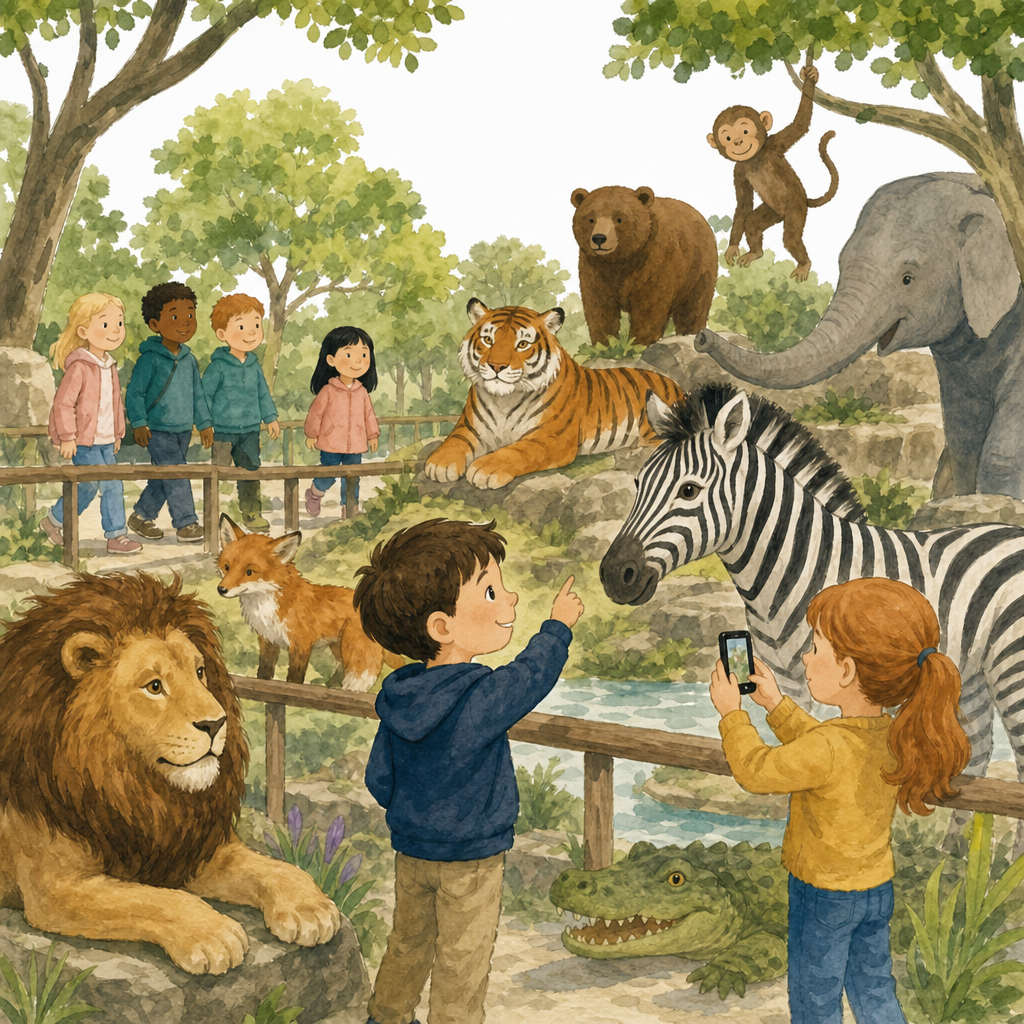
Which wild animal would you least like to meet on a trip to a French zoo or wildlife reserve, and why? Tell a neighbour in English in one short sentence.
Today you will name eight wild animals in French and say what you can see, with a size and a colour.
Quick recycle before we start: size words grand (big, grahn) and petit (small, puh-TEE); colour bank gris (grey, gree), roux (russet/red, roo), brun (brown, bruhn), noir (black, nwar), blanc (white, blahn). Say each one with the class.
Take three or four quick answers about the zoo or reserve hook, then move straight into the recycle strip on the board. Choral-repeat grand / petit and the five colour words with the pronunciations shown. Keep that strip visible for the whole lesson; pupils will reuse it in every description.
This recycle matters: colour and size adjectives are not taught as a full lesson earlier in the course, so treat these two minutes as essential input, not optional warm-up. If someone names an animal that is not on today's list, smile and say you will stick to the eight on the board for now.
Listen first. Your teacher (or the audio) says the French with le or l'. Repeat it together as a class, then flip the card to check. Listen for the soft zh in le singe, like the s in treasure.
After all eight animals, use the size and colour strip still on the board: grand / petit and gris, roux, brun, noir, blanc.
Model pattern: Le renard est petit et roux (The fox is small and russet). Volunteers build one description by changing the animal, size or colour.
Pass 1 (about 6 minutes): name + article only. Whole class on the board. Model each French form yourself (or play audio) with the article, class choral-repeats, then flip to confirm the English. Insist on the article every time: renard alone is not enough; le renard (luh ruh-NAR) is the answer. Warm tip: roux is the classic fox-red, the same word French uses for red hair; try le renard est petit et roux with a grin when you reach that card later.
Pass 2 (about 4 minutes): one model description, then 3–4 volunteers. Point to the board strip (grand / petit; gris, roux, brun, noir, blanc with pronunciations). Model clearly: Le renard est petit et roux (luh ruh-NAR ay puh-TEE ay roo), then L'éléphant est grand et gris (lay-lay-FAHN ay grahn ay gree). Invite three or four volunteers only; do not force every pupil to invent a full sentence yet. Keep the pattern fixed and masculine: article + animal + est + size + et + colour. Save fuller production for the copy task after bingo has recycled the forms.
Listen carefully from the front. When you hear a wild animal from today's list, mark it on your card. First full line calls out, then the class echoes the winning line in French.
How to Play Bingo:
Option 1: Students on Devices (Digital Version)
Option 2: Print Out the Bingo Cards
Open your copy. Write two French sentences that describe wild animals. Copy the pattern and change the animal, size or colour.
Models (stay on the board):
Word bank:
Pattern: animal (with le / l') + est + size + et + colour.
Pause other board clutter and keep the two models plus the word bank visible for the full three minutes. Everyone writes; this is the only stretch where every pen should move.
Walk the room and check each sentence has article + animal + est + size + et + colour. Do not collect these. If a pupil is stuck, point them back to the model and bank rather than inventing a new pattern. Celebrate a clean article on at least one shared sentence before you move on.
We will hear the short scene twice on the class speakers. Listen for today's animal words. After the second play, we answer the questions together on the board.
Whole-class delivery only. Books closed for the first play. You control the audio on the speakers twice; pupils do not press play on personal devices. After the second play, reveal the interactive questions on the IWB and answer them together (thumbs, mini whiteboards, or volunteered full answers). If a question is missed, replay only that stretch.
Listening targets (today's words with pronunciation): le renard (luh ruh-NAR), l'ours (loors), le lion (luh lee-OHN), le tigre (luh TEE-gruh), l'éléphant (lay-lay-FAHN), le singe (luh SANZH), le zèbre (luh ZEH-bruh), le crocodile (luh kro-ko-DEEL).
How to run feedback: The listen-answer interactive loads the counting-animals scenario and shows its own questions after the audio. Work through each on-screen question as a class. Accept answers that correctly name the animal(s) heard; insist on the article when pupils answer in French. Warm beat: if someone caught l'éléphant or le crocodile on the first play, that is sharp listening; ask them to say it back like a guide at the reserve.
Backup if audio fails: Read this short zoo scene aloud twice, then use the questions below.
Scene: Au zoo, je vois le lion. Le lion est grand et roux. Voilà le singe. Le singe est petit et brun. Et l'éléphant! L'éléphant est grand et gris. Regarde le zèbre: le zèbre est grand et noir.
Q1: Which animal is small and brown? (Expected: le singe / the monkey)
Q2: Which animal is big and grey? (Expected: l'éléphant / the elephant)
Q3: Name two animals you heard. (Any two from the scene, with article if answering in French)
Prefer the interactive audio and its built-in questions whenever they load; use the backup only if needed.
You're previewing this lesson. Get full access to this lesson and hundreds more — each one ready to teach, with interactive activities, printable resources and pupil progress tracking built in.