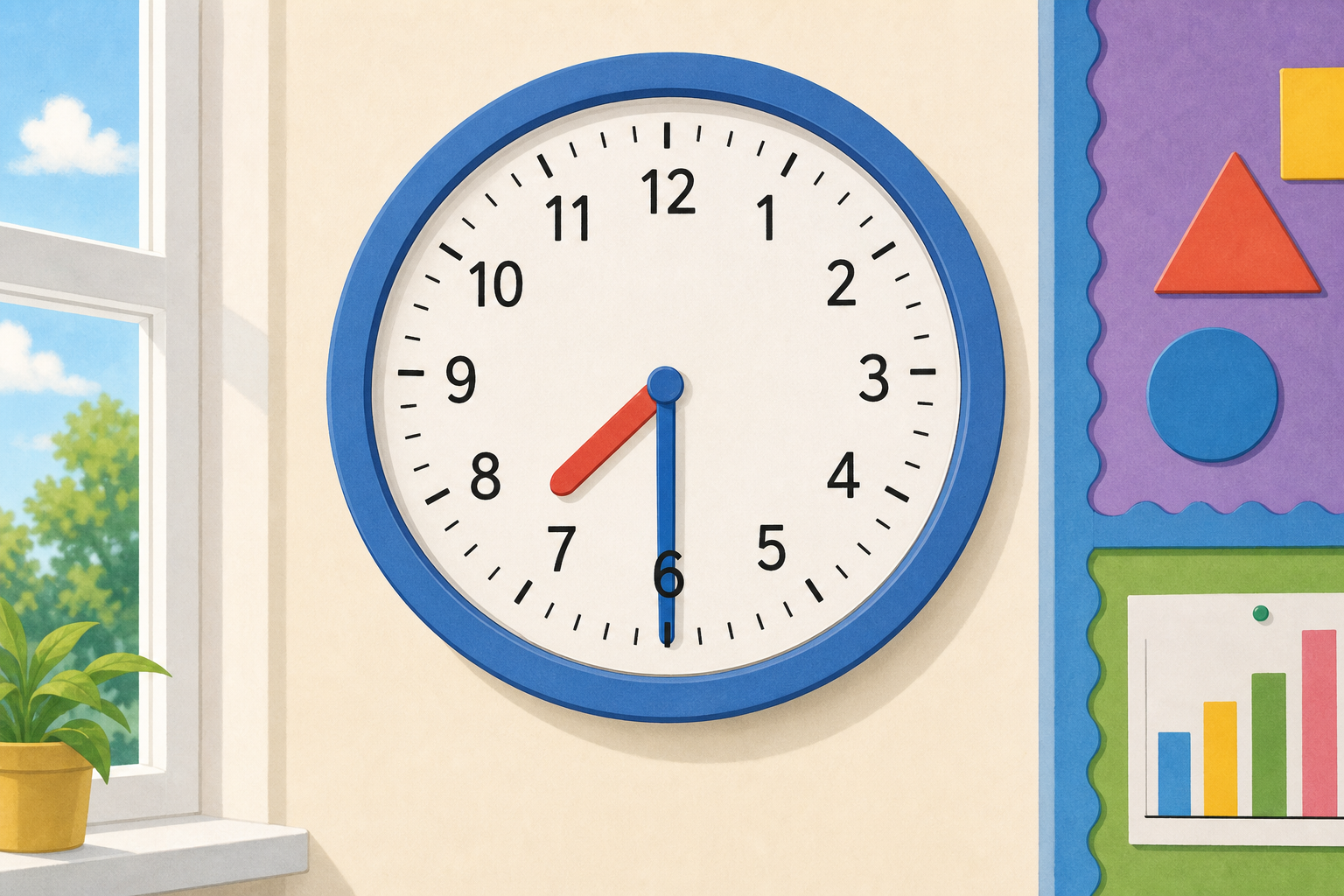
Look up at the clock on our classroom wall. Start at the 12 and count the little marks round to the 3, going up in fives: five, ten, fifteen. If the long minute hand was pointing right at the 6, how many minutes would that be? Have a think before any hands go up.
Point to the real classroom clock as pupils settle. Give five seconds of quiet think-time, then take three hands-up answers, not open call-outs. Listen for whether pupils count each mark or jump in fives at the numbers. Revoice the answer: the 6 is six fives, so thirty minutes.
The clock on screen changes for each time. Watch the minute hand and count round in fives with me.
Here is the rule we are listening for. From o’clock until the minute hand reaches the 6 at the bottom of the clock, we say the minutes PAST the hour: five past, ten past, quarter past, twenty past, twenty-five past, half past. Once the minute hand goes beyond the 6, we count the minutes TO the next hour instead: twenty-five to, twenty to, quarter to, ten to, five to, then the next o’clock.
So the halfway mark, the 6, is where we switch. The same amount past the top can be read two ways. Look at twenty-five past ten, then at ten to seven, and notice which side of the clock the minute hand sits on for each.
Count the minute hand in fives, class chorusing along.
Quarter past three: hand on 3, five, ten, fifteen equals 15 minutes, everyday name quarter past.
Half past eight: hand on 6, count to 30, everyday name half past.
Twenty-five past ten: hand on 5, count in fives to 25.
Ten to seven: the make-or-break one. Hand past 6 onto the 10, count up to fifty past six first, then swap to counting what is left. A full hour is 60 minutes, we are at 50, so 60 minus 50 leaves 10 minutes to go. Point to the hour hand nearly at seven. Let pupils try both names before you confirm ten to seven, not fifty past six.
Today we set these times together on the board: quarter past two, twenty past five, half past nine, and twenty to four. One person comes up and drags both hands; the rest of us count the minute hand in fives and check.
Before each one we ask ourselves: is this a past time or a to time, and which hour are we heading toward?
This round is for talking it through together — pupils take turns at the board and the class agrees or corrects out loud.
The explore clock is freely re-settable: after each time is set and the class has checked it, the pupil at the board simply drags the hands round to the next named time, so all four are set in turn on the one clock. Pick a mix of past and to times so pupils meet both.
Use a quick whole-class question as your pacing lever between the four: before each time ask past or to, and which hour next?, then have the class chorus-count the minute hand in fives, and revoice the pupil's count before confirming. Watch for the classic slip on twenty to four — pupils often set the hour hand right on the four instead of nearly there; revoice: if it is twenty to four, four hasn't happened yet, so the hour hand is just before it.
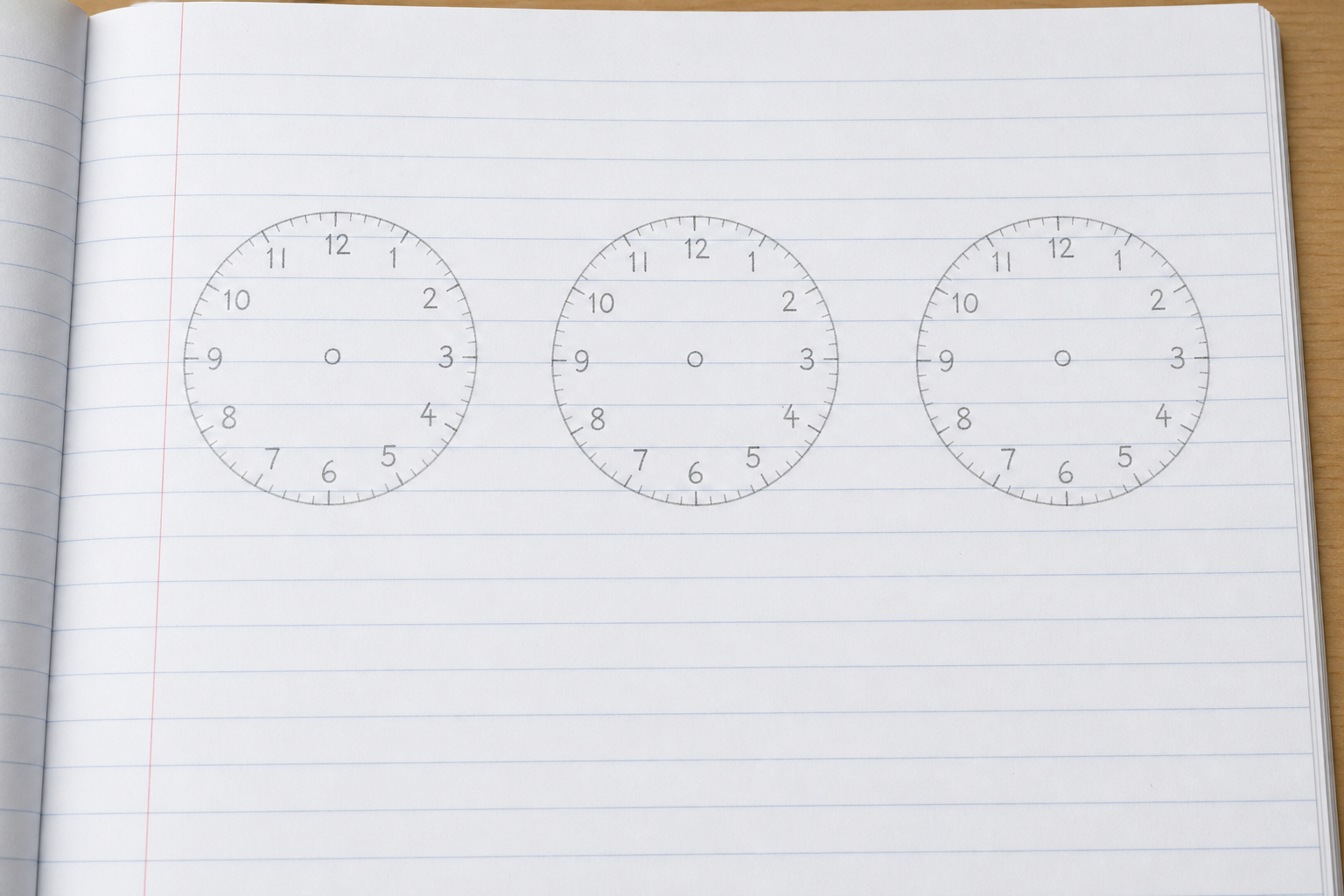
In your maths copy, draw three blank clock faces. On them, mark and draw the hands for these three times. Underneath each clock, write the time in words.
Walk the room glancing at the minute hand position and the past/to naming underneath — this is whole-class copybook practice, not marking. Watch for the hour hand on twenty to nine and five to six: it should sit just before the named hour, not on it.
Today we work through these times one by one: quarter past two, twenty past five, five to eleven, then twenty-five to eight. The last two are to times, so we count the minutes still left until the next hour. We start with five to eleven, where the minute hand is close to the top, and then go to twenty-five to eight, where it is further round. We check each one before moving on.
These are the practice questions — pupils take turns at the board, check each answer, and the class confirms before moving on. Keep the board work brisk rather than over-explaining.
The challenges step up from clear past times to the trickier to times, and the to times are ordered from the easier five to eleven (minute hand on the 11, just one step before the top) to the deeper twenty-five to eight (minute hand on the 7). Before each to time, ask the class: is this a 'past' time or a 'to' time, and which hour are we heading toward? For both to times, the hour hand sits just before the named hour. Use the on-screen ✓ as part of your narration — yes, that's it.
Why does the minute hand count in fives at every number, but the hour hand crawls slowly between them? What is each hand really telling us?
Listen for pupils noticing that the minute hand passes a whole number in the time the hour hand barely moves. Revoice a strong answer: so the long hand counts the small minutes, the short hand counts the slow hours. Head off the idea that both hands move the same speed — that is the misconception behind setting the hour hand on the named hour for a to time.
Next we go even closer, telling the time to the single minute, and we learn how the same time can be written on a clock face or as digits like 7:43.
Keep this brisk. Recap the past/to split with one quick example each before closing.
You're previewing this lesson. Get full access to this lesson and hundreds more — each one ready to teach, with interactive activities, printable resources and pupil progress tracking built in.