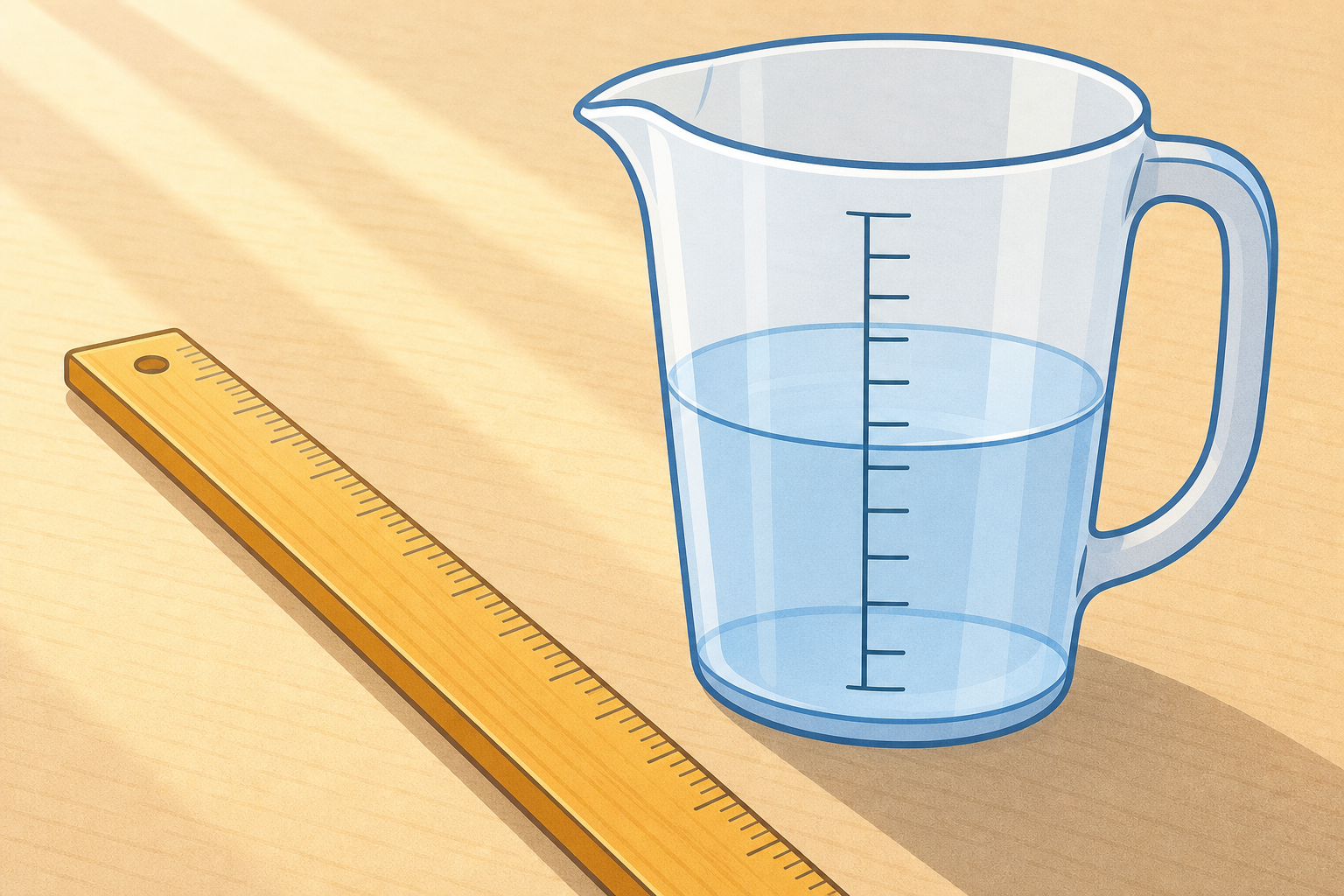
Here is a metre stick and a one-litre jug of water. You already know how to read a scale by counting the equal marks along it. Look at the ten equal marks on the metre stick and the ten equal marks up the jug.
Hands up: where exactly is halfway along this metre stick, and how much water do you think fills the jug halfway up? What part of the whole thing is that halfway mark?
Hold up (or display) a real metre stick and a one-litre jug as pupils settle. Reading a graduated scale by counting its equal marks was met in the earlier measures work, so treat it here as a quick reminder, not new ground. Point once along the ten equal marks on each so every pupil sees the ten-part split before the questions.
Take three hands-up answers only, not open call-outs. Steer toward the word half, and prime the idea that a half is also a number of tenths — you will unpack that in the next step.
Look at the metre stick marked into ten equal tenths. Each tenth is 10 cm. Look at the mark five tenths along: that is exactly halfway. We can read it three ways, half a metre, five tenths of a metre, 0.5 m, and in centimetres that is 50 cm.
Now look at just the first mark. One tenth of a metre is 0.1 m, and that is 10 cm. The marks show 10, 20, 30 centimetres at one tenth, two tenths, three tenths.
Look at the mark eight tenths along. That is 0.8 m, and counting in tens of centimetres it lands on 80 cm, nearly the whole metre, but two tenths short.
Half a litre is the same idea: five tenths of a litre is 0.5 l, and that is 500 ml.
Walk each display in turn, one at a time.
Do not move on until the class can say 'half a metre is five tenths is 50 cm' — that link is the whole lesson.
Now we measure in our groups of four. Each group shares one metre stick and one jug, and everyone takes a turn to point and read. If your group has no metre stick or jug, read the same amounts from the board and mark your copybook edge into ten equal parts.
Take turns to point to and read these amounts, in this order: half a metre, then one tenth of a metre, then half a litre, then three tenths of a metre. Each one is a number of equal tenths — say the tenths aloud, then the centimetres or millilitres.
Finished early? Point to seven tenths of a metre and read it, then work out how many more centimetres would make half a metre from three tenths.
This round is for talking it through together, so keep it low-stakes: no marking yet, just circulate and catch slips on the spot as each group reads aloud.
Groups of four share one metre stick and one jug, and every pupil takes a turn. If a group has no kit, they read the amounts from the board and mark a copybook edge into ten equal parts instead.
In your maths copy, write half a metre three ways in one line, and half a litre three ways underneath it:
Read each line aloud to yourself after you write it.
Walk the row glancing at the two written lines — this is whole-class copybook practice, not marking. Watch for pupils writing 5 cm instead of 50 cm, or 50 ml instead of 500 ml.
Now we take turns at the board and work through these readings together, hardest last: two tenths of a metre (0.2 m), then half a metre (0.5 m), then seven tenths of a metre (0.7 m), then eight tenths of a metre (0.8 m), then half a litre (0.5 l) on the jug. Before each reveal, predict where the mark lands and how many centimetres or millilitres it is.
These are the practice questions, so pupils work it independently and you hold back until each answer is in. Take turns at the board: one pupil moves the cursor and presses Check while the class predicts first.
Have pupils predict the centimetres before each Check so the number is worked, not read. The final jug reading is the key one — it carries the metre-stick pattern into a new unit.
You're previewing this lesson. Get full access to this lesson and hundreds more — each one ready to teach, with interactive activities, printable resources and pupil progress tracking built in.