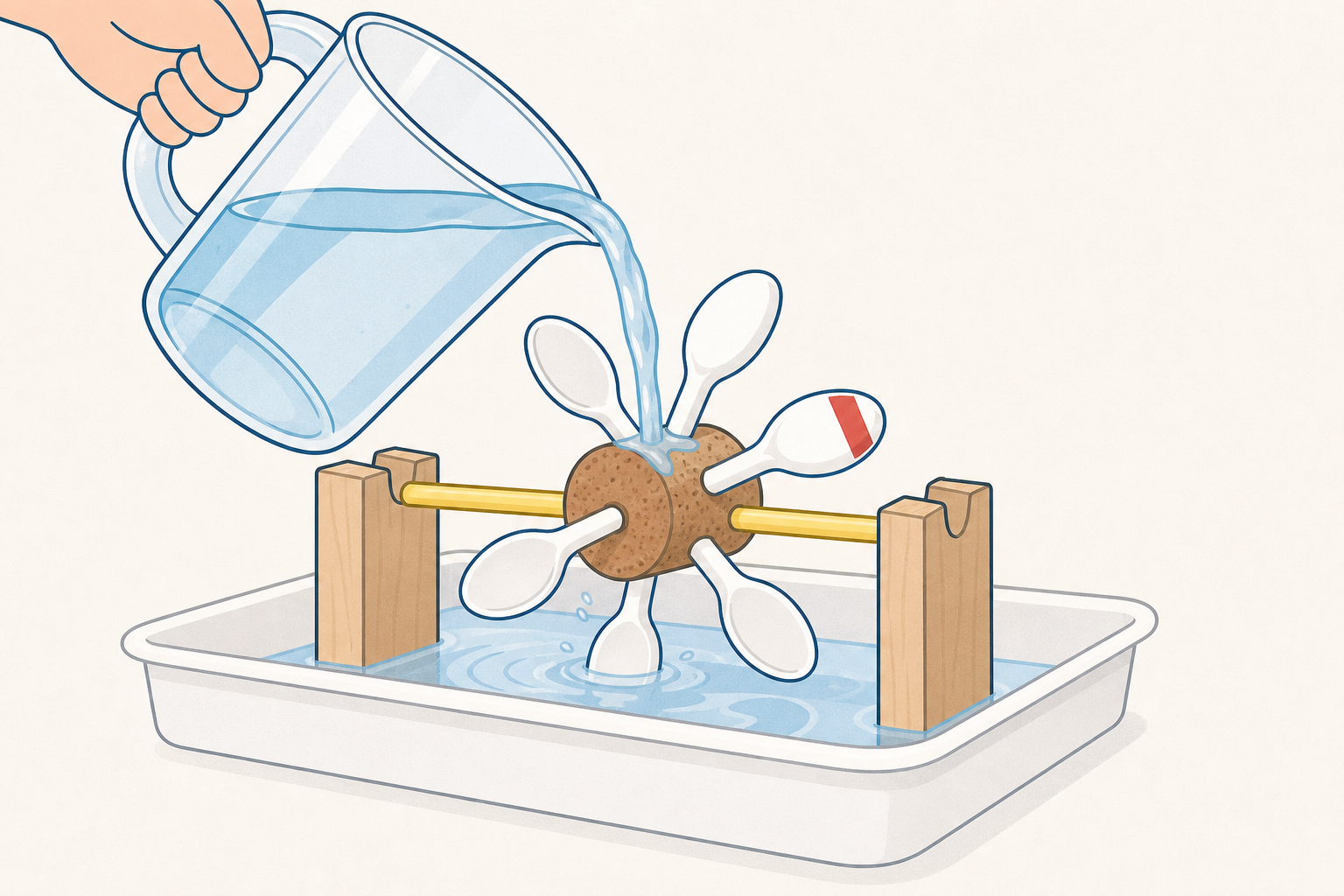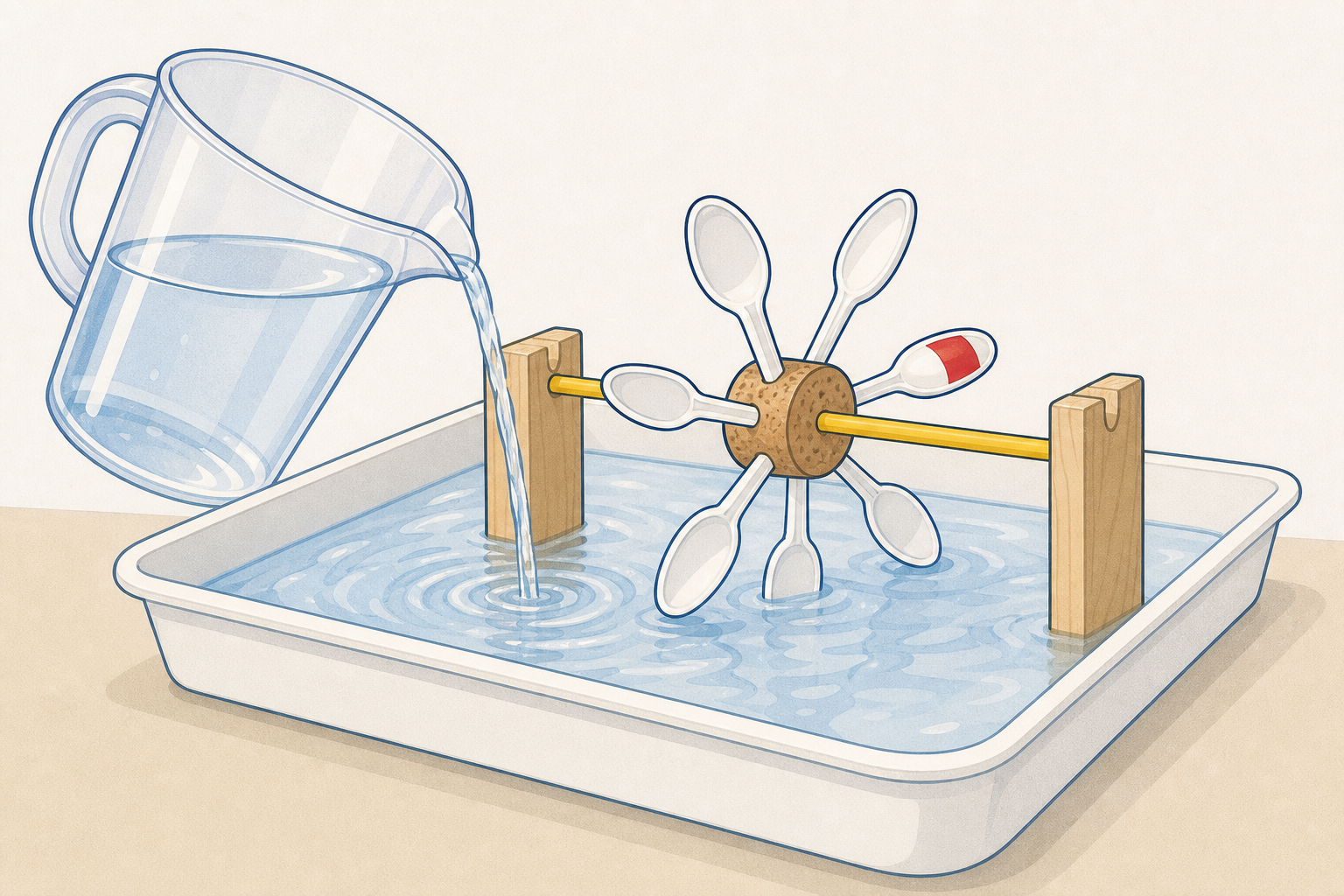
I’m going to pour this jug of water into the tray. Listen and watch what happens when the water moves.
Hands up: can moving water do a real job, or does it only make a splash? Could moving water turn a wheel?
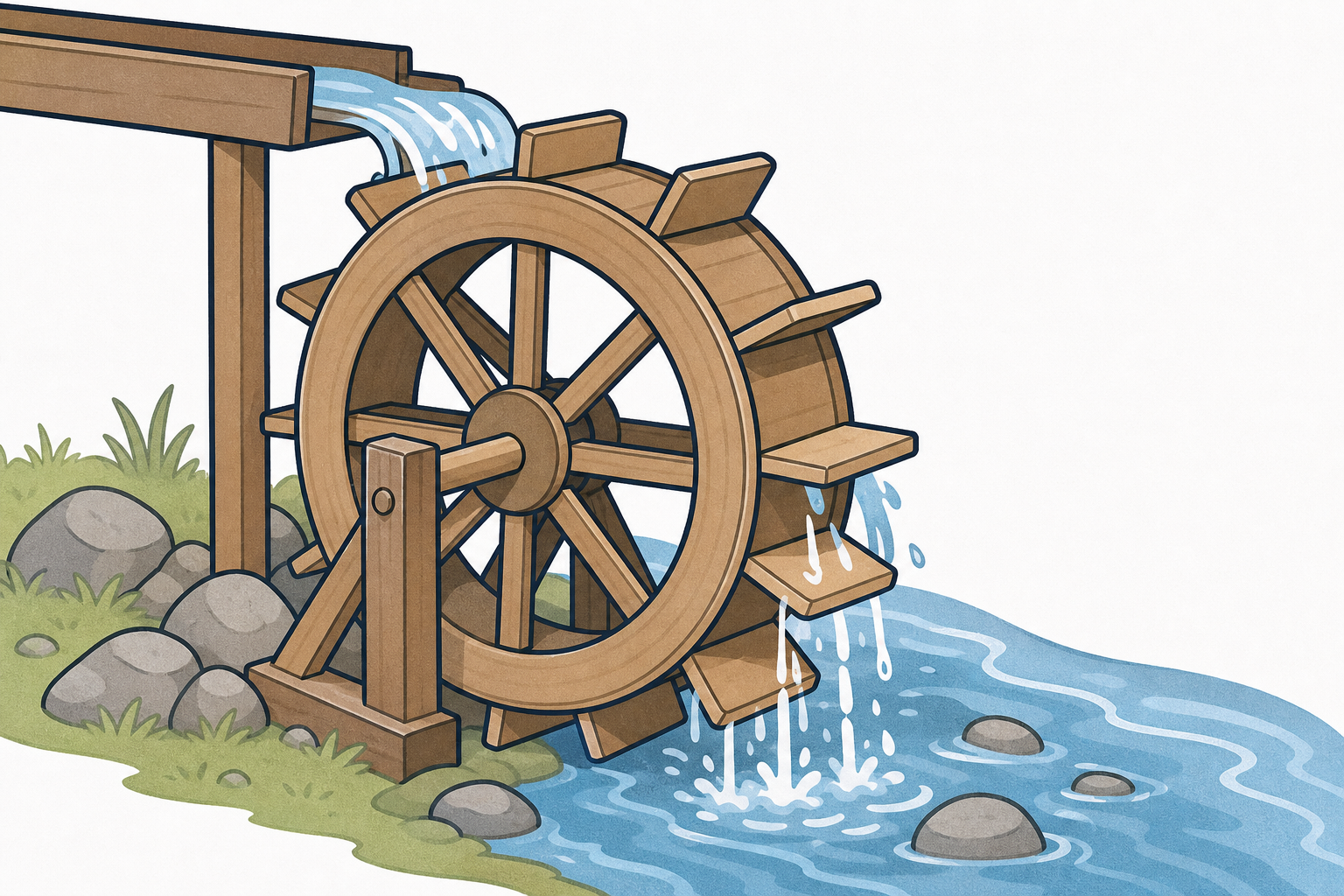
Hold up a full jug beside an empty tray so the class can see the real objects in your hands. Pour a short stream so they hear and see the water hit the tray. Do not show a finished water wheel yet; the build comes next.
Key questions: Where else have you seen moving water push or turn something (a river, a hose, a rain gutter)? What do you think the water would need to hit to make a wheel spin?
Keep this beat light: curiosity only. Save apparatus set-up, variables and vocabulary for the steps that follow.
You saw moving water push its way across the tray. That push is the force of moving water.
A water wheel is a wheel with paddles that catch that push and turn. The moving water pushes the paddles (a force). That push transfers energy to the wheel so it spins and can do a job.
Later we’ll link the same idea to real power stations in Ireland. If we build a small wheel, what one thing might we change to make it spin faster?
Project only the short board text. Use the table below as your reference while you talk. Tie each idea back to the jug and tray the class just watched. Keep hydropower light here; the full Irish link lands in the evidence talk.
Say the force–energy bridge once in plain words: the push is a force; that push transfers energy to the wheel so it can do work. Do not treat the two words as synonyms.
| Concept | Why it matters | Example |
|---|---|---|
| Force of moving water — water that is moving can push on objects and make them turn or move | It explains why rivers, hoses and a jug pour can move things we care about | A strong pour from a jug can spin paddles on a tray water wheel |
| Water wheel — a wheel with paddles that turns when moving water hits it so the water’s push does useful work | It turns the push of water into a spin we can see and count | A cork hub with stick paddles spins under a pour of water |
| Hydropower — using the energy in moving water to do a job such as making electricity | It links our tray model to real clean energy in Ireland | At Ardnacrusha on the River Shannon, river water turns turbines to make electricity |
Misconception to head off: pupils may say the water “gives the wheel energy and then the energy is gone.” Energy is transferred, not used up. The moving water pushes the paddles, so the wheel gains movement; the water slows and collects in the tray. It is not empty of water or “out of energy” in a magical way.
Nature of STEM: name that this is Physics in action — forces and energy transfer. Save the longer Ardnacrusha story for the evidence step.
Ask: if we build a small wheel, what one thing might we change to make it spin faster?
Your group will build a simple water wheel that can spin on a tray.
The axle is the thin stick or straw the wheel spins on. Build in this order: fix the paddles evenly around the hub, slide the hub onto the axle, rest the axle ends on two supports over the tray, then check it spins with a gentle finger push.
Mark one paddle with a small piece of sticky tape so you can count full turns later.
Success looks like this: when you pour water onto the paddles, the wheel turns. Test with a short pour, then stop and wait for the plan step before you change anything.
Hold up each part and name it. Say: the axle is the stick the wheel spins on. Show the short sequence once: paddles on hub → hub on axle → axle on two supports over the tray → finger-spin check → mark one paddle with tape. Then release groups.
Push 4–6 sticks evenly into the sides of the cork (or tape paddle pieces around a bottle cap) so they stick out like spokes. Slide the hub onto the axle. Rest the axle ends on two supports so the wheel hangs free above the tray. Paddles should catch the pour. Mark one paddle clearly so turns are easy to count in the fair test.
If a wheel will not spin: paddles may be uneven, the axle may be jammed, or the pour may be missing the paddles. Fix one thing at a time.
Differentiation: offer a half-built hub with two paddles already in place for groups that need a head start. Confident groups can add a sixth paddle or check that the wheel is balanced.
Safety: cocktail sticks and skewer ends are sharp — no running with them; adult help for firm pushes into corks. Mop spills as you go. No tasting water from trays.
When most wheels turn under a short pour, stop the free play and move to planning the fair test.
We want to find out what makes our water wheel spin faster. First we will sort six cards together on the board as a class model. Volunteers help drag each card into Change, Measure or Keep the same while everyone else watches and calls out ideas.
On the board the six cards are: pour height, how strong the flow is, number of turns in the set time, the water wheel, how long we count for, and the jug. Our class model uses pour height as the thing we change. We always measure number of turns in the set time. The whole class will use the same counting time on the class timer (for example 10 seconds).
Then your group chooses for real: pour height or how strong the flow is. On your Investigation Journal page write your plan under these headings: question, prediction, what we change, what we measure, what we keep the same.
Drive the fair-test-planner interactive on the IWB in explore mode for a whole-class model sort only. Six cards appear: pour height, how strong the flow is, number of turns in the set time, the water wheel, how long we count for, and the jug.
Invite volunteers to the board (or drag yourself from pupil calls). Check the model against the target: Change = pour height; Measure = number of turns in the set time; Keep the same = how strong the flow is, the water wheel, how long we count for, the jug. Then say clearly: groups may keep this plan or swap so that flow strength is Change and pour height moves into Keep the same. The interactive is the class model; agency lives on the journal page.
Agreed class structure:
Worked example (model aloud before groups finalise):
Pupils complete their own fair-test plan on the Investigation Journal page under: question, prediction, what we change, what we measure, what we keep the same. Predictions are never wrong.
Agency: the open choice is which factor each group changes on paper. Do not force every group onto the same variable, and do not re-check the board target against a group that chose flow strength.
Run the fair test your group planned. Change only the one factor you chose. Keep the wheel, the jug and the counting time the same. Count full turns of your marked paddle for each trial and do each setting twice.
The teacher will run short shared 10-second countdowns on the board. Pour only when your tray is ready for that countdown. If you miss a round, wait for the next one. Cover these jobs in your group: pour, count turns of the marked paddle aloud, watch the shared timer, and record. If your group is not four people, double up or share a job.
While another group is pouring, watch and be ready to say whether their test still looks fair.
Do not expect every group to pour on every single countdown. Run repeated shared 10-second countdowns on the IWB. Groups pour only when their tray is ready; others watch, mop, or prepare the next setting. Two or three countdown windows per setting level is enough. This keeps counting time fair and lets you supervise wet trays safely.
Groups use their own water wheel and plan. Typical choices:
Agree a class counting time (10 seconds works well). The time-watcher role watches that shared countdown, not a separate phone. Count full turns of the marked paddle if the wheel blurs.
Roles: the jobs to cover are pour, count turns, watch the shared timer, and record. Groups of three can combine timer-watch with count or record; groups of five can add a second counter or spill-mopper. Do not insist on exactly four people.
Repeats: two trials at each setting. If the two readings are very different, try a third and talk about careful pouring.
What to expect: higher pours and stronger flows usually give more turns because the water hits the paddles with a greater push. After a quick teacher demo, a low pour might give around 4–8 turns in 10 seconds and shoulder height noticeably more — wheels differ, so compare within one wheel, not across groups. Results vary with wheel design; that is useful discussion, not failure.
If nothing much changes: the two settings may be too similar, paddles may be missing the stream, or the axle may be sticking. Help the group fix one thing and re-run.
Fold the watchers in: when you stop at one tray, ask the rest of the class what they predict for that group’s next trial and whether the test still looks fair. Watching is participation; do not invent a separate desk task for watchers.
Safety: wipe spills immediately; keep floors dry; no climbing on furniture for extra height — shoulder height is enough; cocktail sticks stay on the tray.
You're previewing this lesson. Get full access to this lesson and hundreds more — each one ready to teach, with interactive activities, printable resources and pupil progress tracking built in.