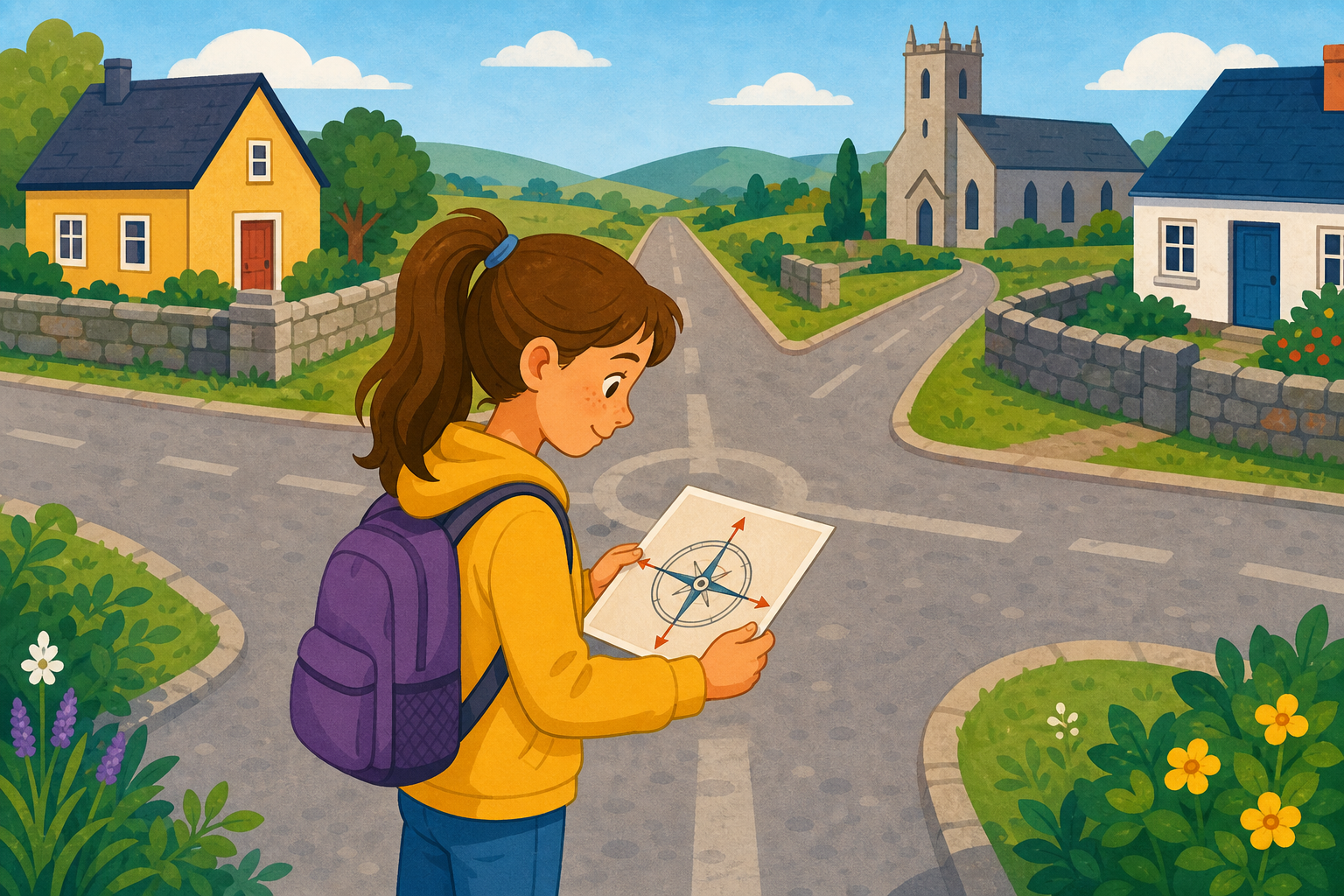
You already know how to plot points like (3, 4) by going along and then up. But what if a place is below the start line, or to the left of it? Look at our grid as the two lines stretch out past zero, in every direction. What appears down here, below zero? And what about over there, to the left of zero?
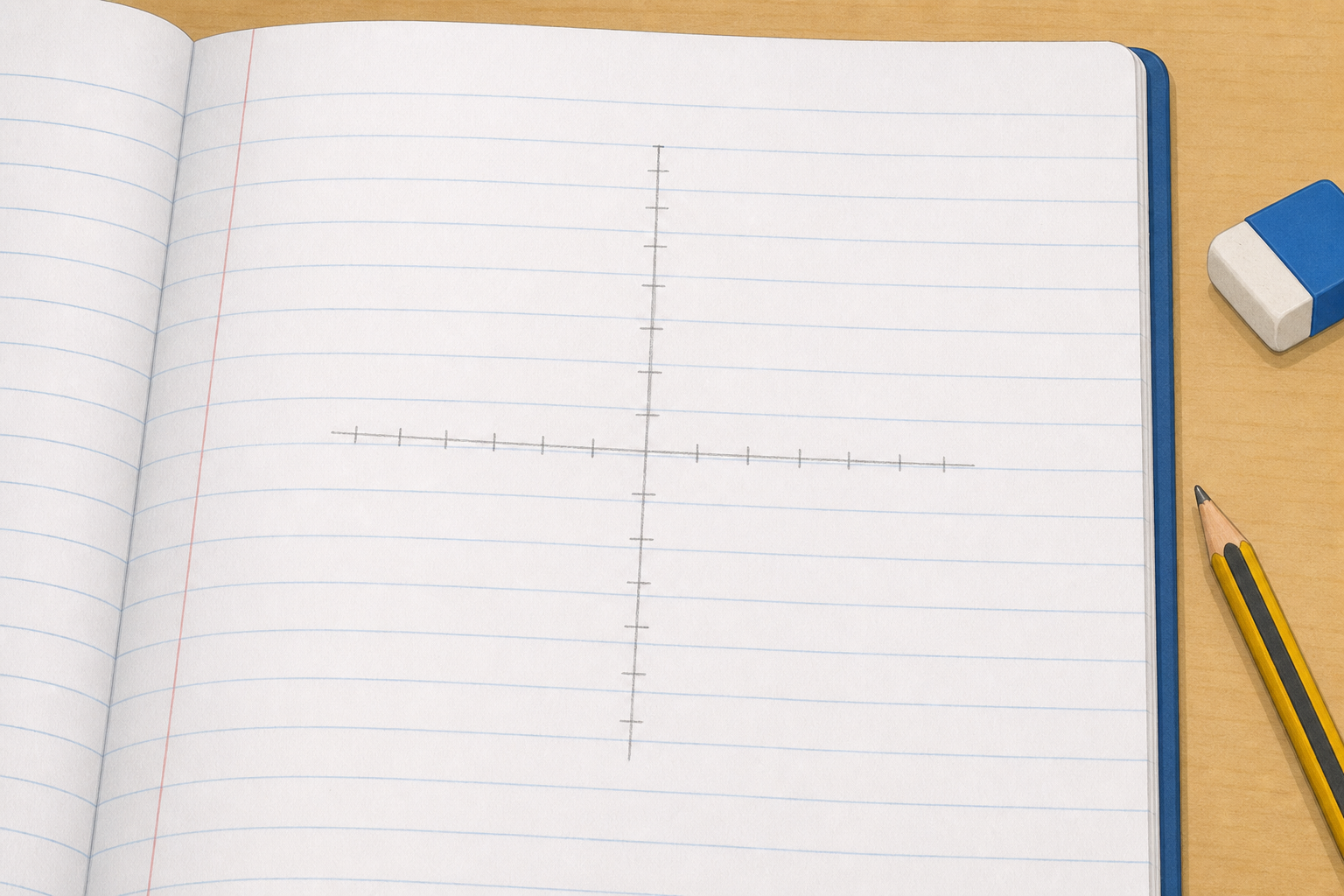
Watch the grid carefully. The two lines crossing at the centre meet at a special point called the origin, written (0, 0). The lines split the whole plane into four regions, called quadrants. We number them I, II, III and IV, starting in the top-right corner and going anticlockwise.
Now watch one point land in each region: (4, 3) up in the top-right, (−4, 3) in the top-left, (−4, −3) down in the bottom-left, and (4, −3) in the bottom-right. Look at the signs each time. What do you notice about whether each number is positive or negative as we move from one region to the next?
Today we work through this together: I will name a point and you tell me which quadrant it lands in, just from its signs. Then a pupil will come up and plot it to check. We'll do points like (5, 2), (−3, 4), (−6, −1) and (2, −5).
In your maths copy, sketch the four-quadrant plane with the axes running from −6 to 6 on each side. Label the four quadrants I, II, III and IV in the right corners. Then write the sign pattern beside each one:
Today we work through these challenges together: first, plot a point in quadrant II. Then plot a point in quadrant III. Then plot a point in quadrant IV. Then the trickiest one, give me a point that sits on an axis and lands in no quadrant at all.
Where do points sit when one of their co-ordinates is zero — not in any quadrant, but somewhere special? A zero means no step in that direction (no step left or right, or no step up or down), so the point stays on a line. Have a think about why that happens.
Next we'll plot and read points with negative co-ordinates anywhere on the plane, going left and down from the origin with confidence.
You're previewing this lesson. Get full access to this lesson and hundreds more — each one ready to teach, with interactive activities, printable resources and pupil progress tracking built in.