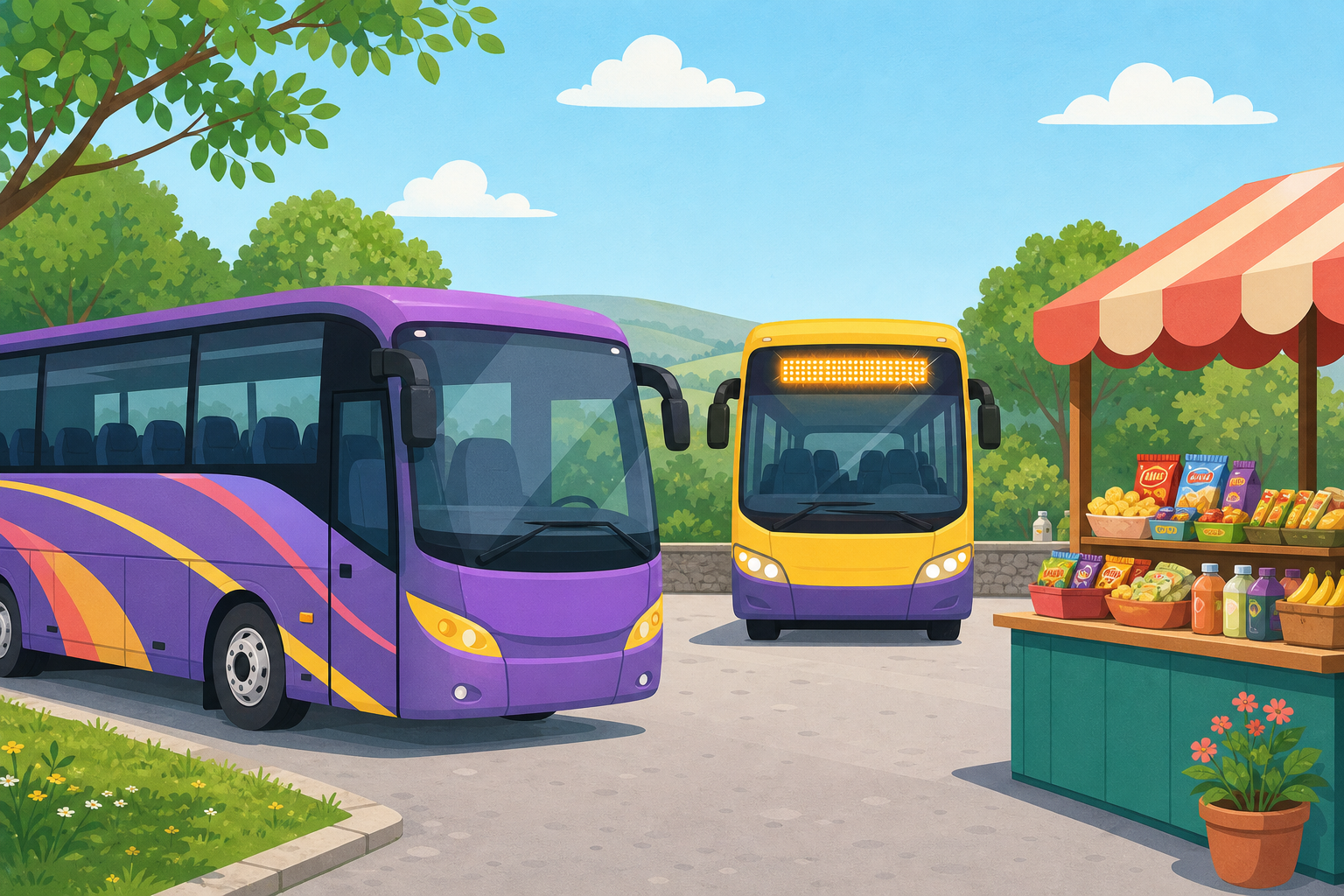
Imagine a class trip to Cork. The bus leaves in the morning, you buy a snack at a stall, and the bus home has a time on its screen. What would you need to work out first: how long the journey takes, the change from your money, or the total price of two snacks?
Take three hands-up answers, not open call-outs. The point is to notice a real day mixes several kinds of maths at once, not to solve anything yet.
Watch four worked problems from a day out. For each one, notice: is it a time step or a money step?
Remember: to write an afternoon time in 24-hour form, add 12 to the hour, so 4 p.m. becomes 16:00. To read a 24-hour afternoon time back, take away 12.
Watch and Notice: work each problem on the board, and let the class predict the step type before you solve it.
Name the kind of step out loud before solving each: this is a time step; this is a money step. Hold out for the class to spot the two-step ones (add the snacks, THEN find the change). On the last one, show the 24-hour reading: 16:20 is after midday, so take away 12 to get 4:20 p.m.
Today we lay out coins for the money step of each problem. Build these amounts in order. Say each amount aloud before you build it. Then check the tray total matches.
Try It Together: pupils take turns at the board and the class agrees or corrects out loud.
Start each amount with the larger coins first. Keep €2.30, €2.70 and €3.50 brisk so there is plenty of time for the €4.99, which catches people out because it needs the small coins. Reconcile any disagreement by reading the running total aloud with the class.
We solve one two-step problem together on the board first. It needs a time step and a money step, so we label each part.
Problem: The bus screen shows 14:20. The journey lasts 40 minutes. A snack costs €1.50 and you pay with €2. What time do you arrive, and what change do you get?
Watch the board working. Then in your maths copy, write the same problem and both steps. Write Time: for the time step and Money: for the money step, so anyone reading your work can see what you did first. Write the arrival in full 24-hour time, like 15:00.
Work It in Your Copy: model the full solution on the board before anyone writes. Name each step type out loud, write the label, then the working under it.
Board model (mixed time and money):
Hold out for both labels on the board before pupils open their copies. Slip to watch: final answers only with no labels, or arrival written as 3 o'clock instead of 15:00. Nudge them to show the count-on under Time: and the subtraction under Money:.
Walk the room glancing for the two clear labels and the working under each, not marking.
Today we work through these together, each one a step harder:
This is the practice round — pupils take turns at the board, check each answer, and the class confirms before moving on. Keep the board work brisk rather than over-explaining.
On the last one, hold out for pupils to count on the 40 minutes first (14:20 to 15:00), then read the arrival back as 3 p.m. by taking away 12 from 15. The full 24-hour writing (15:00) is practised in the copybook step.
You're previewing this lesson. Get full access to this lesson and hundreds more — each one ready to teach, with interactive activities, printable resources and pupil progress tracking built in.