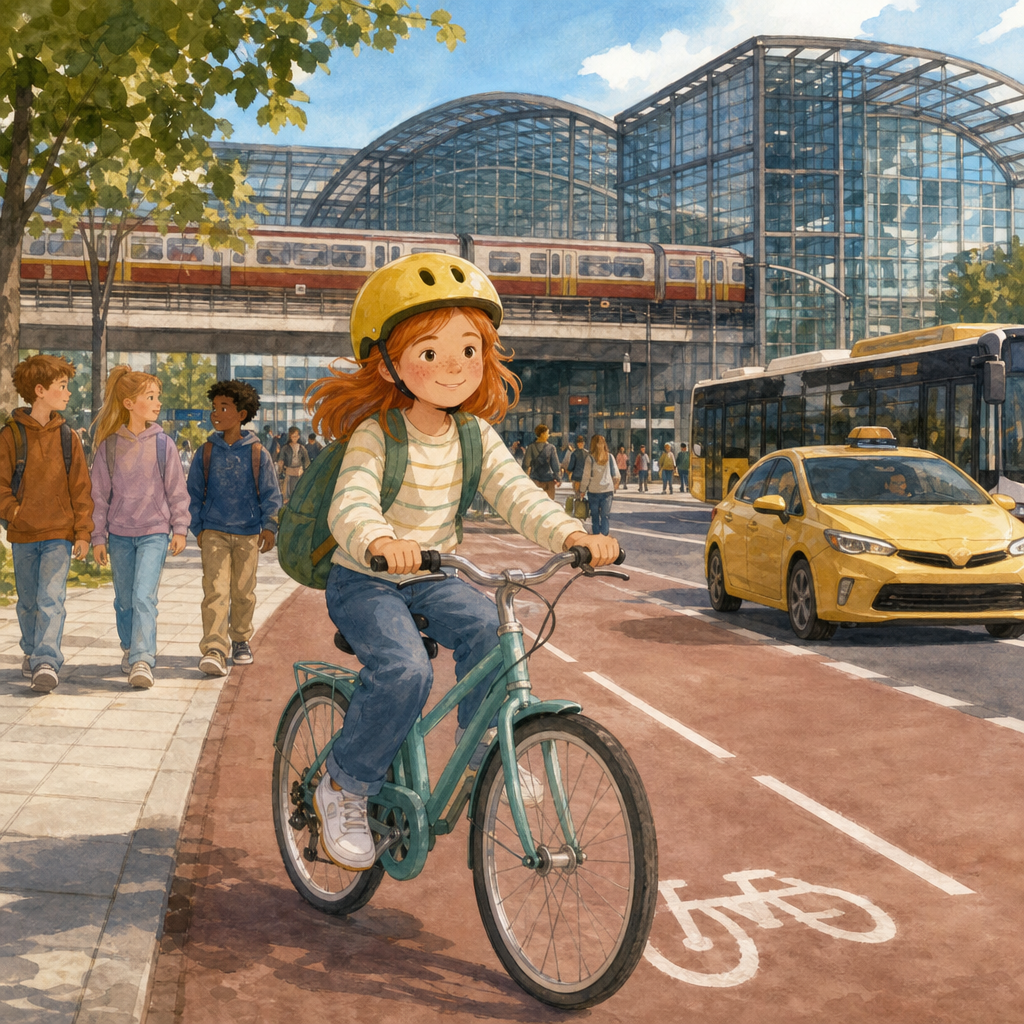
How did you get to school today? Hands up for walking, bus, car, bike. Count the different ways in the room.
Now picture the morning rush outside Berlin Hauptbahnhof: bikes whizzing past, yellow taxis, long-distance trains, and city buses pulling in. Today you will learn eight German words for getting about, so you can name them and put them in order from slowest to fastest.
Take a quick show of hands for walking, bus, car and bike. Name two or three of the ways you hear in English, then paint the Berlin Hauptbahnhof picture in one sentence so the lesson feels placed in Germany from the start. Do not introduce the German words yet; the word-table in the next step does that job.
Here are today's eight German transport words. We will learn them in two groups of four so they stick.
Listen to each word, then say it back together. Watch the little word in front (der or das): it means "the" and always belongs with the noun. Say the pair every time, not the noun alone.
Teach in two passes so working memory is not flooded. Today's set only uses der and das (no die words), so keep the board language to those two little words.
Group 1 (first four): das Auto (dahs OW-toh), der Bus (dair booss, short u, like English "bus", not "booze"), das Taxi (dahs TAHK-see), der Zug (dair tsook). Zug has a great little ts at the front, like the start of a sneeze: ts-ook. Class, big ts together: der Zug! Nice. Point at the little word (der/das) every time. After group 1, do a quick point-and-say check: you point at the word or a gesture, class whispers the full pair.
Group 2 (next four): das Fahrrad (dahs FAHR-raht), das Flugzeug (dahs FLOOG-tsoyk), das Boot (dahs boht), das Motorrad (dahs MOH-toh-raht). Same pattern: you play or say, class repeats twice (once together, once by table). Quick point-and-say check on all eight before you leave the step.
Aside for colour: der Zug covers everything from a local S-Bahn to Germany's ICE high-speed trains. Notice the capital letter on every noun; that is a German spelling rule. Celebrate every answer that brings der or das with it.
A busy Berlin street is waiting on the board (bike lane, buses, taxis and more). First, when the teacher points at a picture, whisper the German word with its little word in front (der or das). Then volunteers will place the labels. When a label is right, the whole class says it together.
Run this as whole-class IWB turn-taking. Before anyone comes to the board, do one full "teacher points at picture → class whispers the German with der or das" round so every pupil says each word, not only the volunteers.
Then invite volunteers to place one label at a time. After each correct placement, the class repeats the full pair chorally (not only the child at the board). Warm praise beat: "Yes — das Fahrrad, little word and all. Well spotted." If a label is wrong, say the correct pair together before moving on. Celebrate every answer that brings der or das with it.
Write four ways of travelling, each with its little word in front (der, die or das), ordered from slowest to fastest. Take care with the capital letter on every German noun. Choose your four from the list.
Pause the board for writing. Everyone writes; this is the only three minutes where every pupil's pen is moving. Keep the word-table on screen the whole time so nobody is writing from memory.
Show one worked example on the IWB first, e.g. das Boot as a slow option, then invite them to choose any four from the visible list. A sensible slowest-to-fastest model might run das Boot → das Fahrrad → der Bus → der Zug or das Flugzeug. Boot and Fahrrad often fight for slowest: either is fine if pupils can explain. Accept any justified order. Check that the little word sits in front of every noun and that nouns are capitalised. Today's set has no die words, so only der and das should appear. Do not collect these.
Flip two cards at a time and find each German word with its English meaning. When a match is found, the whole class says the German pair (little word plus noun) out loud before the next turn.
When every pair is found, play a quick Faster? duel: the teacher points at two pictures and the class shouts the German for the faster one, little word plus noun.
A different look at the same eight words. Whole class on the IWB only: volunteers take turns flipping cards. Do not plan for pupil devices or pair work on phones or tablets.
On every successful match, the class says the German with its article together (der or das only in today's set). If a pair is missed twice, cheer the save: class says the German pair clearly, then carry on. Keep the energy light; this is recognition practice before pens move in the next step.
Closing production twist (about 2 minutes): once the board is clear, run three or four Faster? duels. Point at two transport pictures (e.g. das Boot and der Zug). Class decides which is faster and shouts only that German pair. No English answers. This breaks the pure recognition loop and gets every voice producing the words again before writing.
You're previewing this lesson. Get full access to this lesson and hundreds more — each one ready to teach, with interactive activities, printable resources and pupil progress tracking built in.