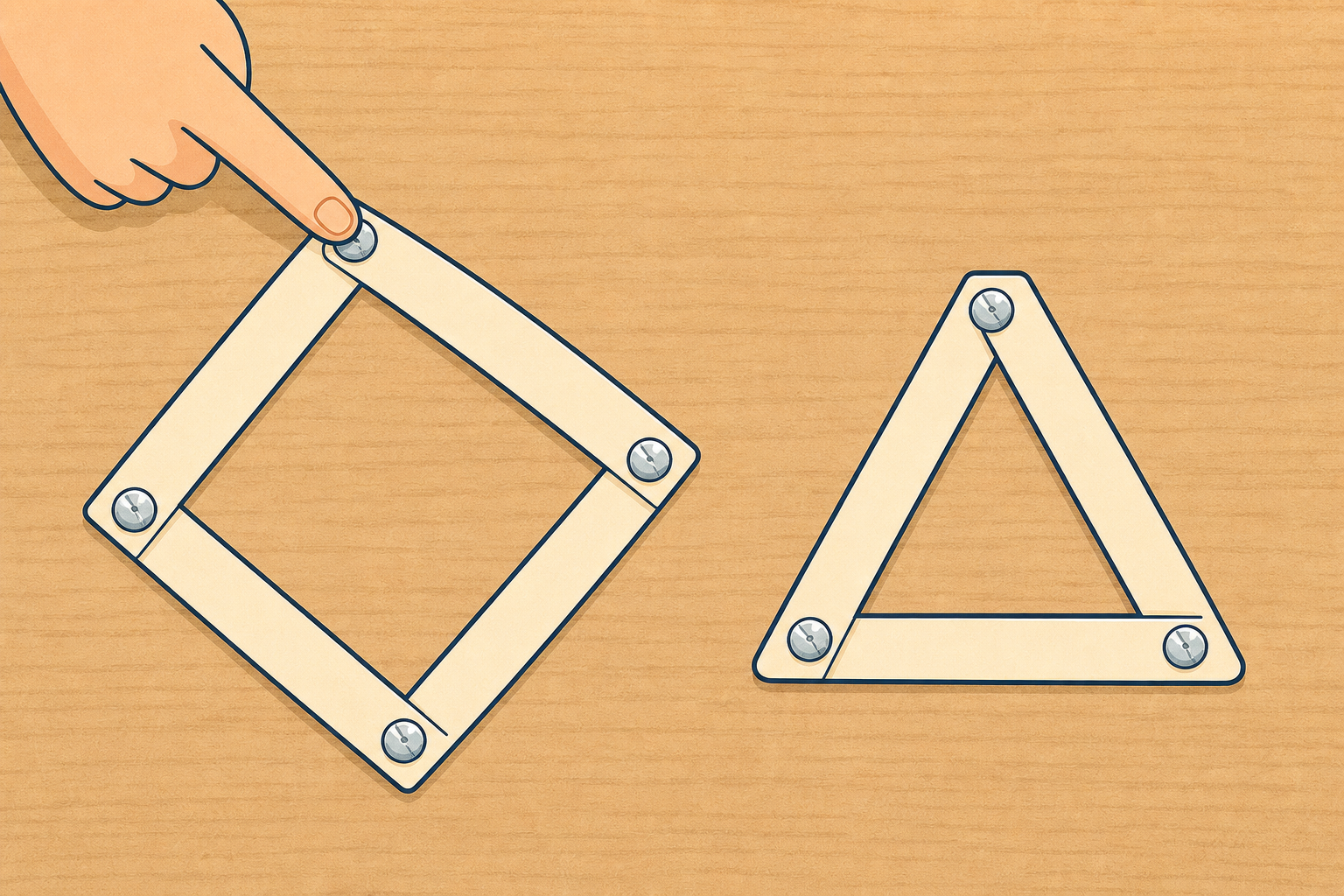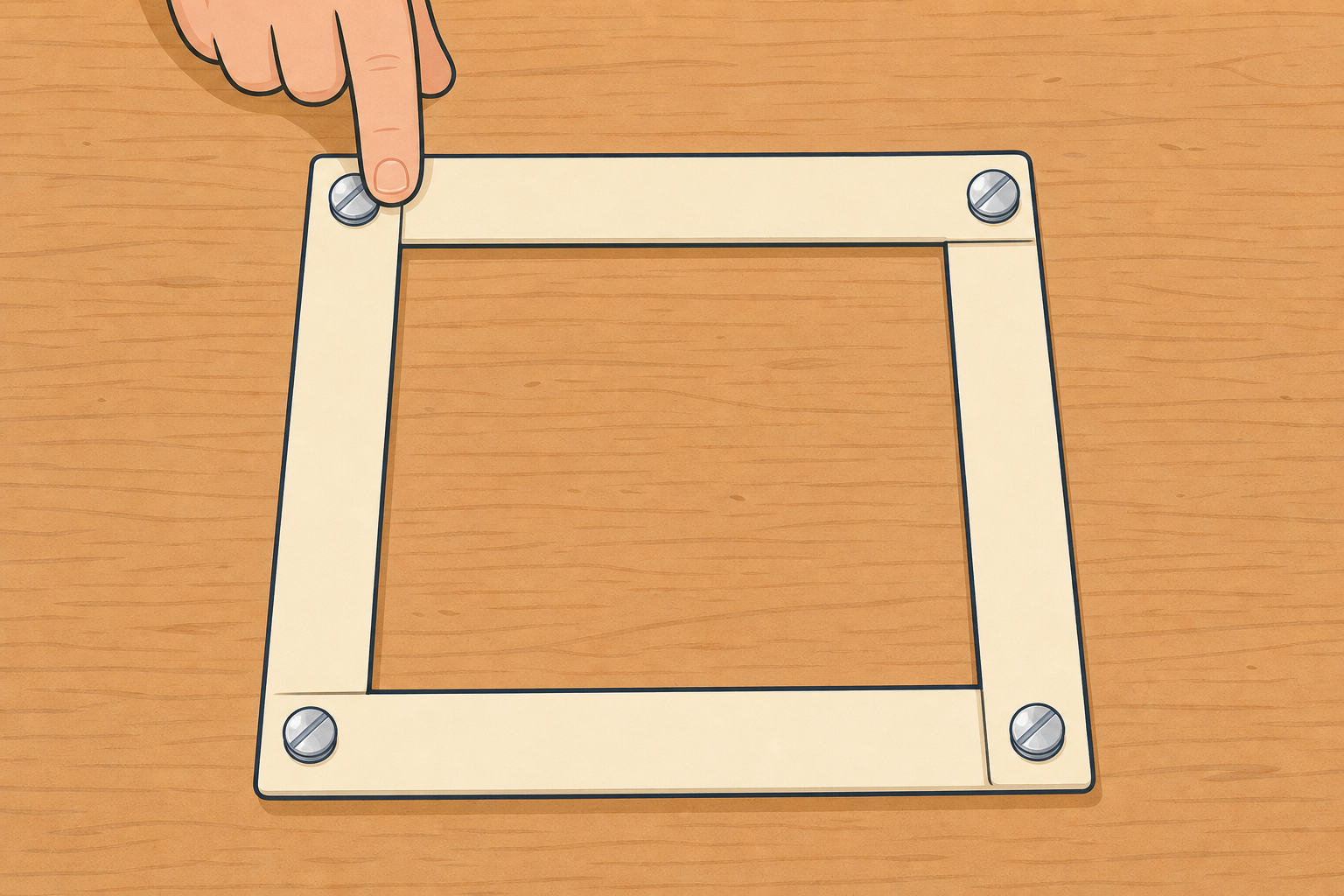
I'm holding a loose square made of card strips. If I push one corner sideways, what do you think will happen?
Hands up your guess: will it stay square, or will it lean over?
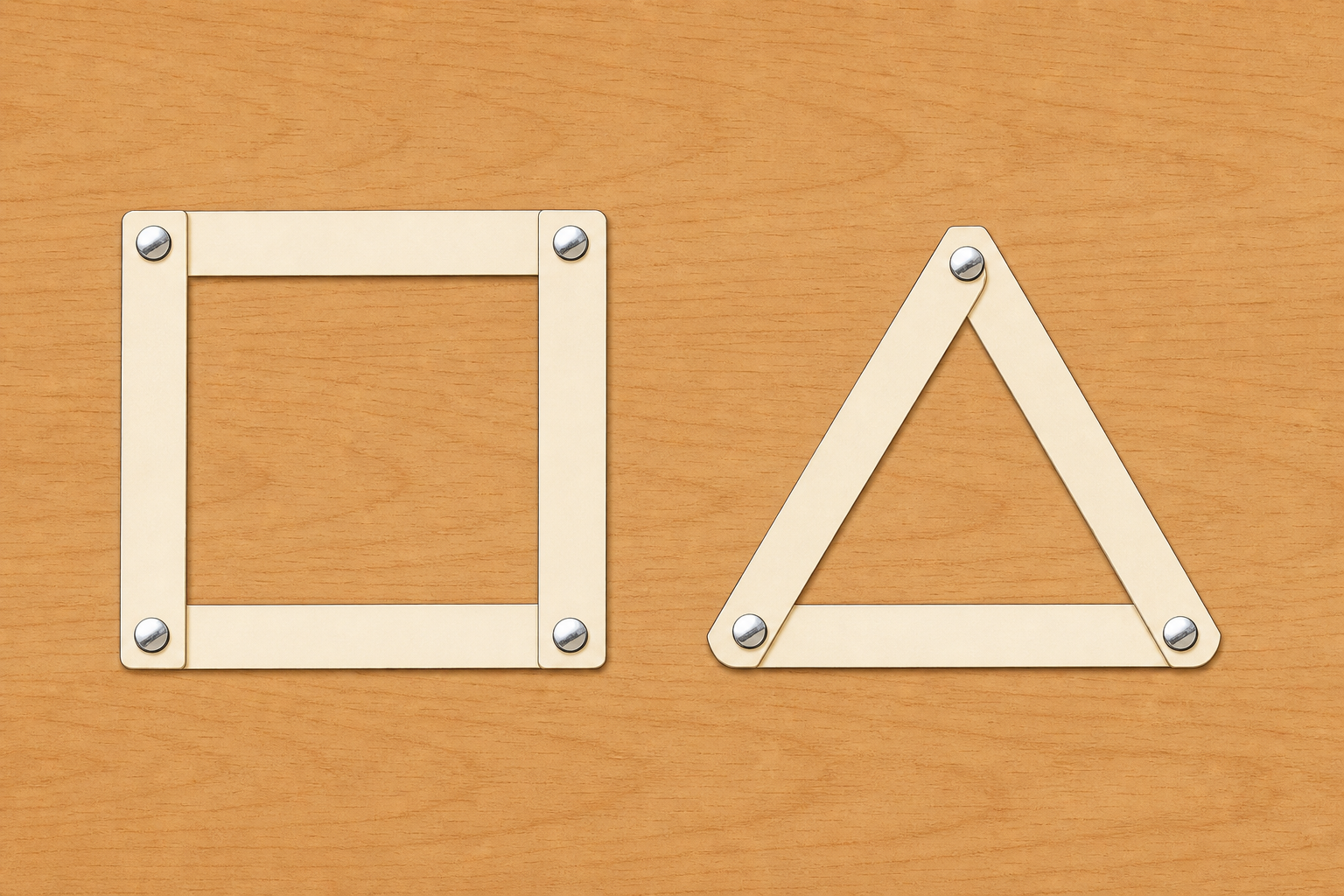
Hold up a ready-made loose square of four equal card strips joined with split pins so the whole class can see it. Do not push it yet. Take two or three predictions only.
Keep the hook light: no full set-up, no vocabulary table, no bracing yet. The frames come out in the next activity.
Have the strip sets ready on group tables for the build step, not laid out as the investigation during this beat.
Which shape do you think will refuse to lean: a square or a triangle?
Two words for today. Rigid means a shape keeps its form when you push it. A brace is an extra strip that stops a frame leaning.
We will build both shapes the same way, keep the pins wobbly, and push one corner sideways with one finger. Then we will try one brace on the square.
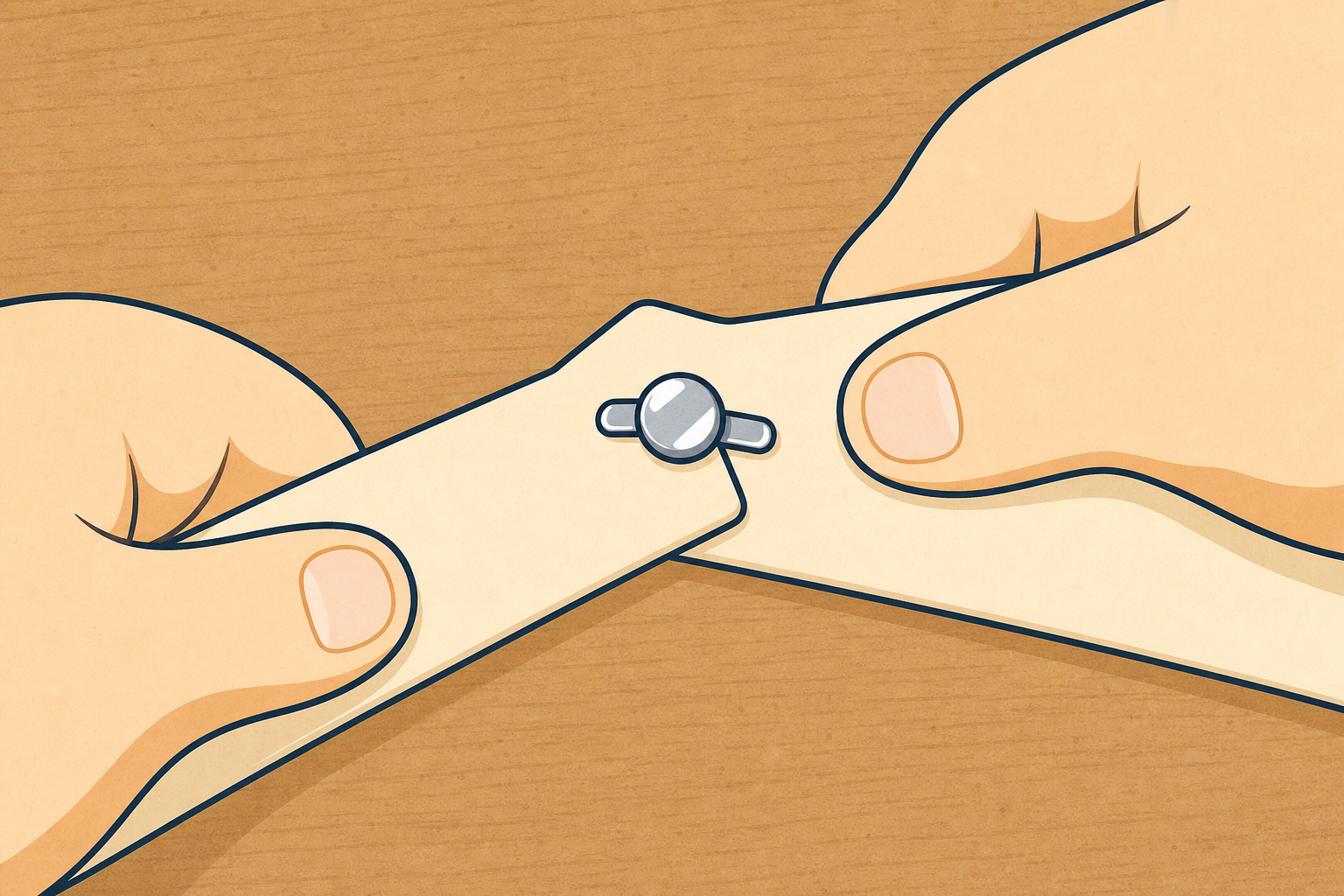
Teach only rigid and brace before the build. Leave the word structure for the triangle hunt. Project only the short board text above.
| Concept | Why it matters | Example |
|---|---|---|
| Rigid shape — a shape that keeps its form when you push a corner sideways | Builders choose shapes that will not lean when a force pushes them, so gates, roofs and bridges stay safe | A triangle of card strips will not change shape when you push a corner; a loose square will |
| Brace — an extra strip fixed across a frame to stop it leaning | One diagonal can turn a wobbly square into a frame that holds, without making a whole new shape | Pinning one strip corner to corner across a card square stops it collapsing into a leaning parallelogram |
Misconception to head off: children may say the triangle is "stronger" because the strips are thicker or the pins are tighter. Keep every joint equally loose and every strip the same length so the only difference is the shape. Use "holds its shape" or "rigid", not "strong".
Worked model (teacher shows method only — do not give the results):
Say: Your group will find out what happens to the square, the triangle, and the braced square. Keep every pin loose so the test is fair.
In your group, join four equal card strips into a square with split pins, and three strips into a triangle the same way. Keep the pins wobbly so the corners can move.
Hold each frame flat on the desk. Push one corner sideways. What happens?
Then pin one extra strip across the square, corner to corner. Push again. What changed?
Groups build both frames first, then test. Circulate and check: all pins must stay loose so the test is fair. If a square "holds", a pin is too tight — loosen it and try again.
What to expect: the square leans into a parallelogram every time; the triangle does not move; after one diagonal brace, the square holds. Let groups discover this; do not announce it first.
Key questions:
Differentiation: less confident groups can build the square first with an adult pinching the first two corners; confident groups can try a second brace the other way and say whether two braces change anything they can feel.
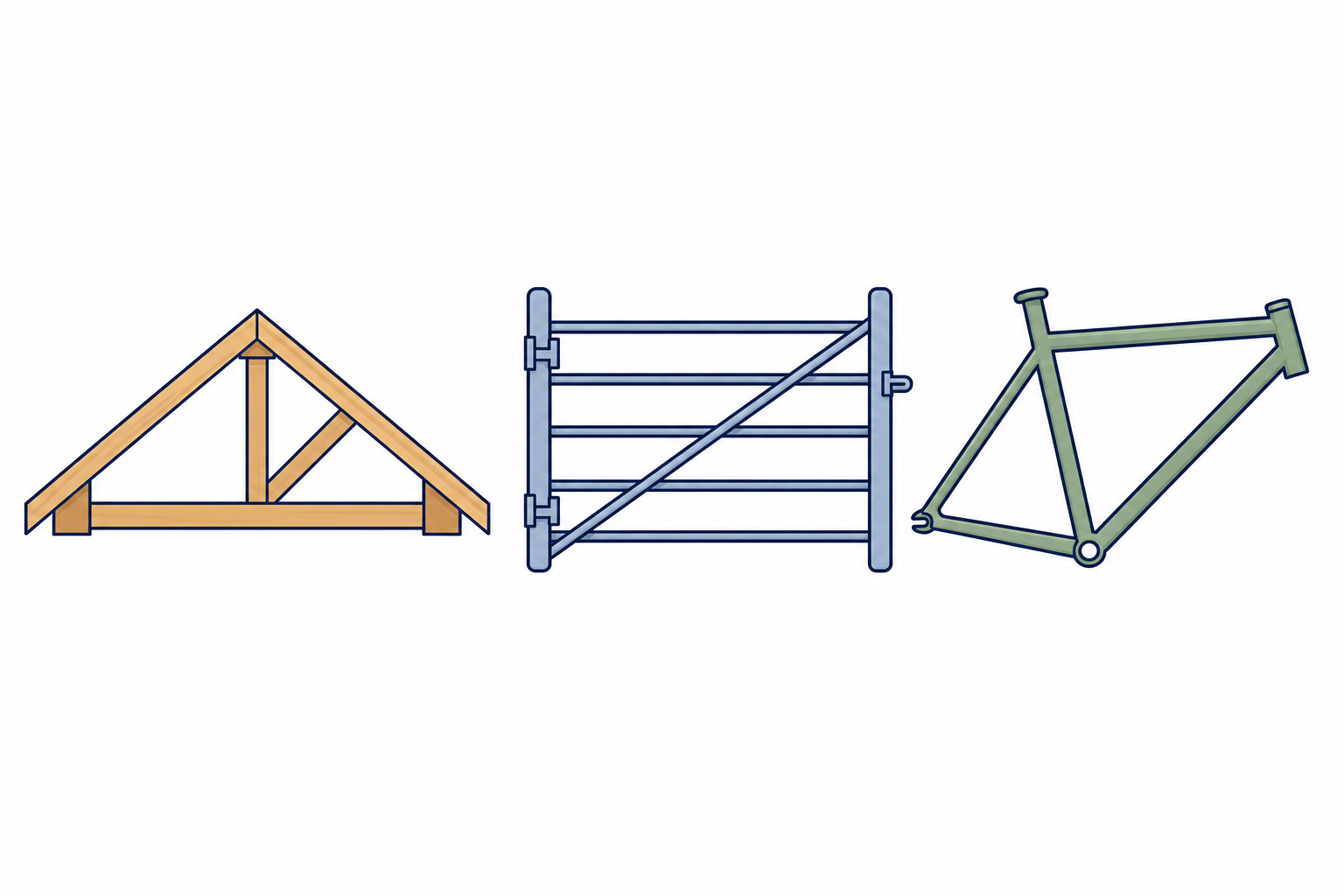
Nature of STEM weave, lightly: bracing shows up everywhere once you look — Irish farm gates, roof trusses, bike frames, pylons.
On your Investigation Journal page, record what happened to each shape.
For the square, the triangle, and the braced square, note: did it move, and what the extra strip changed.
Pupils record on the Investigation Journal page. Keep the language concrete: shape, did it move, what the brace changed. Do not invent named boxes or columns beyond what the journal type supports.
Sentence starters if needed: The square… The triangle… When we added the brace…
Quick check as you circulate: every group should have tested all three conditions before writing.
A structure is something built to hold its shape and do a job, like a gate, a roof or a bike.
Look at the photograph cards and think about places around our school. Where can you spot triangles that are doing a real job holding something up?
Sort each find into the three job groups on the board: Roof or frame · Gate or fence · Machine.
Introduce structure here, tied to the photo cards, not earlier.
| Concept | Why it matters | Example |
|---|---|---|
| Structure — something built to hold its shape and do a job | Once you know which shapes hold, you can spot the same idea in real Irish buildings and machines | A farm gate, a bike frame, a pylon, or the roof trusses above the classroom |
Write these short labels on the reverse so you can check answers. Front of each card is the photo only (no text in the image).
Put the three short job labels on the board for groups to glance at while sorting: Roof or frame · Gate or fence · Machine. Avoid long multi-clause category names. Use plain talk such as "stopping a gate leaning" rather than "stiffening".
After sorting the cards, take a two-minute look from the classroom doorway or corridor window for one real triangle in the school (roof edge, gate, shelf bracket). Stay inside if weather or supervision makes outdoor walking awkward.
Sorting talk: the point is the job the triangle does, not the material. Ask: what would happen to this structure if that triangle were a loose square instead?
Display-only close of this beat: groups call out one find and which job group they put it in. No typed reflection.
You're previewing this lesson. Get full access to this lesson and hundreds more — each one ready to teach, with interactive activities, printable resources and pupil progress tracking built in.