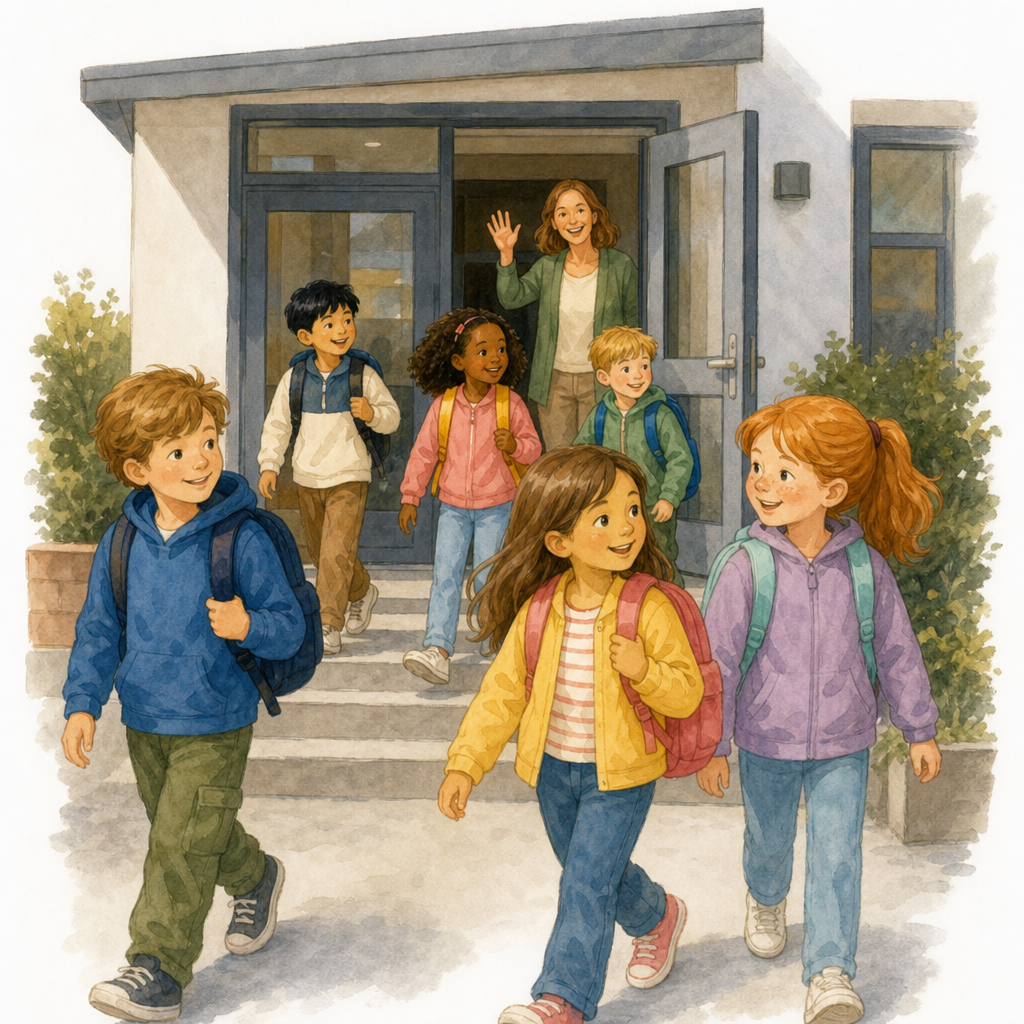
You already know how to start a chat in German. Greet your teacher now, using a hello you already know.
Nice one. Now how do you finish the chat and walk away? Today we fix that gap.
Invite the whole class to greet you with a German hello they already know (for example Guten Tag, goot-en TAHK, or Hallo, HAH-loh). Accept the greeting warmly, then freeze and ask how they would end the exchange. Do not supply the answer yet; the gap is the hook.
Keep this beat light and quick. Two or three pupil attempts at a goodbye in English are enough before you move on. The board work for this lesson runs to about 47 minutes; the last quarter of an hour is the Activity Book page at their desks.
Here are today's German goodbyes, one card at a time. You will see the English and hear the German first. Join in and say it with the class, then the card flips to show the spelling.
Listen for the chooss sound in Tschüss and the long -zay-en ending on Auf Wiedersehen. In Gute Nacht, notice the soft kh at the end of Nacht.
Run this on the IWB with the whole class. For each card: show the English, play the audio, lead a choral repeat (once all together, once by table), then flip to reveal the German spelling. Never ask pupils to guess the German before they have heard the model.
Two-pass teaching (keeps load manageable): First pass, five core items only: Tschüss, Auf Wiedersehen, Bis bald, Bis morgen, Gute Nacht. Second quick pass (about two minutes): Bis später, Bis gleich, Schönen Tag noch. Lean on the card audio for every item; the cards carry spelling and sound.
Register / use tags (say these aloud as each card lands; do not draw a board sort here):
Culture point only (about 30 seconds): In German-speaking places, children often say Tschüss to friends but switch to Auf Wiedersehen when they leave a teacher or another adult. The goodbye itself can show how close you are. Read those two words aloud once more, then move on. The full Friend / Adult / Either sort is the thumbs game at the end of the next step, so leave the columns for then.
We take turns at the board. When a card flips, everyone says the German together quietly from their seats. Volunteers come up to find each German goodbye with its English meaning.
Whole-class turns on the IWB: one or two volunteers per match, the rest of the class listening and ready to help with a quiet choral say on every flip. Keep the volume up so audio leads the room.
If the same pair is missed twice, pause, replay the audio, say the German together, then continue. Watch for pupils mixing Tschüss (chooss) with Auf Wiedersehen (owf VEE-der-zay-en); a quick friend-versus-adult reminder settles it.
Two-minute wrap before you leave this step (main Friend / Adult / Either sort): whole-class thumbs game. You call out each goodbye once. Pupils show: thumbs up = friend, arms folded = adult, flat hand wave = either / time-based / situational. Cycle all eight so every item is heard and sorted, not only matched. Correct gently using the tags from step 2. This sort is what later copy and pair work lean on, so do not skip it.
The goodbye list stays on the board while you write. Open your copy and write:
Take care with the umlauts in Tschüss (ü) and später (ä).
Pause the board. Keep the full goodbye list clearly visible for the whole three minutes so pupils copy spellings, not invent them. Everyone writes; this is the only stretch where every pupil's pen is moving.
Walk the room and check: each copy has the two register labels on Tschüss and Auf Wiedersehen, plus one Bis… line with a when-note. Do not ask them to force friend/adult onto time-based or bedtime phrases. Do not collect the copies.
You are leaving your classroom in Hamburg. Turn to the person beside you.
The board shows the frame:
Round 1: say goodbye as classmates (try a friendly one). Round 2: one of you is the teacher at the door (use a careful adult goodbye). Anchors on the board: friend = Tschüss · adult = Auf Wiedersehen · time-based Bis… options work with either.
Pin the dialogue frame and the two colour-coded goodbye lists (Friend: Tschüss; Adult: Auf Wiedersehen; Either / time: the Bis… set plus Schönen Tag noch and Gute Nacht for evening) on the IWB for the whole activity. Assign partners as the person beside them so nobody is left hunting.
Model one full exchange with a volunteer before pairs begin. Example: Partner A: Hallo! (HAH-loh). Partner B: Guten Tag! (goot-en TAHK). Partner A: Tschüss! (chooss). Partner B: Bis bald! (biss BAHLT). Then model a careful classroom-door version ending with Auf Wiedersehen (owf VEE-der-zay-en).
Circulate and listen for the ending more than the opening. Prompt anyone who freezes with the two anchors, and remind them a time-based Bis… works with either partner. After about five minutes, call a clean stop and hear two pairs share one exchange each. After the first shared pair, name one thing that sounded strong (for example a crisp Tschüss) and give a five-second class cheer.
You're previewing this lesson. Get full access to this lesson and hundreds more — each one ready to teach, with interactive activities, printable resources and pupil progress tracking built in.