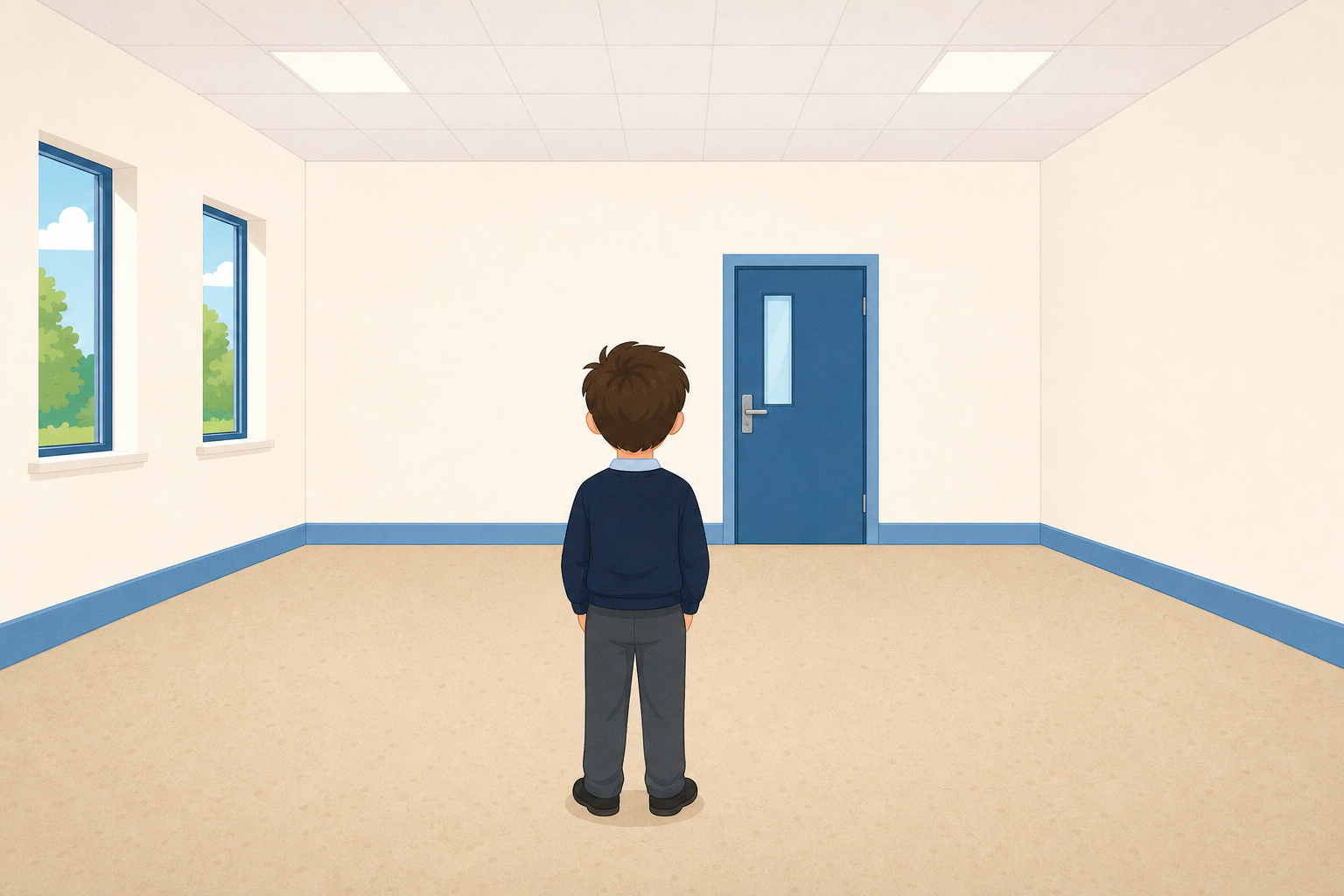
Stand up and face the front of the room. Without moving your feet, we will turn together and name each stop.
First we turn clockwise (to the right): one quarter turn, then another to make a half turn, then one more to make a three-quarter turn, then one last quarter to face the front again. Before each stop, say where you think you will be facing.
Now face the front again. This time we turn anticlockwise (to the left) the same way: quarter, half, three-quarter, then full turn back to the front. Notice that a half turn still leaves you facing the opposite wall, whichever way you turn.
Whole-class body movement, everyone standing. Work one full example end to end before sitting.
Clockwise worked demo (face front = start): quarter right → side wall; second quarter → half turn, back wall (opposite); third quarter → three-quarter, other side wall; fourth quarter → full turn, front again. Count aloud: 1, 2, 3, 4 quarters.
Anticlockwise worked demo (reset to front): same four stops but to the left. Stress half turn = opposite wall both ways; three-quarter anticlockwise lands on the wall that quarter clockwise used.
Slip to watch: pupils spinning the wrong way or calling a three-quarter a half. Hold the class to one direction at a time. Quick hands-up on “where after a half turn?” then sit.
Watch the arrow on the screen. It starts pointing up. Each time it turns a quarter, it moves the size of one square corner: first it points right, then down, then left, then back to the start.
Now watch a square turn. A square looks the same after every single quarter turn, because a quarter turn is exactly the size of a square corner.
Alongside the screen, use the two joined card strips as your real turning arm. Open them a quarter turn and lay your paper right-angle corner into the opening so the class sees a quarter turn is a square-corner turn. Then open a half turn (a straight line, two corners) and a three-quarter turn (three corners). Keep saying the direction: clockwise.
The point to draw out on the square: because a quarter turn is exactly a square-corner turn, the square looks the same after every quarter turn. Hold your paper corner against the screen as each quarter turn lands.
Today we work through these turns together on the shape on the screen. First give it a quarter turn clockwise. Then turn again to make a half turn. Then turn once more for a three-quarter turn. Then one last turn brings it all the way back to the start. Before each one, say where you think the shape will end up.
Talk this one through together — pupils take turns at the board and the class agrees or corrects out loud.
Advance the arrow a quarter turn each time and have the class read its new direction aloud and name the turn so far: after one quarter it points right; two quarters make a half and it points down; three quarters make three-quarters and it points left; four quarters bring it back to the start. If the on-screen control does not stop and hold cleanly at each quarter, use your card arm alongside the screen to fix each named position. Keep a real clock face beside you so you can point to the minute hand swinging from 12 to 3 (quarter), to 6 (half), to 9 (three-quarter).
Rotate four pupils across the four turns. Watch for pupils turning anticlockwise — hold the whole class to clockwise so the counting stays consistent.
In your maths copy, draw an arrow pointing up. Then draw the same arrow three more times beside it: after a quarter turn, after a half turn, and after a three-quarter turn, all turning clockwise. Label each one.
Walk the room glancing at the arrow directions — a quarter turn clockwise should point right, a half turn down, a three-quarter turn left. No marking, this is whole-class copybook practice.
Now let's name the turns together. The arrow starts pointing up. We turn it clockwise and stop, then say which turn moved it there: a quarter turn, a half turn, a three-quarter turn or a full turn. Say your answer before we look at where it ends up.
This is the practice round — pupils take turns at the board, turn the arrow and name the turn, and the class confirms before moving on. Keep it brisk rather than over-explaining.
Anchor everything on the quarter turn = square corner idea: a quarter turn points the arrow right, a half turn points it down (the opposite way), a three-quarter turn points it left, and a full turn brings it back to the start. Advance the arrow with the on-screen control (or your card arm alongside if the control does not hold cleanly); ask pupils to name the turn before you stop and reveal the direction. Work through the four on-screen prompts in order so every named turn gets a turn.
You're previewing this lesson. Get full access to this lesson and hundreds more — each one ready to teach, with interactive activities, printable resources and pupil progress tracking built in.