1 - Start ~4 mins
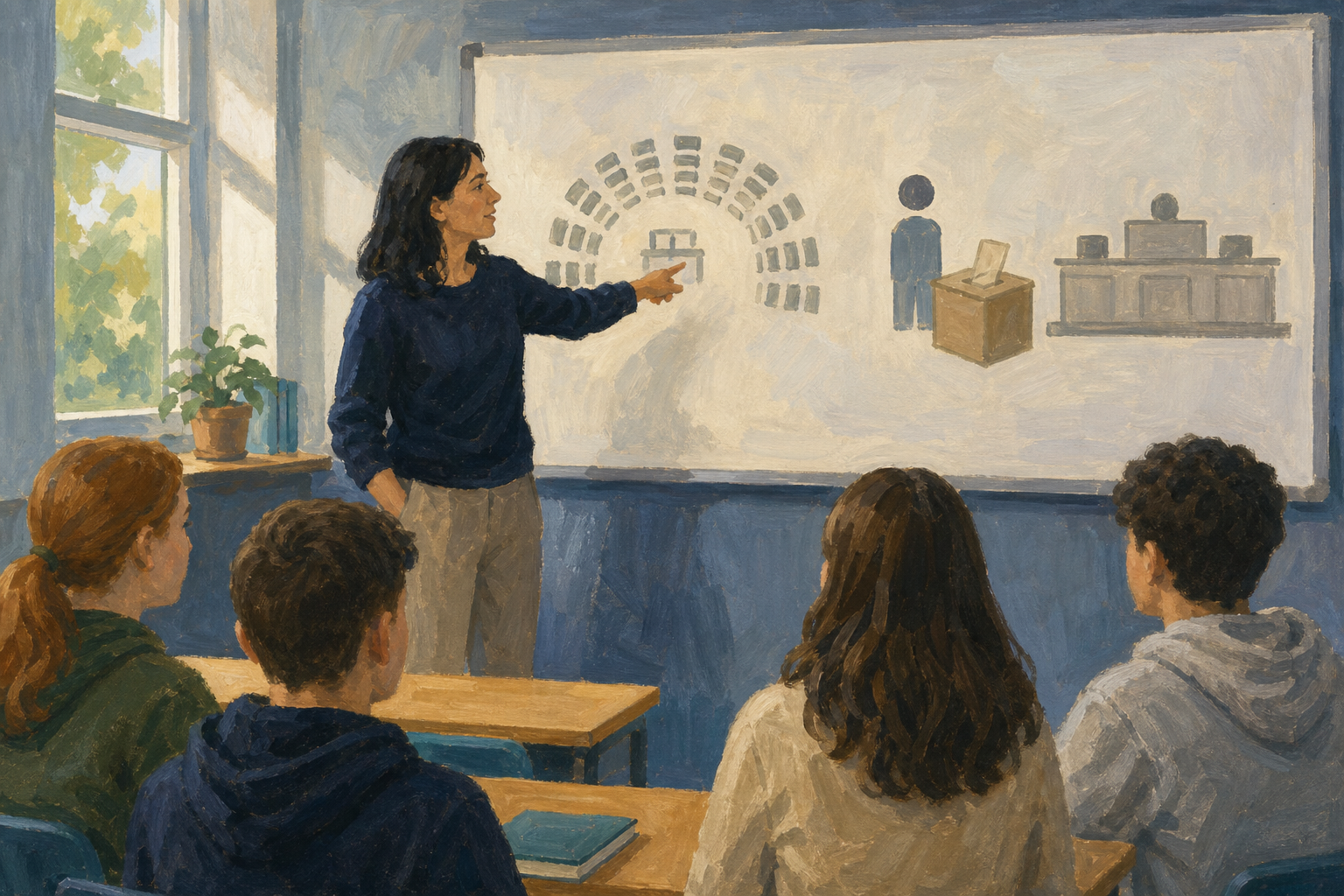 Today the class puts two real ways of organising government side by side: a parliamentary system, like Ireland’s, and a presidential system, like that of the United States.
The job is not to pick a favourite country. It is to notice how a government is formed, how it can be removed, and what a citizen can actually do between elections under each. Those differences change how people shape their state.
2 - Two Ways to Organise Power ~9 mins
In a parliamentary system such as Ireland’s, voters elect TDs to the Dáil. The Dáil nominates the Taoiseach, the President appoints them, and the Taoiseach forms a government. That government stays only while it holds the Dáil’s confidence. Day-to-day power sits with the Taoiseach and cabinet; the President is head of state, not the everyday boss of government.
In a presidential system such as that of the United States, voters elect the President on a separate ballot from the legislature (Congress). The President is both head of state and head of government, chooses the cabinet, and serves a fixed term. Congress is elected separately, and the President does not need a day-to-day confidence vote in Congress to stay in office.
Three questions matter for each system: who is elected, who forms the government, and how it can be removed. Check one contrast in your own words before the cards open: confidence vote versus fixed term. The cards carry the rest of the detail so you can see the trade-offs row by row.
3 - Compare the Two Systems ~19 mins
On the cards below, first mark the formation row together as a class so everyone shares the same starting picture.
Then work the remaining rows in pairs, one at a time across both cards: how a government can be removed, who leads day to day, what a citizen can do between elections, and how the legislature and executive relate. For each row, start with a real example of what it means for an ordinary citizen.
You may mark which design looks stronger on a single row. That is a judgement about that row only. There is no overall winner, because these systems organise power differently rather than doing one job better.
In the last three minutes, every pair writes one line on what each system makes easy for citizens who want to shape their state, and one line on what each makes hard. Keep those lines ready for the next step.
Two systems of government
4 - What Each Makes Easy and Hard ~5 mins
Talk these through as a class. Use the lines you wrote at the end of the comparison. There is nothing to type or save.
1. What does the parliamentary system make easier for citizens who want to shape their state, and what does it make harder?
2. What does the presidential system make easier, and what does it make harder?
3. Looking only at the time between full elections, where does a citizen have more routine ways to influence the people in power under each design?
Stay with trade-offs you can point to on the cards. A fair comparison names a strength on each side.
5 - What You Covered ~3 mins
You compared two systems of government on the same questions: how a government is formed, how it can be removed, who leads day to day, what citizens can do between elections, and how the legislature and executive relate.
You used Ireland as a parliamentary example and the United States as a presidential example, and you practised naming what each design makes easy and hard for citizens who want to shape their state, without crowning a winner.
Unlock the full learning experience
You're previewing this lesson. Get full access to this lesson and hundreds more — each one ready to teach, with interactive activities, printable resources and pupil progress tracking built in.
This lesson is copyright of Coding Ireland 2017 - 2026. Unauthorised use, copying or distribution is not allowed.