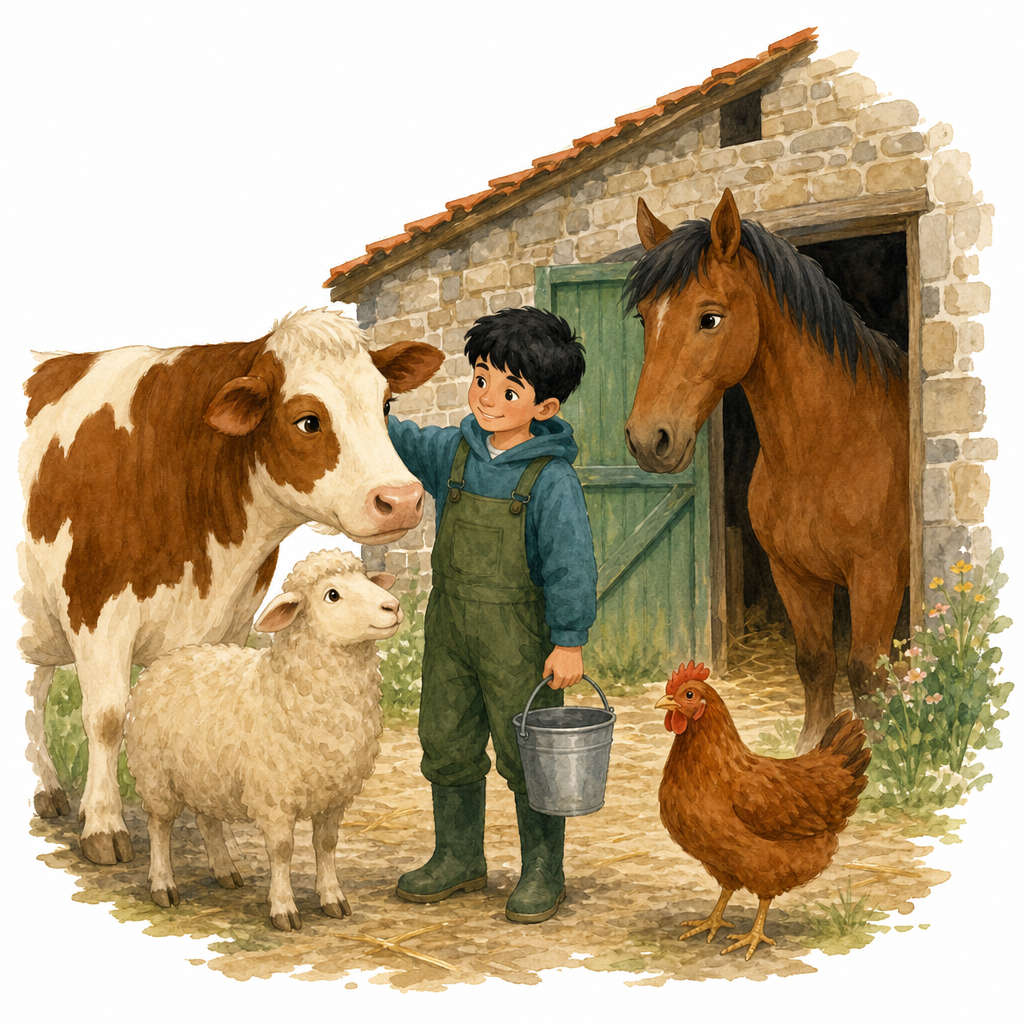
 Imagine walking into a small granja in rural Andalucía: stone barn, dry heat, bells on the goats. Which of these animals have you actually stood beside: a cow, a sheep, a horse, a pig? Hands up for each one.
Today we learn eight farm animals in Spanish, so you can name the ones you know and the ones you have only seen in a book. We will also talk about why people choose animals as symbols.
By the end of this lesson, you will be able to:
- Name eight farm animals in Spanish with el or la
- Spot those words by ear in a game of bingo
- Say a farm animal aloud when the wheel lands on it
- Talk about why people use animals as symbols
Here are today's eight farm animals, one card at a time. You will see the English first. Try to say the Spanish before you flip, then listen and say it back together. Keep el or la with every word.
When we meet el burro, roll the rr if you can: it sounds like a little motor.
Everyone gets a bingo card. Listen carefully. When you hear a farm animal, mark it on your card. Say the Spanish quietly to yourself as you mark each one.
When every animal on your card is marked, call out Bingo! and read your animals back in Spanish.
Open your copy. The eight animals are still on the board: copy four of them with el or la. Beside each one, sketch the animal.
- el caballo — Horse
- la vaca — Cow
- el cerdo — Pig
- la oveja — Sheep
- la cabra — Goat
- la gallina — Hen
- el pato — Duck
- el burro — Donkey
The wheel lands on a farm animal. When it is your turn, say the Spanish word aloud with its article. Big brave voice: article plus animal. Mistakes welcome. Listen for your classmates and help if they get stuck.
Unlock the full learning experience
You're previewing this lesson. Get full access to this lesson and hundreds more — each one ready to teach, with interactive activities, printable resources and pupil progress tracking built in.
This lesson is copyright of Coding Ireland 2017 - 2026. Unauthorised use, copying or distribution is not allowed.