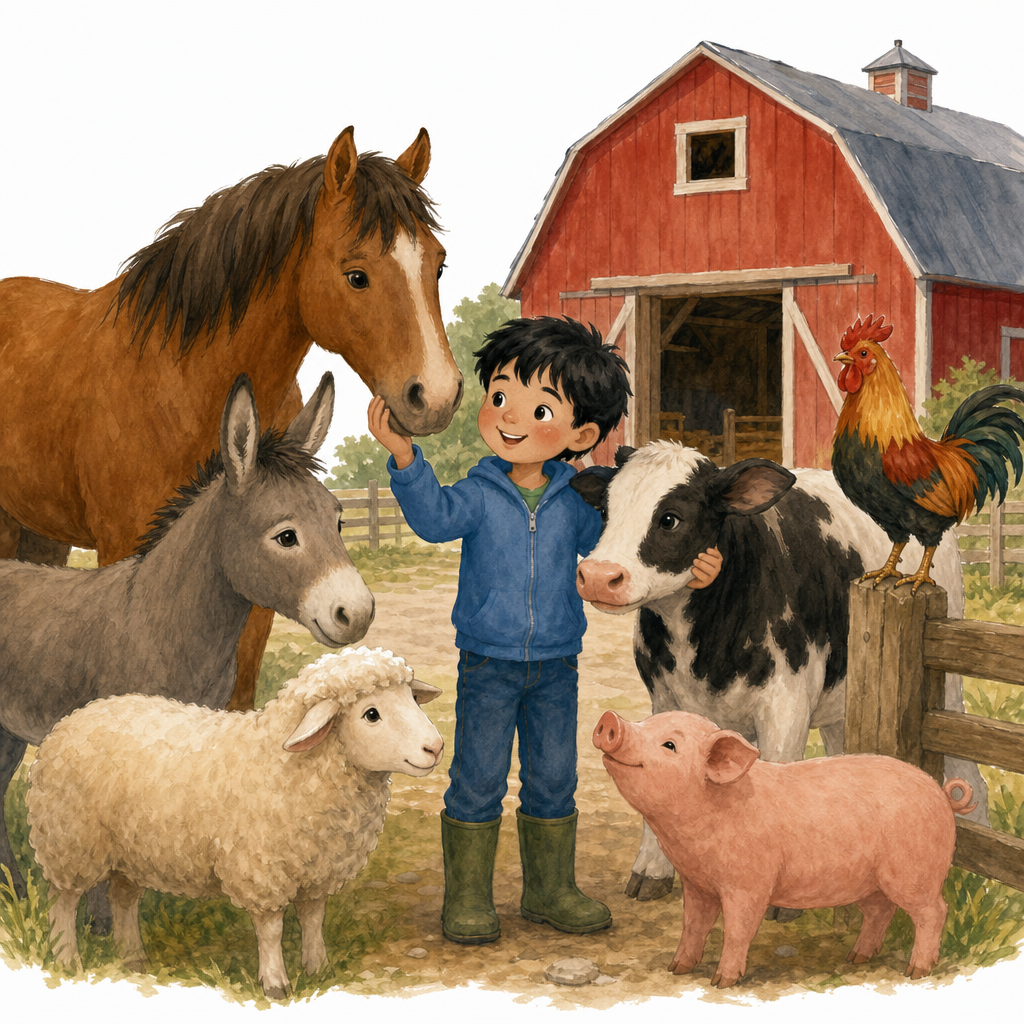
 Think of a farm. Which of these animals have you actually stood beside: a horse, a cow, a sheep, a pig? Hands up for each one.
Today we learn eight farm animals in French, so you can name them and spot them when you hear them.
By the end of this lesson, you will be able to:
- Name eight farm animals in French
- Recognise them when you hear them in a game
- Say each word aloud with confidence
Here are today's eight farm animals. See the English first, try the French, then flip to check. Listen carefully and say each word back together, article and all.
You each have a bingo card with farm-animal pictures. Listen for the French name (with le, la or l'). Cross off the matching picture if it is on your card. When every picture on your card is crossed off, stand and call Bingo!
Open your copy and write four farm animals with their articles (le, la or l'), copying carefully from the board.
- le cheval — Horse
- la vache — Cow
- le cochon — Pig
- le mouton — Sheep
- la chèvre — Goat
- l'âne — Donkey
- la dinde — Turkey
- le coq — Rooster
We are à la ferme (at the farm). The wheel lands on an animal. When it is your turn, say: À la ferme, il y a … and finish with the French word, article included.
Unlock the full learning experience
You're previewing this lesson. Get full access to this lesson and hundreds more — each one ready to teach, with interactive activities, printable resources and pupil progress tracking built in.
This lesson is copyright of Coding Ireland 2017 - 2026. Unauthorised use, copying or distribution is not allowed.