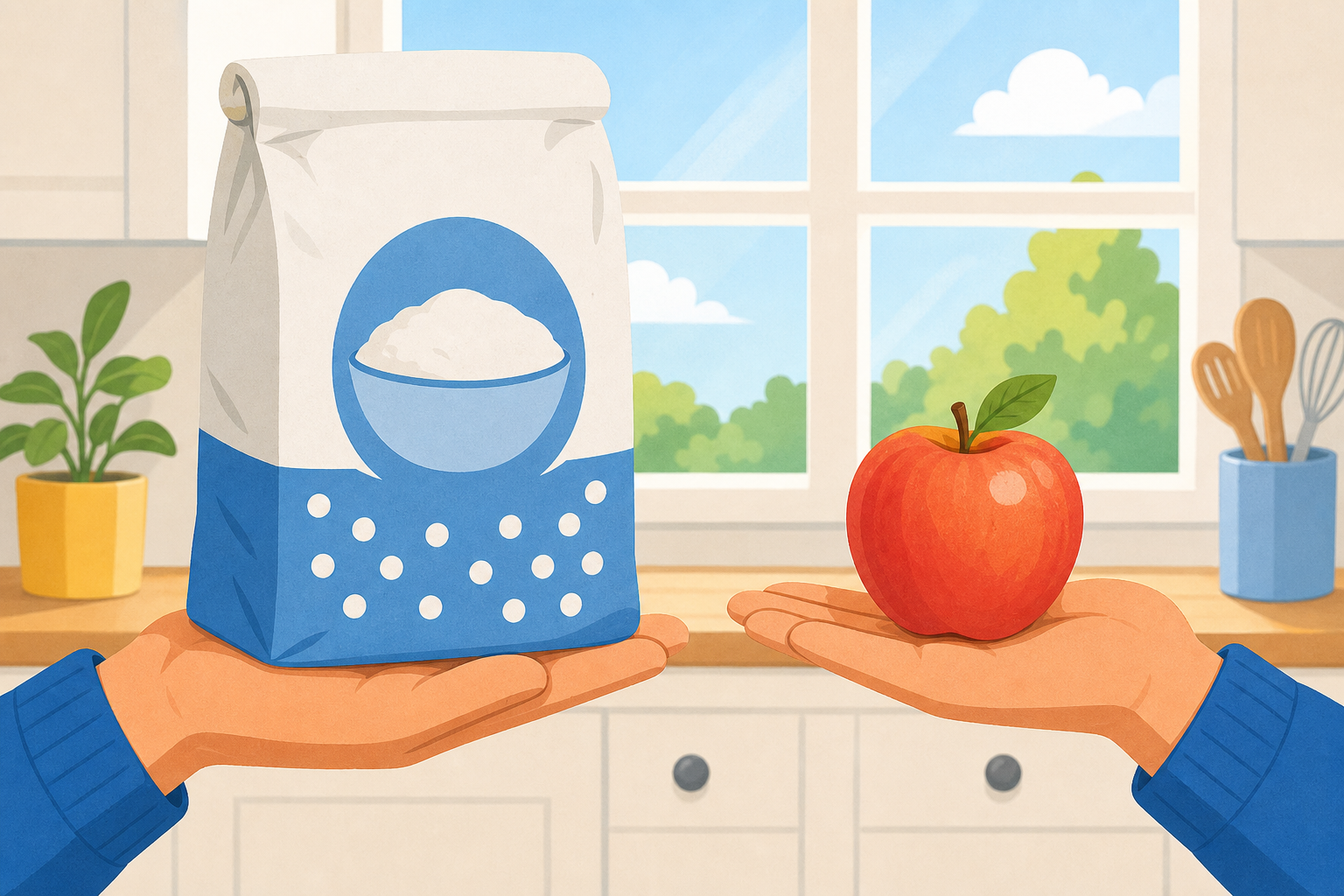
I am holding a bag of sugar in one hand and an apple in the other. One of them is a kilogram and one is only a couple of hundred grams. Just by lifting them, hands up: which one do you think is the kilogram, and how did your hand help you decide?
Hold up (or show a photo of) a bag of sugar and an apple. Take three hands-up answers, not open call-outs. Draw out the word heft — feeling the weight in your hand before any scale is used.
Watch the scale at the front as I weigh four things. First an apple: the needle settles near 200 g. A gram is our small unit, so light things are counted in grams. Predict before the next one: is a bag of pasta heavier or lighter than the apple?
Now the bag of pasta reads 500 g. Notice the needle points exactly at a marked line, so we read it straight off. Now the bag of sugar tips right over to 1 kg, our big unit, and it is the same as 1,000 grams.
Last of all the loaf. The needle does not sit on a big mark. It lands between two of them, so we count the small divisions to read it.
So the loaf weighs 750 g. Whenever the needle lands between marks, use this same four-step count.
Demonstrate with a real scale at the front, holding each object up before you place it on. Read the needle aloud each time: 200, then 500, then 1 kilogram, then work the loaf fully.
Now we weigh together at your tables. We weigh these four items in this order: a rubber first, then a full pencil case, then a hardback book, then a schoolbag. Before each one goes on the scale, we say our estimate out loud, choosing grams or kilograms, and then we read the scale and see how close we were. Write each estimate and reading on your Weighing Record Sheet as you go.
Pupils measure at their desks with their own scales; circulate and catch alignment slips on the spot. The class reads aloud and you reconcile any disagreement as you circulate.
In your maths copy, write four classroom items, one under the other. Beside each one write your estimate and the weighed reading from your Weighing Record Sheet, choosing grams (g) or kilograms (kg).
Walk the room glancing at whether pupils chose a sensible unit for each item; no marking, this is whole-class copybook practice. A common slip is writing kg for the rubber; prompt heavy or light?
Now it's time to compare and put weights in order. A fresh set of objects will come round the room: a small water bottle, a tin of beans, a bag of oranges and a big dictionary.
Weigh each one, then order all four from lightest to heaviest on your Weighing Record Sheet. Some of these weigh less than a kilogram and some weigh more, so watch your units carefully, and mark which ones cross the 1 kg line.
For a stretch, find something on your desk that weighs about half a kilogram, that is 500 g, half of our 1 kg bag of sugar.
Organisation: each group keeps its own scale and the objects circulate. Have one of each object and pass them from group to group in the same order, so every group weighs the water bottle first, the tin next, then the oranges, then the dictionary. Keep the pass-on rhythm brisk; the class confirms each reading aloud at the end.
You're previewing this lesson. Get full access to this lesson and hundreds more — each one ready to teach, with interactive activities, printable resources and pupil progress tracking built in.