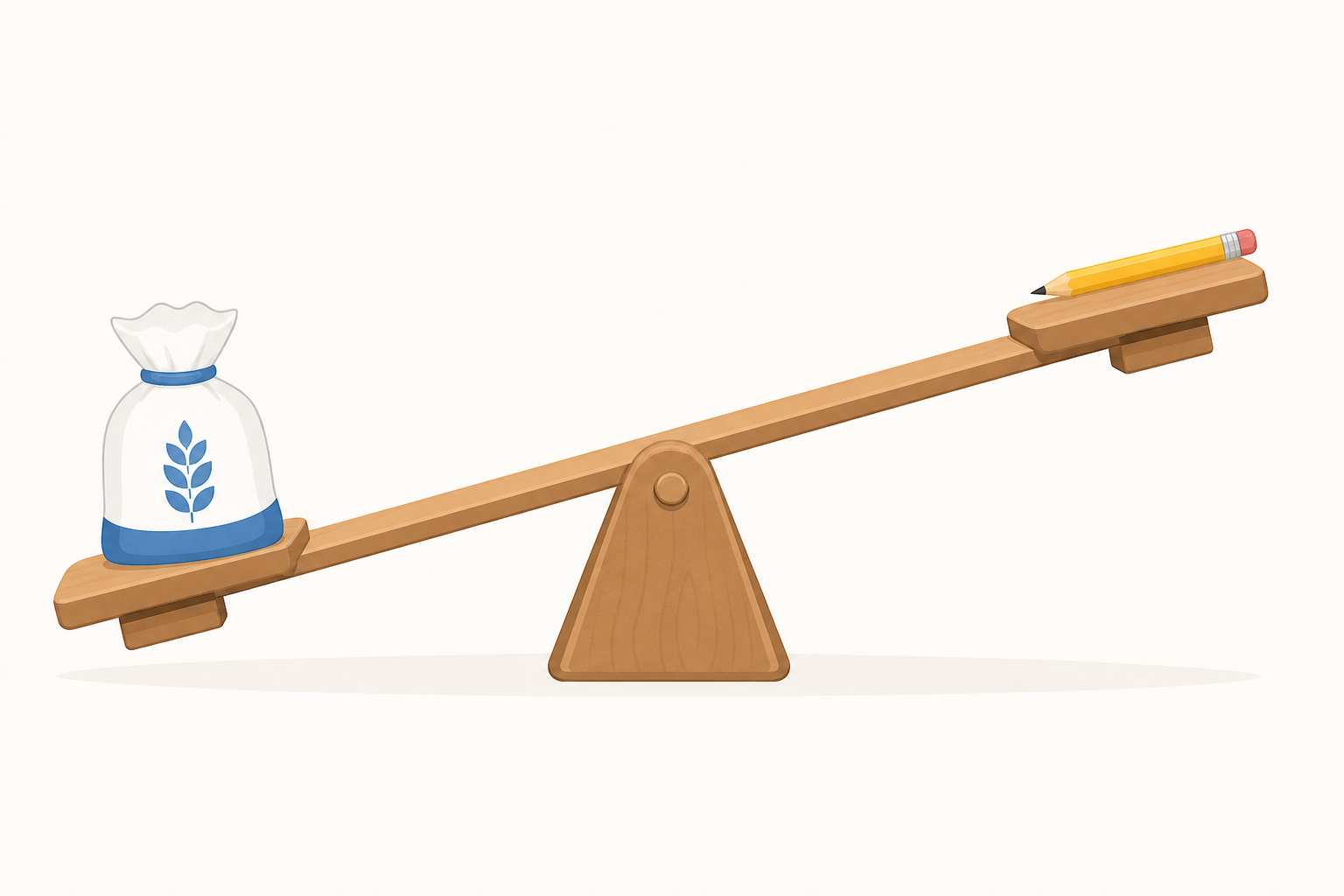
Hold out both hands like a see-saw. If a bag of sugar sat in one hand and a pencil in the other, which hand would drop down? And here is the tricky one: is a bag of sugar more than one kilogram, less, or exactly one?
Hold up a real bag of sugar and a pencil, one in each hand, as you ask this. Take three hands-up answers, not open call-outs. Let the guess about "exactly one kilogram" sit unanswered — the scales will settle it.
Four weights on the dial, from lightest to heaviest. Look at where the needle points each time, and notice how far round it has moved as the weight gets heavier. When the needle reaches the very top mark, that is one whole kilogram: 1 kg = 1000 g.
Point to each needle position and say the weight aloud. On the 1 kg dial, hold out for the class to notice the top mark is 1000 g — that is the whole lesson: a thousand grams make one kilogram.
On the 250 g and 750 g dials, ask a pupil to read where the needle sits before you confirm. Is that nearer half a kilogram or nearer a whole one?
Today we weigh real things. Your group uses its own scales for this. We will feel each one in our hands first and guess, then set it on the scales to check: an apple, a copybook, a lunchbox, and a bottle of water. Feel before you read the dial each time.
Pupils measure at their desks with their group's scales — circulate and catch alignment slips on the spot. The class reads aloud and you reconcile any disagreement as you circulate.
Insist on a hand-estimate before the reading every time — the felt weight is what teaches grams vs kilograms. Watch for pupils reading the needle from the side; get eyes square over the dial. Is this a grams thing or a kilograms thing?
In your maths copy, write 1 kg = 1000 g at the top. Then list four objects. For each one, write your hand-estimate in grams or kilograms first, then the scale reading beside it.
Walk the room and glance that the estimate is written before the reading — no marking, this is whole-class copybook practice. Check the 1 kg = 1000 g line went in correctly at the top.
Set out four station objects around the room, one for each group to start at: a rubber, a full pencil case, a library book, and a one-litre bottle of water. Feel your object, guess grams or kilograms, then weigh it at your group's scales and write the reading. When you hear the signal, every group moves on to the next station. As a stretch, put all four in order from lightest to heaviest by their weights.
This is the practice round, run as a station rotation — four station objects, groups start one at each and rotate on your signal, weighing at their own scales each time. Keep the rotation brisk so every group weighs all four; the class confirms each reading aloud at the end.
The rubber lands in grams, the water bottle around a kilogram — this is where grams-vs-kilograms clicks. For the ordering stretch, ask what they compared: the number, or the unit first. Which is heaviest, and how did you know before you weighed it?
You're previewing this lesson. Get full access to this lesson and hundreds more — each one ready to teach, with interactive activities, printable resources and pupil progress tracking built in.