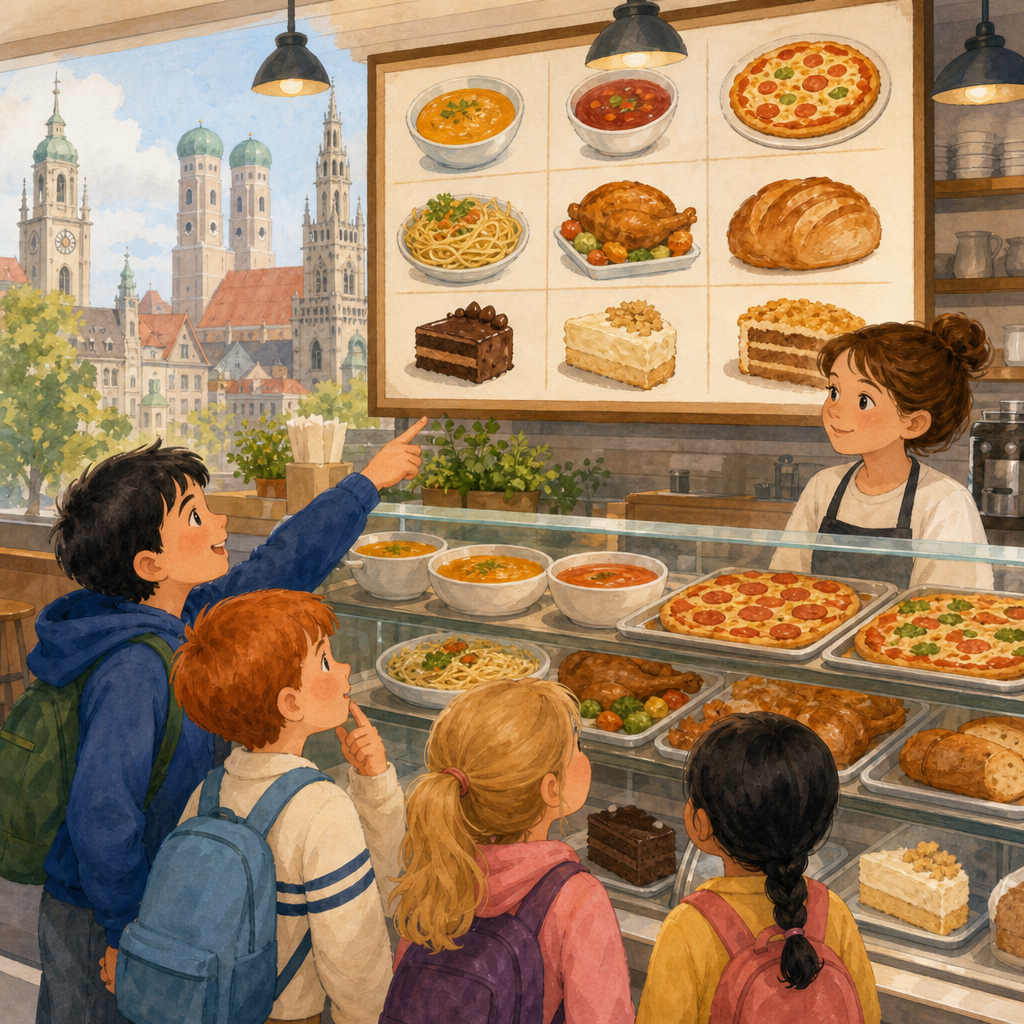
Imagine you are standing in a busy café in Munich and the board is only in German. What would you order if you could not read a word?
Think of two foods you would point at, and keep them in mind. By the end of today you will know eight German food words and hear a real café-style order.
Title tip if you say it aloud: das Essen (dahs ESS-en) means food or the meal. Take three or four quick ideas from the class about what they would order by pointing. Do not translate yet; the word-table in the next step will give them the German. Keep the energy light: the point is curiosity about food words, not a full brainstorm. You might hear someone guess a sausage or a cake already. Smile and park it; they will meet the real words next.
Your teacher will play each food word on the board. Listen, then say it back together twice. Watch which ones take der, die or das: you learn the article as part of the word.
You will meet the first four foods, say them back, then meet the next four. After each group there is a quick challenge: your teacher points or says the English, and you call the German with its article.
Run the word-table on the IWB in two passes of four so later words do not wipe out earlier ones. After the first four, spend about two minutes on a bridge beat: point at the picture or say the English, and the class calls back the German with der, die or das. Then reveal the second four, choral-repeat twice (whole class, then by table), and run the same bridge again.
Let the interactive carry the words and audio. Point at the article every time so the pair sticks. Notice the capital letter on every German noun.
At-a-glance pronunciation sheet (say each with the article):
Warm coaching: say each one like you mean it. Keep articles glued to the nouns every time.
Someone is ordering food in a German café. Keep today's food words visible on the board as your checklist. Listen to the whole order twice before anyone answers. Tick or raise a finger whenever you hear one of today's foods. Then choose the best answer for each question.
Teacher Transcript Pack (authoritative for this lesson)
Teach listening from this pack. A non-specialist can deliver the whole step from these notes alone, with no need to reverse-engineer the platform clip.
Script (read aloud at natural café speed, twice; class speakers optional):
Guten Tag. Ich möchte die Suppe und das Brot, bitte. Auch ein Stück vom Kuchen. Danke.
Sense for you only: Hello. I would like the soup and the bread, please. Also a piece of the cake. Thank you.
Foods from today's eight that are heard: die Suppe, das Brot, der Kuchen (the other five board foods do not appear).
Closed questions and answers (ask only after the second reading; pupils may answer in German or English):
In class (always):
Optional platform extra (only if speakers work and you have 2 spare minutes): Open the listen-answer activity (ordering-food) and play the platform clip once for extra listening only. Do not score pupils on on-screen platform questions unless you previewed the clip and copied the platform's own correct feedback onto a sticky note. The Transcript Pack above already meets the learning objective; the clip is enrichment, not the answer key.
Prep (30 seconds): Read the script aloud once to yourself. No platform harvest required.
Open your copy and write the three foods from today you would most like to eat, with their articles, and one you would not.
Copy der / die / das, put a capital letter on the noun, and add the two dots on Käse if you choose it.
Pause the board. Everyone writes; this is the only three minutes where every pupil's pen is moving. Keep the word-table on screen while they copy. Check that each noun has der, die or das in front and a capital letter. Do not collect these.
We will label the meal together on the board. When it is your turn, say the German word with der, die or das, then place the label. Everyone else whispers the word from their seat.
Run this on the IWB with volunteers only. The teacher drives the board; pupils at desks stay involved by whispering each word as the label is placed, or by showing a quick thumb signal if they agree. If a label is wrong, say the correct word together with the article before moving on. Nice work if they keep der / die / das with every label: that is proper German.
You're previewing this lesson. Get full access to this lesson and hundreds more — each one ready to teach, with interactive activities, printable resources and pupil progress tracking built in.