1 - Getting Started ~3 mins
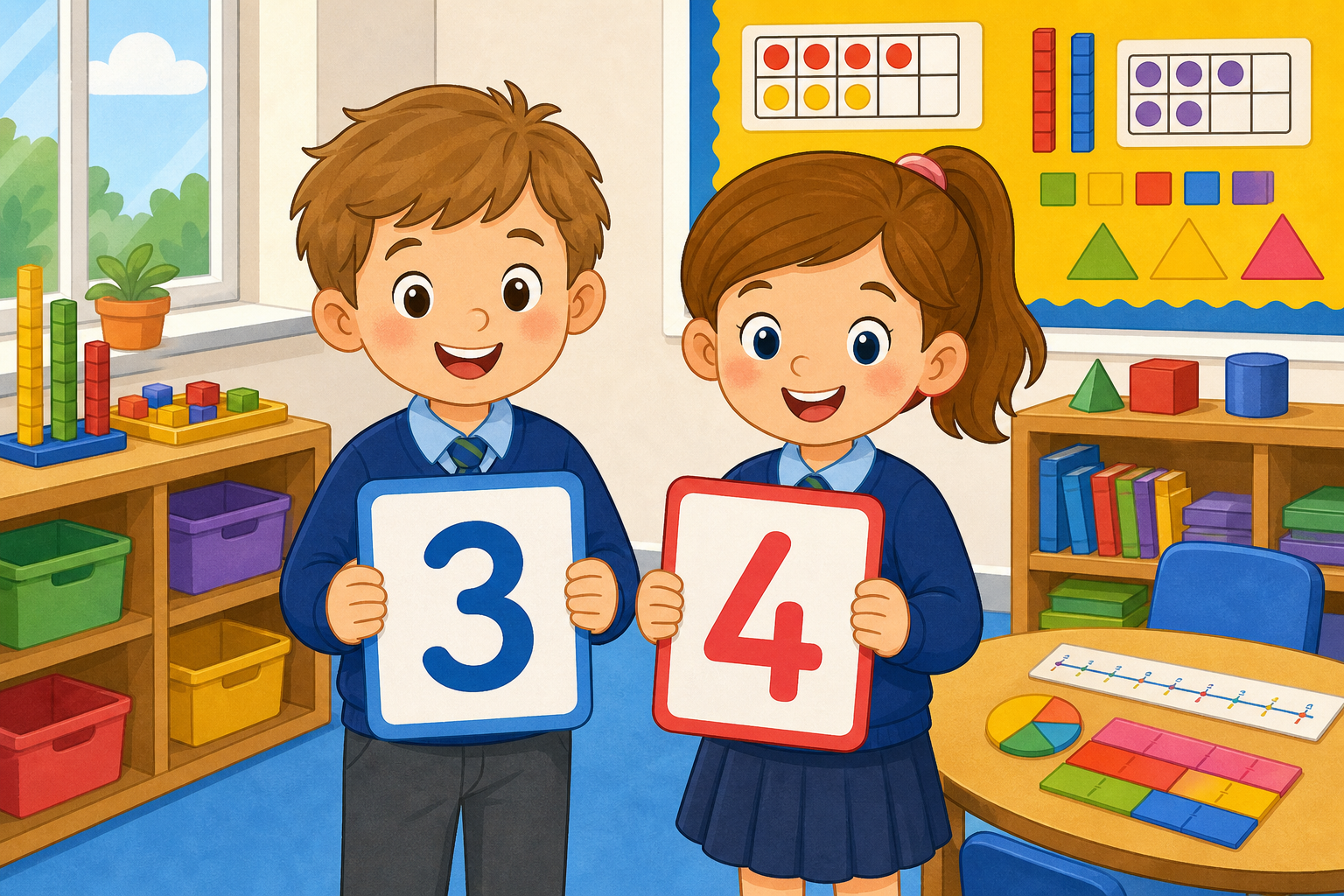 Two big digit cards are at the front of the room: a 3 and a 4. Two pupils hold them up to make a two-digit number. Then they swap places. Did the number change? Which number is more, and how do you know?
2 - Watch and Notice ~10 mins
Two numbers on the board, each built with tens rods and unit cubes. Look at how many tens rods each one has. That tells you which number is more.
The digit on the left is the tens digit. It tells how many tens rods. The digit on the right is the units digit. It tells how many loose cubes.
In 43 the 4 sits with the tens rods: it means four tens (40). In 34 the same 4 sits with the units: it means only four. Same digit, different place, different worth.
Same digits again, but swapped. Which number is more this time?
One last pair. Look at the tens digit: it decides which number is more.
3 - Try It Together ~8 mins
Build each pair on the place-value mat and say which is more. We will try 34 and 43, then 25 and 52, then 61 and 16. Look at the tens digit first every time: that is the digit on the left.
Build and compare
4 - Circle the Tens Digit in Your Copy ~2 mins
In your maths copy, write 34 and 43. Circle the tens digit in each: the digit on the left, which tells how many tens rods.
5 - Class Challenge ~8 mins
Build the bigger number of each pair. Check the tens digit first: the digit on the left tells how many tens rods.
21 and 12
35 and 53
79 and 97
Build the bigger number
Unlock the full learning experience
You're previewing this lesson. Get full access to this lesson and hundreds more — each one ready to teach, with interactive activities, printable resources and pupil progress tracking built in.
This lesson is copyright of Coding Ireland 2017 - 2026. Unauthorised use, copying or distribution is not allowed.