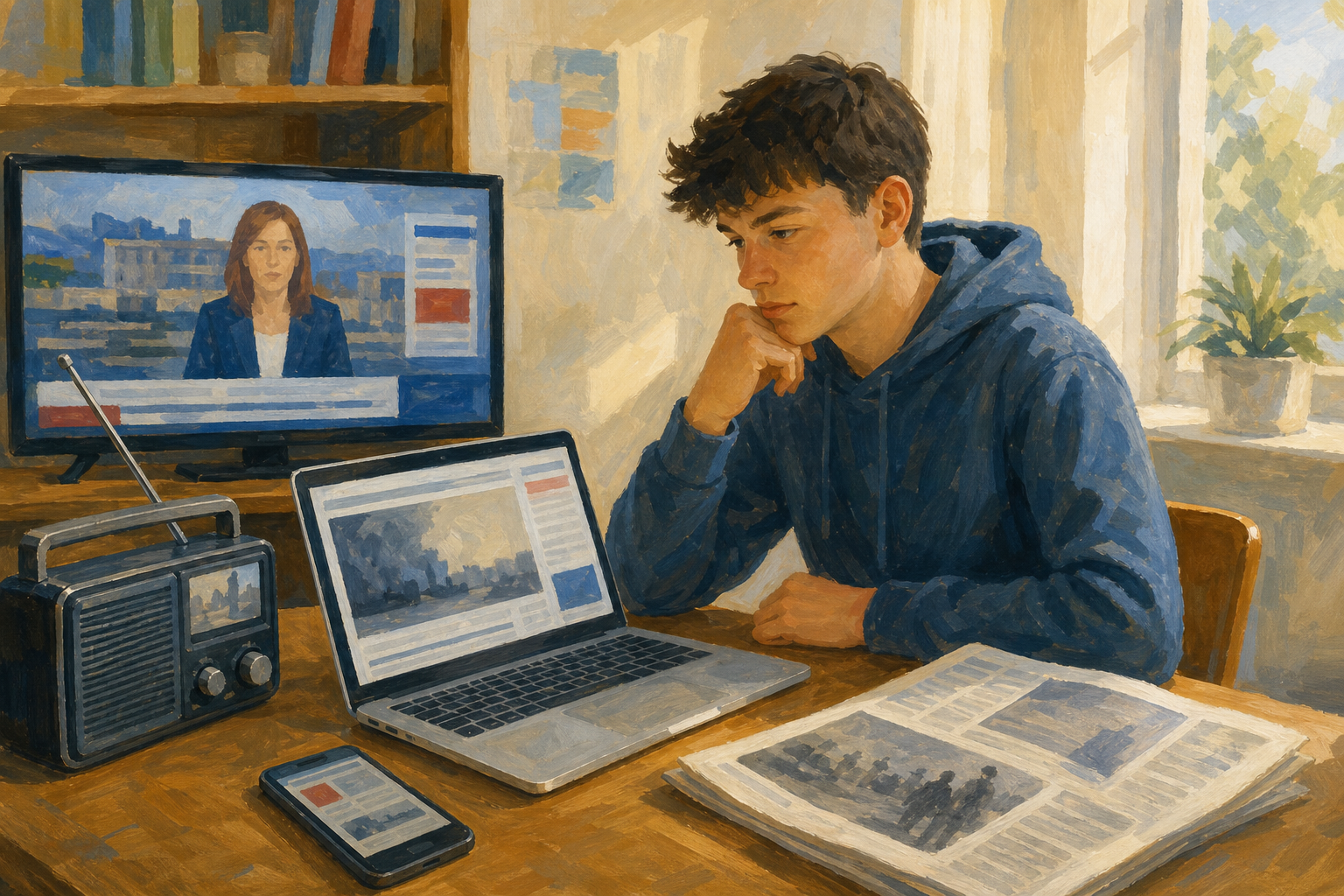
Three kinds of media matter for today. Broadcast news on television and radio. News organisations that run newspapers and news websites. Social media platforms, where almost anyone can post.
Quick pair check: which of the three do you guess is fastest, and which goes deepest? One sentence each, then hands down.
You will compare them on five rows: speed, depth of reporting, less reliant on ads aimed at you, accountability when something is wrong, and who can answer back.
Money shapes the news you get. Here is how each kind is usually paid for. Broadcast: a mix of advertising, a household licence fee for public services, or commercial owners. News organisations: cover price, subscriptions and advertising. Social media: usually free to open, paid for by advertising aimed at you. On the cards, stronger on that row means less reliant on ads that target the user.
None of these is simply better. Each is strong on some rows and weak on others. The cards are next.
Below, three cards sit side by side with the same five rows on each: speed, depth of reporting, less reliant on ads aimed at you, accountability when something is wrong, and who can answer back.
Work one row at a time and keep each row to about three minutes. Read all three values. Talk with the person beside you, then click the card you judge stronger on that row. On the ads row, stronger means less reliant on advertising aimed at you. There is no correct answer and no overall winner. The point is the trade-off.
If your teacher gives you a starting row, begin there, then move through the rest.
When every row has a pick, look at where your points landed and what that pattern says about each kind of media.
Comparing kinds of media
Talk with a partner, then be ready to share with the class:
Where did you last hear something you believed straight away?
Why that source, rather than another?
Listen for whether people trusted speed, a known name, or the chance to check for themselves.
Unlock the full learning experience
You're previewing this lesson. Get full access to this lesson and hundreds more — each one ready to teach, with interactive activities, printable resources and pupil progress tracking built in.
This lesson is copyright of Coding Ireland 2017 - 2026. Unauthorised use, copying or distribution is not allowed.