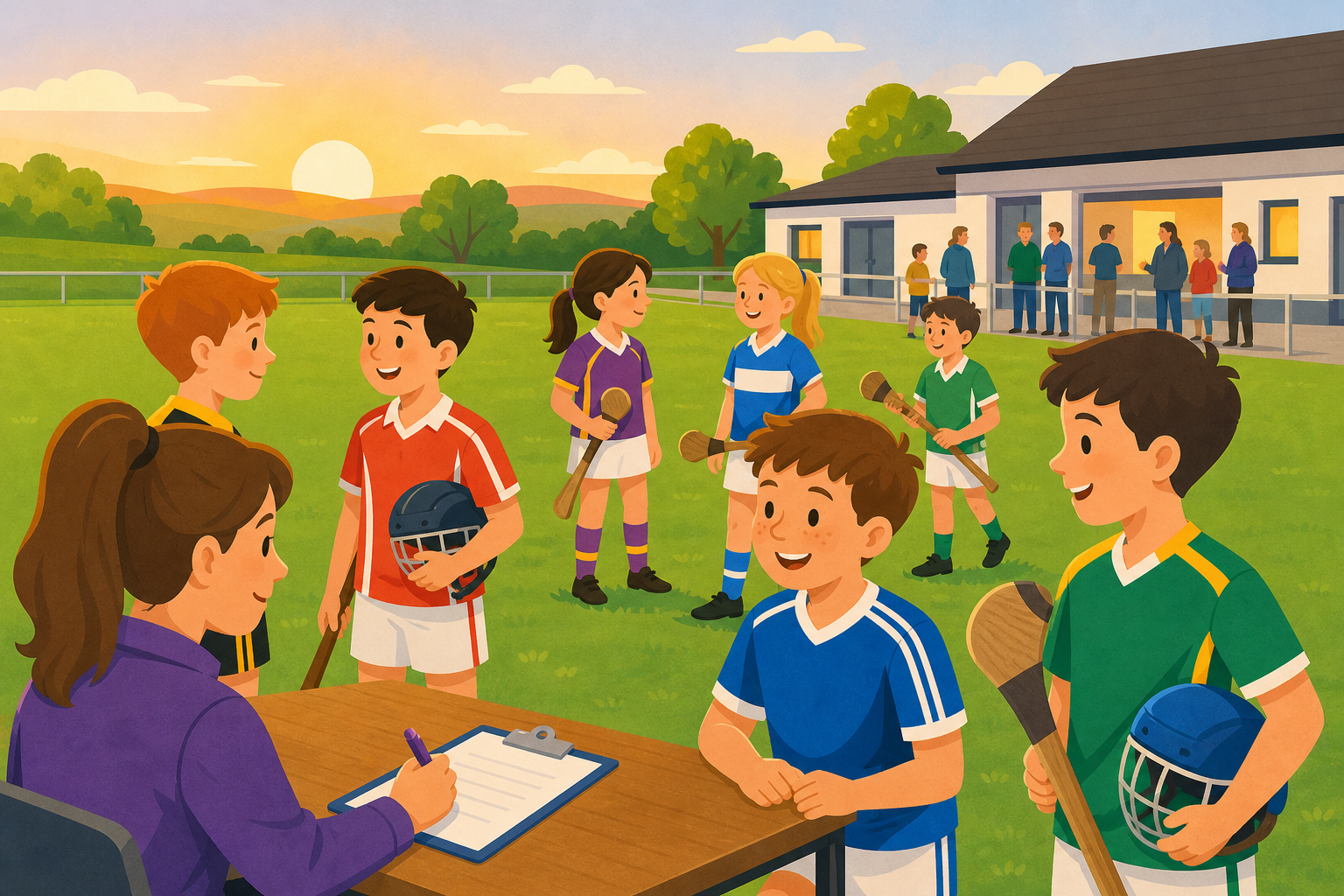
Here is a short story about our hurling club. The club has 248 members, and 137 more people sign up over the summer. How many members are there now?
Before we work anything out, listen for the words in the story. Which words tell you what to do with the two numbers?
Read the story aloud once, then a second time slowly. Take two or three hands-up answers to which words are the clue before anyone works out a total.
Underline more sign up on the board and revoice: 'more join' means we put the two amounts together — that's adding.' Don't rush to the answer; the job here is naming the signal, not the sum.
Each screen shows a number sentence. Listen for the clue words in the story your teacher reads that tell you whether to add or take away. After the three screens, a two-step puzzle is done with no screen.
153 + 128: circle "more come" and "altogether" — groups joining, so add. 153 + 128 = 281 fans.
345 - 268: circle "sells" and "left" — ask do the jerseys go up or down before revealing. 345 - 268 = 77 jerseys.
314 - 246: the make-or-break one. Build it on the board — draw the two scores as bars side by side, mark the gap between the tops, name it the difference. "How many more" asks how big that gap is; take the smaller from the bigger. 314 - 246 = 68 points. Let two or three pupils argue why it feels like adding but is subtracting.
Two-step (no screen): read the story — €175 one stall, €168 another, then €240 spent. Say the plan aloud: first add the two collections, THEN take away what was spent. 175 + 168 = 343, then 343 - 240 = €103 left. This sets up why some stories need two number sentences.
This is a whole-class board activity. We take turns at the front to work through these stories together, and everyone else follows along and calls out the clue words. For each story we decide whether it is an adding story or a subtracting story before we work out the answer.
For each story we find the clue words first, choose + or −, then build the number sentence and check it together.
This round is for talking it through together — pupils take turns at the board and the class agrees or corrects out loud. The watching class follows along and calls out the clue words.
For each story, insist the class names the clue words before anyone chooses the operation — that habit is the whole lesson. Revoice a strong answer: 'so "left" tells us the bars go away, that's why we subtract.'
The Kerry vs Mayo story is the one to slow down on: 'how many more' is a subtraction even though it sounds like counting up. Ask a pupil to prove it makes sense — 22 take away 15 is 7, so Kerry won 7 more.
In your maths copy, for these two problems write the number sentence first, with a + or − sign, and then work the answer underneath.
Write the number sentence, then your working, then the answer with a label (tickets or seats).
Walk the room and glance for two things: a correct + or − sign chosen, and the number sentence written before the working. No individual marking — this is whole-class copybook practice, not assessment.
Today we work through these stories in order at the board, deciding add or subtract each time. They get a little trickier as we go.
The last two go together: they are the two steps of one money story. Work through each step in order.
These are the practice questions — pupils take turns at the board, check each answer, and the class confirms before moving on. Keep the board work brisk rather than over-explaining.
The first three build the pattern: a clean add, then the 'how many more' difference that trips people up, then a plain take-away. Have the class predict + or − aloud before each pupil chooses.
The last two items are the key one — they are one two-step money story split into its two jobs so pupils see both on screen. Do the first item (175 + 168 = 343) as an add, then the answer 343 is carried straight into the next item as the starting amount. Name the two jobs clearly: 'first we joined the two collections to get €343, now we take away the €240 we spent.' Then the pupil enters the take-away on the interactive activity.
You're previewing this lesson. Get full access to this lesson and hundreds more — each one ready to teach, with interactive activities, printable resources and pupil progress tracking built in.