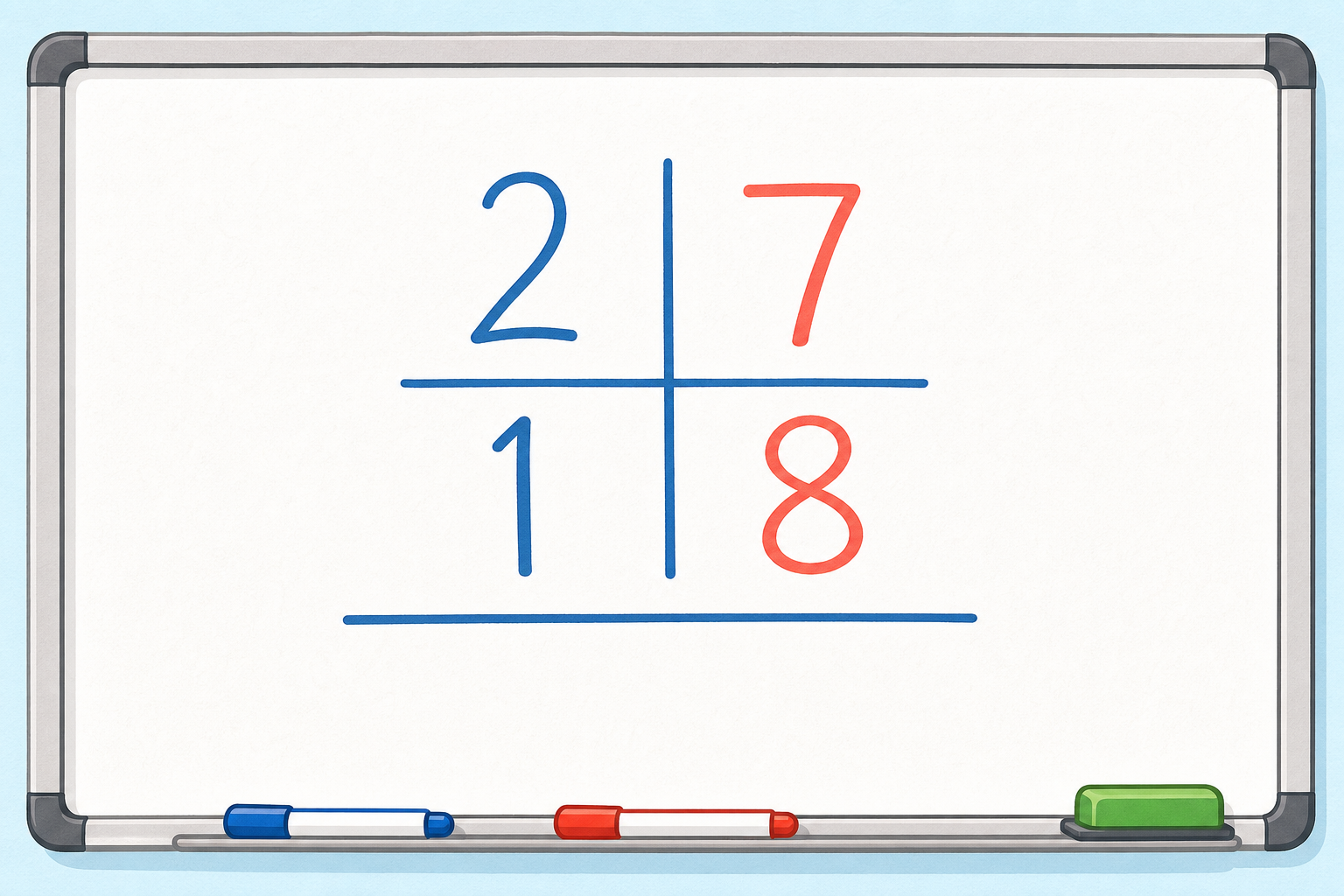
Here is a sum to look at: 27 + 18. When we add the units, 7 and 8, we get 15. But there is only one little box for the units answer, and 15 will not fit in one box. Hands up: when the units make ten or more, what do you think we should do with the extra ten?
Display 27 + 18 on the board as you read. Take three hands-up answers, not open call-outs. Do not reveal the method yet — let pupils wonder. Give five seconds of quiet think-time before any hands go up.
Look at these column additions. Every sum starts on the right, with the units, and sometimes ten ones bundle into one ten that is carried left. Keep your eye on where that carried ten goes.
Start with the bundle before any column work. Hold up ten ones cubes (or ring ten dots) and swap them for one ten-stick beside the columns: ten ones make one whole ten, too big to stay with the units, so it moves left to the tens. This is the why of the carry, hands-on, before the method.
Work each sum units first, always pointing at the units column.
34 + 28: 4 and 8 make 12, write 2, carry 1; tens 3 + 2 + 1; sum 62. Point back to the bundle to show the carried 1 is a ten.
47 + 35: ask them to predict the carry before revealing. 7 and 5 make 12, write 2, carry 1; sum 82. Pause here for a breath.
56 + 19: stress that even a small number can push past ten. 6 and 9 make 15, write 5, carry 1; sum 75.
48 + 48: link to doubles they know. 8 and 8 make 16, write 6, carry 1; sum 96.
Each time, stress the carried 1 is worth one ten, not one unit.
Now we work through some additions together, column by column on the board. Our first sum is 38 + 27. After that we will do 45 + 26, then 57 + 38, then 69 + 27, each one a little harder than the last. Everyone tracks each step on the board with us: for every sum we ask whether the units overflow and a ten must be carried, and we say each step aloud before we check it.
Try Together: this round is for talking it through together — pupils take turns at the board and the watching class agrees or corrects out loud while tracking each step on the board.
Run the column-addition interactive in explore mode. Work the four sums in order of rising difficulty: 38 + 27 (the opening sum on screen), 45 + 26, 57 + 38, then 69 + 27. Bring a pupil to the board to set the units answer and decide whether a ten carries, then the class checks. Rotate four pupils across the four sums. Watch for the common slip of writing the whole units total (e.g. 12) in the units box instead of writing 2 and carrying 1.
In your maths copy, set out these two sums in neat tens-and-units columns, one digit per column:
Add the units first, carry a ten where you need to, and ring the carried ten so you can see it clearly. Then add the tens.
Walk the room glancing at column alignment and the ringed carry — this is whole-class copybook practice, not marking. Look for digits lined up straight under each other.
Today we work through these additions together, getting a little harder each time: 23 + 14, then 36 + 27, then 58 + 35, then 49 + 49. For each one we ask the same question first — did the units overflow, so do we carry?
Class Challenge: these are the practice questions — pupils take turns at the board, check each answer, and the class confirms before moving on. Keep the board work brisk rather than over-explaining.
Run the column-addition interactive in challenge mode; it advances in sequence through all four sums in the practice set. 23 + 14 has no carry — a deliberate gentle opener so pupils don't carry out of habit. The others all carry. Use the 'did the units overflow — do we carry?' callout each time. Watch for pupils carrying when they shouldn't on the first sum.
One pupil says the carried ten should sit above the units column, because that is where the big total came from. Another says it must go above the tens column. Who is right, and how would you settle it?
Listen for pupils explaining that the carried 1 is worth one ten, not one unit, so it belongs in the tens column. Point back to the ten-stick from the bundle at the start: ten ones became one whole ten, and a whole ten lives with the tens. Revoice a strong answer: 'so the extra ten can't stay with the units — it's a whole ten, so it joins the other tens'. Head off the idea that the carry is just a small leftover digit, and give a few pupils time to put the reasoning in their own words.
Next we take the same column method one step bigger, adding three-digit numbers in hundreds, tens and units columns.
Recap the units-first rule, the bundle of ten ones into one ten, and why the carry lives in the tens column. Keep this brief.
You're previewing this lesson. Get full access to this lesson and hundreds more — each one ready to teach, with interactive activities, printable resources and pupil progress tracking built in.