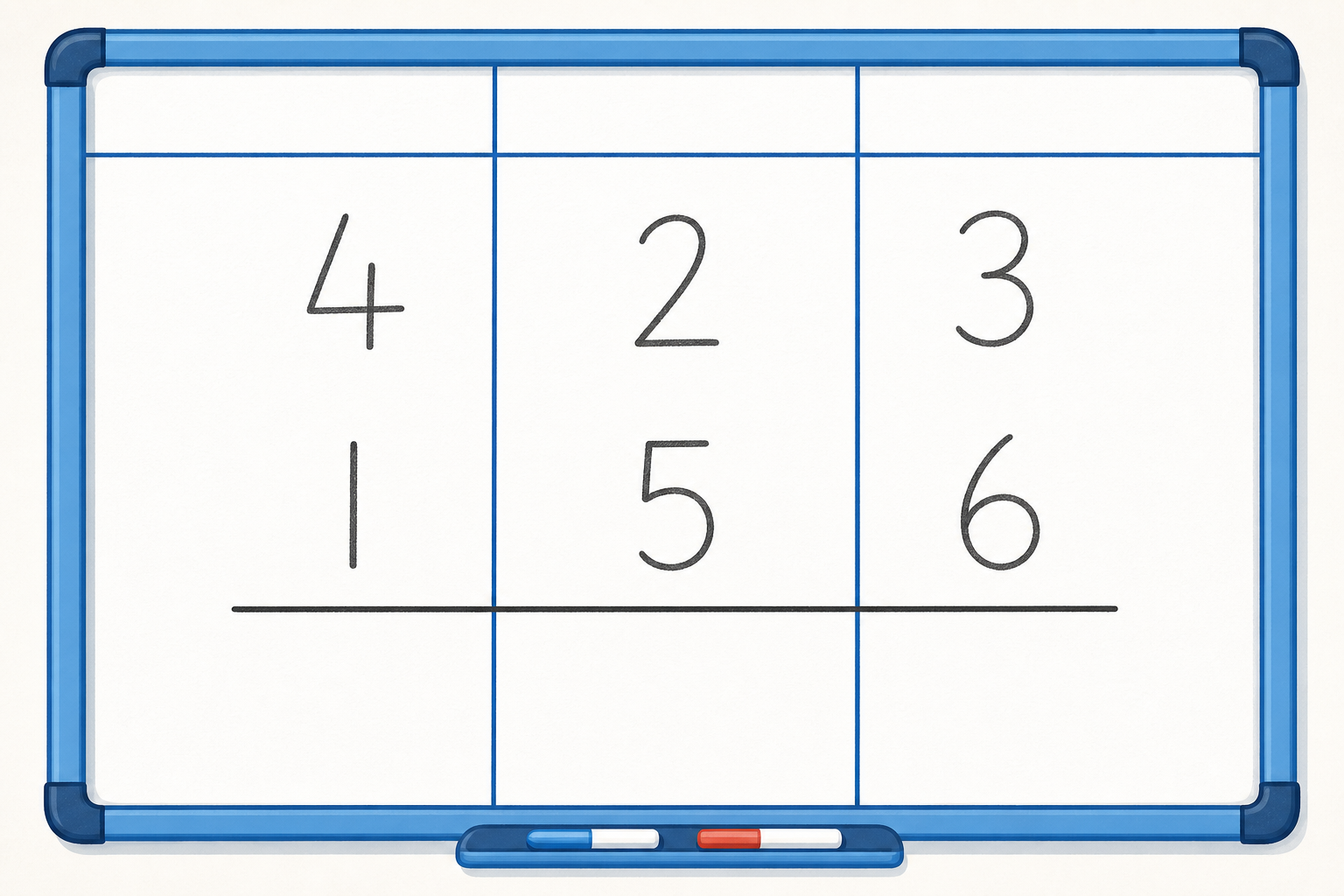
Here is a subtraction set out in neat columns: 423 take away 156.
Look at the units column first. It says 3 take away 6. Is there a wrinkle already? Hands up: which columns in this one do you think will need us to rename before we can take away?
Display 423 − 156 in hundreds-tens-units columns as pupils settle. Take three hands-up answers, not open call-outs.
You are just fishing for a prediction here (the units and the tens will both need renaming) — don't confirm or work it yet, that is the next step.
Watch the interactive work through four subtractions, one at a time, always starting in the units column. Each one needs a little more renaming than the last. Watch what happens when a column runs short.
Reveal one at a time, working from the right, pause between each.
368 − 142: no rename. Units 8−2=6, tens 6−4=2, hundreds 3−1=2, answer 226. Use it to fix the habit of starting in the units; every top digit is big enough.
452 − 127: one rename. Units 2−7 can't be done, take a ten across, so 5 tens drop to 4 and units become 12. Point at the rename-note as the ten crosses. 12−7=5, 4−2=2, 4−1=3, answer 325.
534 − 268: renames twice. First ask the on-screen guess, how many columns run short, think-only, no wrong answer, few seconds quiet, then reveal. Units 4−8 too small, rename a ten, 4 becomes 14, tens drop to 2. Tens 2−6 too small, rename a hundred, 2 becomes 12, hundreds drop to 4. 14−8=6, 12−6=6, 4−2=2, answer 266. Watch for pupils who forget to drop the tens digit the second time.
600 − 245: the key one, say it slowly. Units 0−5, but the tens are also zero and have nothing to give, so the rename reaches the hundreds first: 6 hundreds becomes 5, tens jump to 10, give one ten to the units. 10−5=5, 9−4=5, 5−2=3, answer 355.
First I'll sketch 275 take away 132 on the board and we'll say each column aloud as we fill it in — this one is gentle, and every top digit is big enough, so no renaming.
Then we'll use the tool for 364 take away 138. This one makes us rename, so we'll work from the units first and decide whether to rename before we take away.
This round is for talking it through together — pupils take turns at the board and the class agrees or corrects out loud.
275 − 132 is a quick by-hand board sketch to confirm the units-first habit with no renaming — do this on the pen before you open the tool.
Then run the interactive in explore mode for 364 − 138: the units (4 − 8) run short, so a ten is renamed. Have the pupil at the board tap the rename-note cell first, then the answer cells. The class calls out each column before the digit goes in.
First we will check one subtraction together on the board so you can see exactly how the add-back works. We already know 368 take away 142 is 226. Now add the answer back to the smaller number, column by column: 226 + 142. Units 6 + 2 = 8, tens 2 + 4 = 6, hundreds 2 + 1 = 3. We land on 368, the top number, so the subtraction is correct.
In your maths copy, set out these two subtractions in hundreds, tens and units columns, one under the other, and work each one:
Rename where you must, and cross out and drop the digit next door when you rename. When you finish, check each answer the same way we just did: add it back to the smaller number and you should land on the top number again.
Before copies open, board-sketch the inverse check for a known fact from earlier: 368 − 142 = 226, so write 226 + 142 in columns. Units 6+2=8, tens 2+4=6, hundreds 2+1=3, total 368. Point: answer + smaller number must equal the top number.
Then walk the room glancing at column alignment and the rename crossings-out. This is whole-class copybook practice, not marking. Watch for the zero in 703: the tens have nothing to give, so the rename has to reach the hundreds first. Slip to watch on the check: pupils adding the answer to the top number instead of the smaller one.
Now we'll work through some more subtractions together, each one a little trickier than the last: 486 take away 253, then 473 take away 128, then 521 take away 276, then 800 take away 347. The last one has a zero waiting to catch us out, so we'll say the renaming aloud before we fill it in.
Pupils take turns at the board, check each answer, and the class confirms before moving on. Keep the board work brisk rather than over-explaining.
You're previewing this lesson. Get full access to this lesson and hundreds more — each one ready to teach, with interactive activities, printable resources and pupil progress tracking built in.