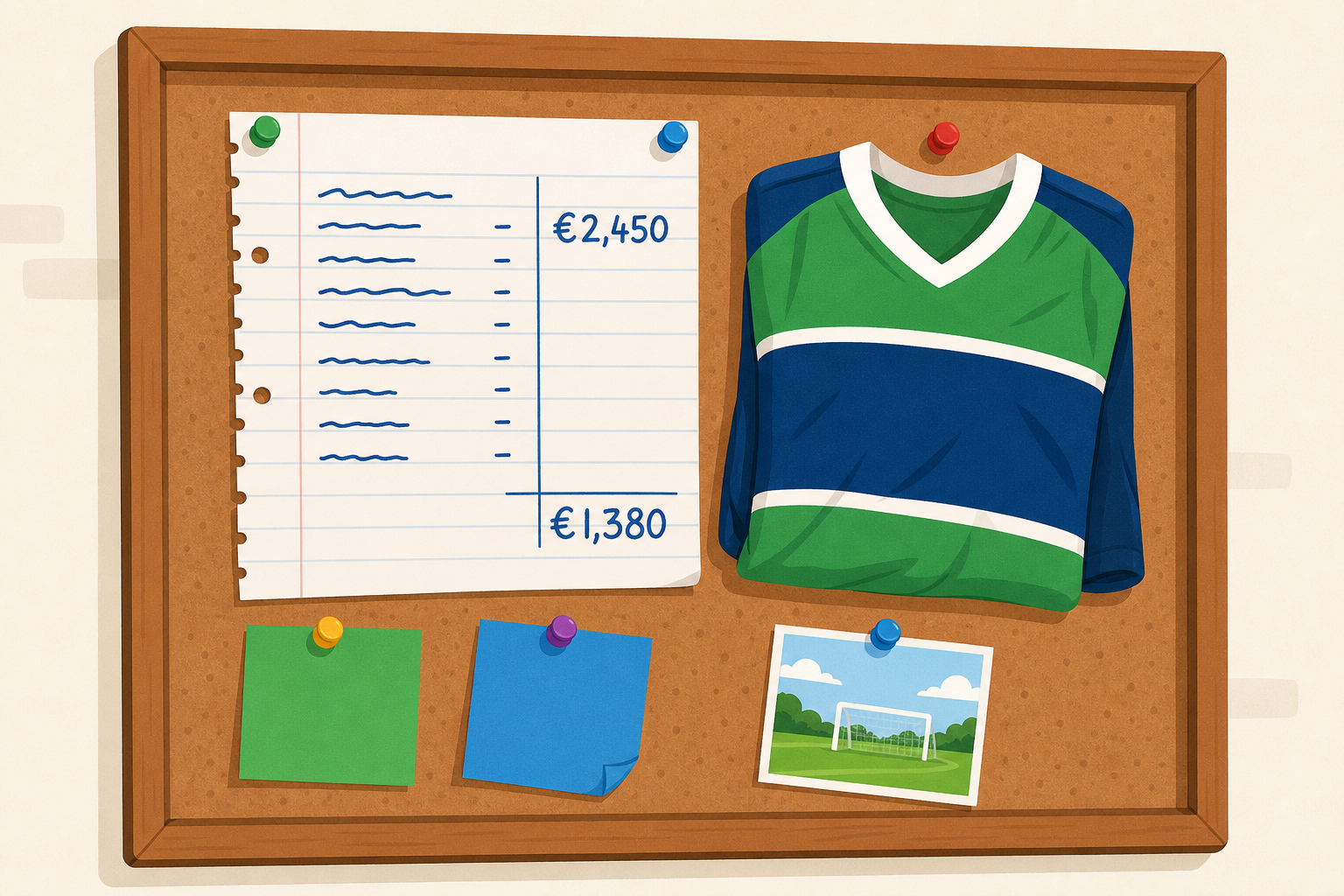
A club had €2,450 in its account and spent €1,380 on new jerseys. We won't work it out yet — just roughly, about how much do you think is left over?
And where in this sum do you think we might have to rename a column before we can take away?
You already know how to rename with three-digit numbers. A fourth column changes nothing: work from the right, and when a column is too small, rename one from the column on its left. The interactive works three subtractions with the borrows marked. Predict each answer before we check it.
How can we be sure a subtraction is right? We add our answer back to the smaller number. If it gives us the larger number we started with, we know we were right.
Let's check the last one: 5,000 − 2,648 = 2,352. So we add 2,352 + 2,648. If it comes to 5,000, our subtraction was correct. We set the addition out in columns on the whiteboard together: 2,352 + 2,648 — units make 10, tens carry, hundreds carry — all the way back to 5,000.
This is a watch-the-board round — pupils take turns working each sum while the rest of the class predicts and checks along. We'll work these one at a time: 4,562 − 1,238, then 3,406 − 1,572, then 6,300 − 2,145, and finally 7,000 − 3,486. We'll say each rename aloud before we check it, and watch the zeros in the last two carefully.
In your maths copy, set out these two subtractions in columns, one under the other, and rename where you need to:
When you have each answer, check it by adding your answer back to the smaller number — it should give you the larger number you started with.
You're previewing this lesson. Get full access to this lesson and hundreds more — each one ready to teach, with interactive activities, printable resources and pupil progress tracking built in.