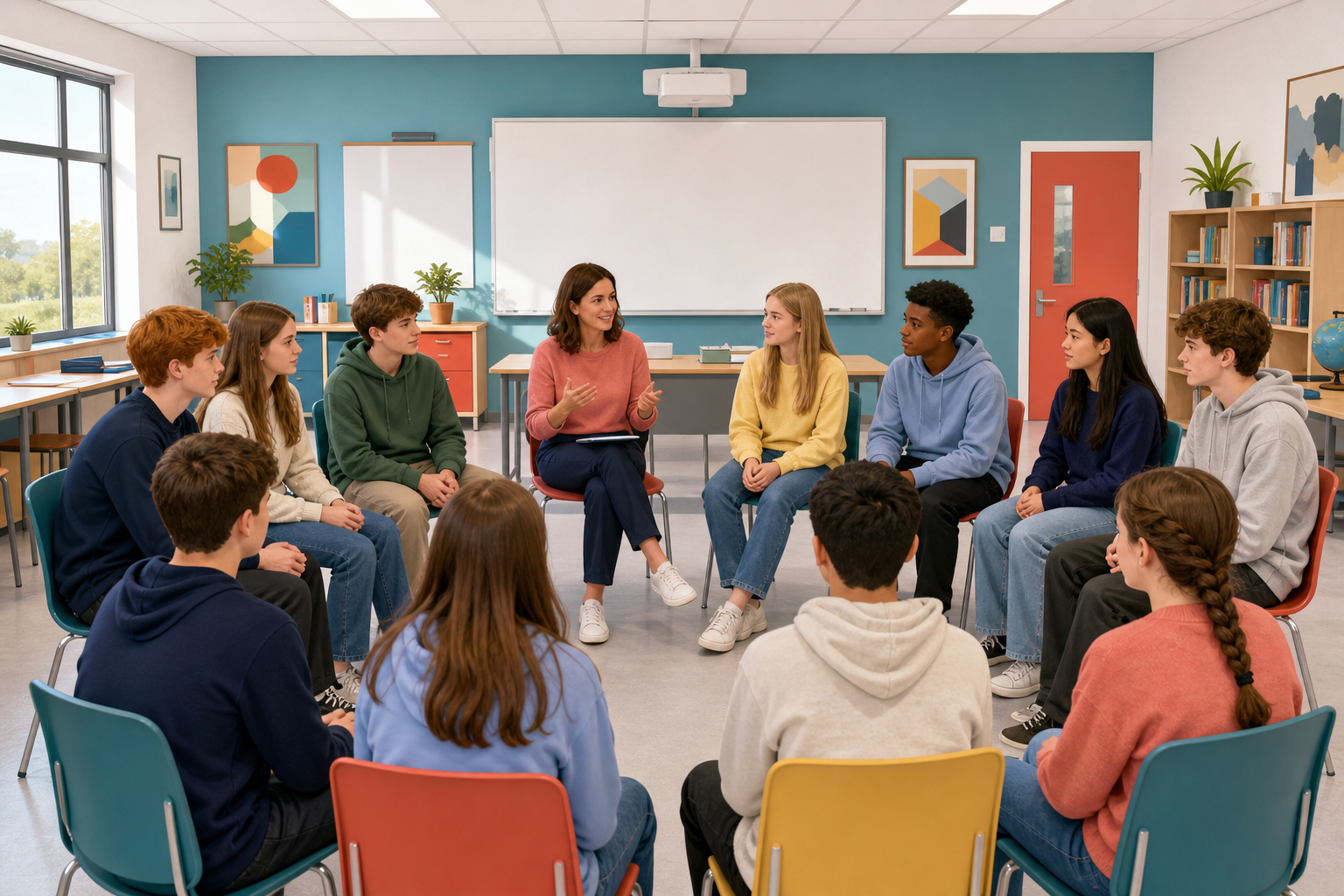
 Last lesson, your group wrote draft charter statements under five headings: respect, consent, privacy, responding to harm and fair use.
Today:
- Each group pitches (presents) its best statement.
- The class joins similar lines and votes on the final list.
- You decide where the charter will live and how to use it.
If your group's drafts are missing, write two lines now that start with "I will" or "We will", so you can still pitch.
| Hard to keep | Easy to check |
|---|---|
| “Be nice.” | “Ask before posting a photo of someone else.” |
| “Don’t be a bystander.” | “If I see a pile-on, I tell one adult the same day.” |
| “Respect privacy.” | “I don’t screenshot a private chat into a group.” |
A vague line is hard to keep because it does not say what to do. A clear line names the action, so you can tell if it happened. A pile-on is when lots of people join in against one person, and a bystander is someone who sees it happen.
- Pitch: each group reads out one statement.
- Merge: lines that say the same thing become one.
- Vote: a line goes in if more than half the class votes for it.
- Commit: you decide where the charter lives and how to use it.
Which draft from your group do you most want in the final charter, and why?
This step covers the first two stages: pitch and merge. Work in the same groups as last lesson. Last lesson's draft is already in the class list on the board. When it is your turn, read out your statement, say which heading it goes under, and give one reason it belongs in the charter. If it is not in the list yet, your teacher types it in, so each line is written only once.
| Move | Time | What you do |
|---|---|---|
| 1. Choose | 2 min | Pick one statement your group still stands by. Cut anything vague. Rewrite any line that is not something a student can actually do. |
| 2. Pitch | 30 seconds | Read the statement, name the heading, and give one reason it belongs in a charter for inside and outside school. |
| 3. Respond | 20 seconds | While another group pitches, write down one good thing about their statement or one question that would make it clearer, not both. For example: “Is this clear enough?” or “Does this cover messaging apps as well as school work?” |
| 4. Merge | 20 seconds each time | After five or six pitches, the class joins lines that say nearly the same thing into one stronger line. Your teacher types the new line into the list and takes out the two old ones. Your group then gives a thumbs-up or suggests changing one word. The class leaves out any statement nobody can give a good reason for. |
You do this step together as a class, using the list on the board. The lines you pitched and merged are already in it.
- If a heading is missing something important, suggest wording from your seats. The list also shows some suggested lines: only use one if a heading needs it, and put it in your own words.
- Everyone votes on each line with thumbs up or thumbs down. If more than half the class votes for a line, your teacher ticks it as adopted, which means it goes into the charter. If the class is split, improve the wording once and then vote again.
- As a class, decide where the charter will live, such as a shared class folder or the classroom wall. Then decide how you will use it, such as checking it before you publish or when something goes wrong online.
- The list saves your charter, so your teacher can open it again later. Your teacher also puts a copy where the class decided it will live.
Our class charter
You now have one shared charter, written in your own words and adopted by the class. It is not a list of punishments but a set of rights and responsibilities you chose for going online, in school and outside it.
A statement belongs in the charter if anyone in the class could follow it without asking what it means. You also decided where the charter will live and how you will use it, so it will not be forgotten after today.
Unlock the full learning experience
You're previewing this lesson. Get full access to this lesson and hundreds more — each one ready to teach, with interactive activities, printable resources and pupil progress tracking built in.
This lesson is copyright of Coding Ireland 2017 - 2026. Unauthorised use, copying or distribution is not allowed.