 Today you will test the piece you plan to publish against four checks: safety, consent, crediting and accuracy. Consent means people agreed to be shown in it, and accuracy means the facts are correct. You check it on your own first, and then a partner checks it. Anything that fails must be fixed, or written down as a next step.
If you have no draft, rebuild it from your research log and plan, or check a partner's draft instead.
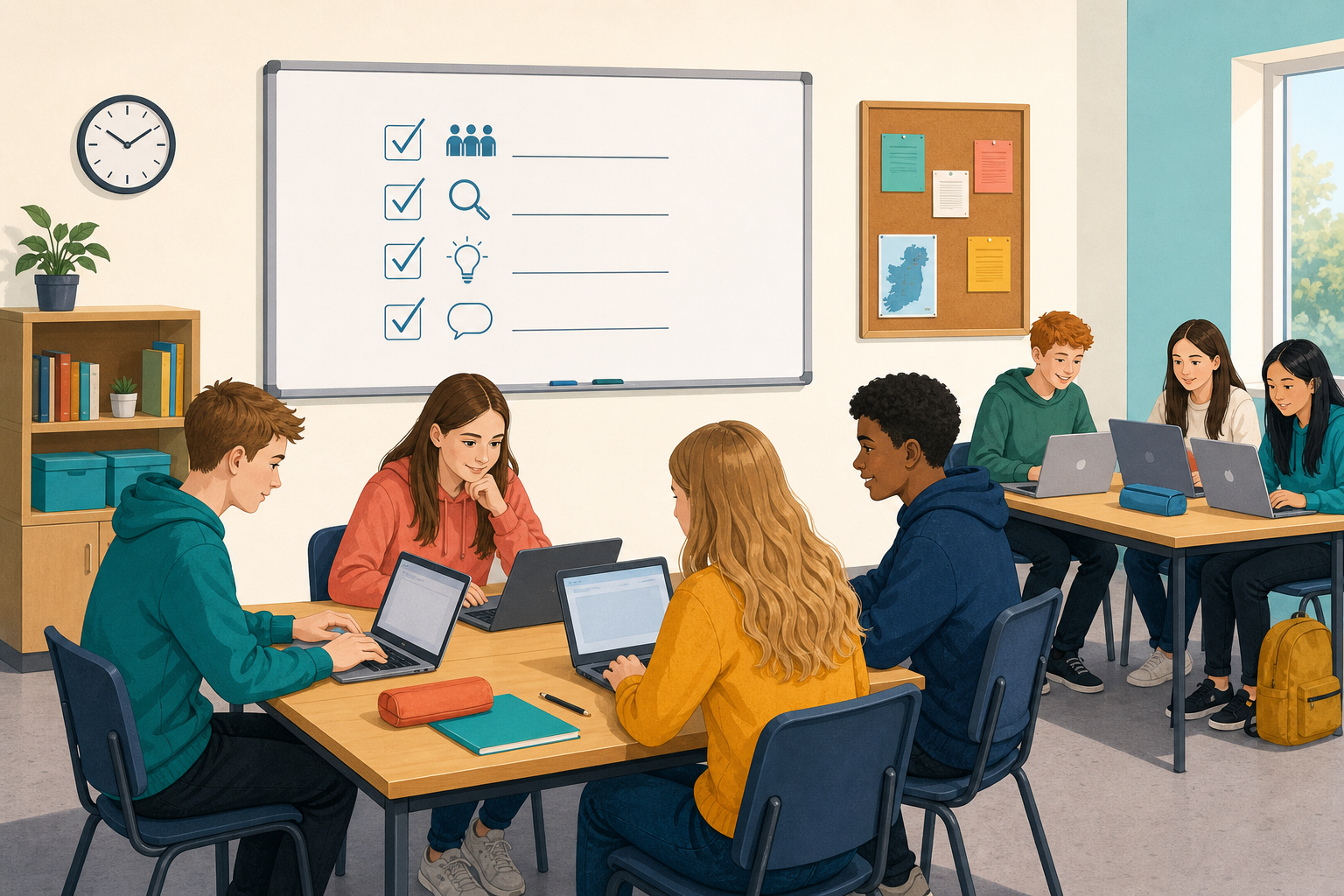 Your piece must pass these four checks.
- Safety: Could it put anyone at risk? Look for private details, like a person's full name together with their school, or where they live. Also look for anything that breaks the rules your class agreed.
- Consent: Did everyone whose face, voice, name or words appear agree to it being shared with your audience?
- Crediting: Every borrowed picture, clip, sound or text needs a credit saying who made it, where it came from and the licence, which is the rule on whether you may reuse it.
- Accuracy: Are the facts right? Look for anything made to sound bigger than it really is, anything out of date, or an opinion given as a fact. Note any AI help in your log.
When a check fails, point to the exact line, picture or credit that caused it.
Open your draft and go through the four checks on your own. For each one, decide pass or fail and write a short note so a partner can follow your thinking.
Fill in the check card below, with one row for each check. The card is already in the box called Enter Your Work at the bottom of this step, or you can copy it into your notes.
| Check | Pass/Fail | Exact line, image, credit or gap (or short pass reason) | Fix now / next step |
|---|---|---|---|
| Safety | |||
| Consent | |||
| Crediting | |||
| Accuracy |
The check: ___
Pass or fail: ___
Your evidence or reason: ___
Fix now or next step: ___
For a fail, your evidence is the exact place in the piece that shows the problem, such as "second image, no creator named" or "opening paragraph names a classmate without consent". For a pass, give one short reason why you are sure.
- all four checks are marked pass or fail
- every fail names an exact place in the piece
- you are ready to give your draft and notes to a partner
If all four pass and you still have time, find the place that came closest to failing and write what would have made it fail.
Keep your card with your draft by sending it from the Enter Your Work box or by saving your notes beside the draft.
Swap drafts and check cards with a partner. Keep anything you find between the two of you.
- Read your partner's draft once without looking at their notes.
- Run the four checks in the partner check below, naming exactly what caused each fail.
- Compare your answers with your partner's notes. Where you disagree, look at the piece together and find the line, picture or credit that shows who is right.
- After about 10 minutes, give the draft back and fix what you can on your own piece, such as adding a missing credit or removing a picture without consent. Write any fail you cannot fix yet as a next step beside your draft.
Then save your draft and next-step notes the class way, so they are ready for the publishing session.
If you have no draft of your own, stay as a second checker on your partner's piece. Confirm each fail, suggest one fix, and write it as a next step for them.
Partner check: the four checks, with fresh eyes
Which check caught the most fails in your pair: safety, consent, crediting or accuracy? Give one example. When you share with the class, use examples like a missing creator on image 2 or an opinion stated as fact in paragraph 3. Any fail about a real person's face, name or consent stays between you and your partner.
It is much better to find a fail now than after the piece is public, when it could cause harm, leave someone uncredited or spread a false claim.
Unlock the full learning experience
You're previewing this lesson. Get full access to this lesson and hundreds more — each one ready to teach, with interactive activities, printable resources and pupil progress tracking built in.
This lesson is copyright of Coding Ireland 2017 - 2026. Unauthorised use, copying or distribution is not allowed.