 So far you have asked whether you can trust a piece of content, and whether it is biased or shaped by an algorithm. Today you will ask who it was made for, and why.
You will learn a shared four-field frame, which is four headings the class will use to look at any piece of content. You will use it on some example pieces, and then on one piece you choose yourself.
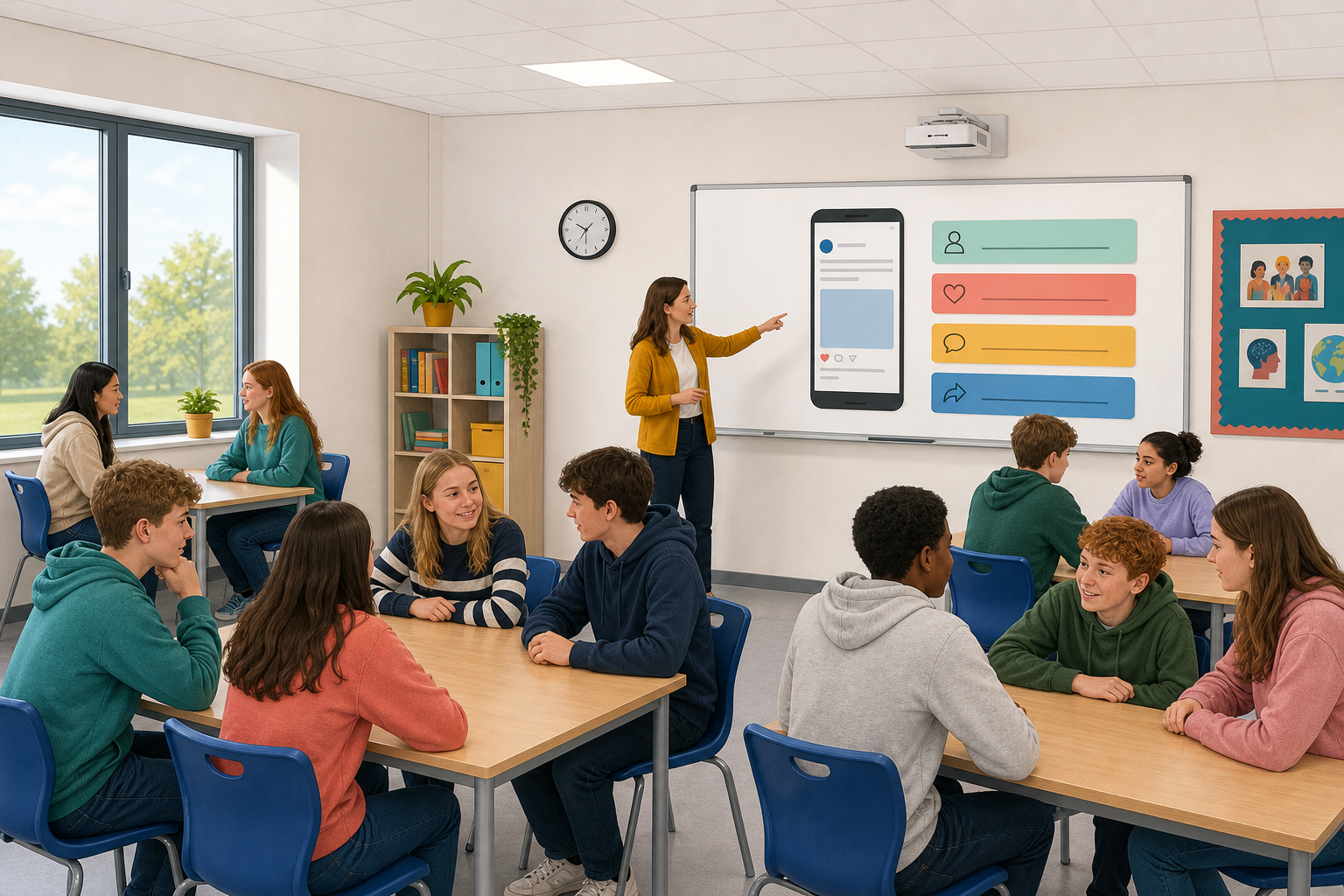 Every piece of digital content is made for someone, for a reason. That is why a sports highlight reel looks so different from a charity campaign.
From today, the class will use these four fields to look at content.
- Theme is what the content is about.
- Purpose is why it was made, such as to inform, sell or entertain.
- Intended audience is who it is really aimed at, not just everyone online.
- Techniques used are the choices made to reach that audience, such as music, colours or hashtags.
Look at this made-up post together as a class.
"Rainy-day study mix 🌧️📚 45 mins of lo-fi beats for Junior Cycle revision. Tag a mate who needs this. Free mix link in bio. #StudyTok #JC2026"
Posted by @FocusFuel, a small account that shares study tips and links out to free mixes.
(Lo-fi beats are calm, relaxed background music.)
With a partner, talk through the four fields for this post, and be ready to share one with the class. You do not need to write anything down.
Work with a partner. For each piece, write the four fields in short phrases, not full paragraphs. The class goes through the pieces together, one at a time, so be ready to explain any field.
- Your class looks together at Piece A, the post in the activity below.
- With your partner, you have about two minutes to fill in all four fields for it on screen.
- One pair shares one field, and the class agrees with it or changes it.
- Then you do the same for Piece B, on paper or in your notes, set out like the table.
A neat, simple graphic, like one made in a free design app such as Canva, posted on the school app. It has a green header, the school crest and bold text: "TY fundraising bake sale. Friday 12:40, main hall. Homemade only. All profits to the Nepal trip." Small print: "Nut-free table available. Volunteers sign up with Ms Byrne."
| Field | Your notes |
|---|---|
| Theme | |
| Purpose | |
| Intended audience | |
| Techniques used |
On each piece you finish, put a star beside the field you feel least sure about.
Only if you finish early
Pick Piece C or Piece D and do the four fields for it on paper too. Then read the other one, and decide which of the two hides its purpose better.
Piece C: climate awareness reel. Fifteen-second reel: a slow drone shot of a flooded Irish street, tense music, white text flashing "This was last winter." then "What will next winter look like if we do nothing?" Final frame: "Share if you care. Link to our petition in bio." Posted by @GreenSignalIE, a youth climate account.
Piece D: product review post. "Honest take on the SoundNest buds after two weeks. Battery is class for the Luas commute; mic is average on calls. I get a small cut if you buy through my link. Saying that up front." Posted by @TechByTom, a mid-size review account, with a photo taken from above of the earbuds lying flat on a school bag.
Check that you have labelled Piece A on screen, written Piece B's four fields in your notes, and starred the field you feel least sure about on each piece. You do not have to do Pieces C and D.
Piece A: take the post apart
Pick one piece of digital content you use or have seen recently. It could be a post, a story, a short video, a game trailer, a school update, a sports clip or a product review. Do not pick anything private, or anything unkind about someone in the room.
If you cannot look it up on a phone in class, pick one piece you remember well. Name it in one line, like the examples below, and do not just write a type of content such as "football videos".
"the GAA championship trailer on RTÉ Player last weekend"
"the free-premium banner in [game you play]"
(A free-premium banner is an advert inside a game offering you the paid extras for free.)
Then, on your own, work out the four fields for your piece.
- Theme: what is it about?
- Purpose: why was it made?
- Intended audience: who is it really for?
- Techniques used: which choices try to reach that audience?
- You have named your piece in one line, saying what it is and where you saw it.
- You have filled in all four fields in plain sentences.
- You have added one more line: "It is really for ___ because ___".
- You could say your answer out loud in under thirty seconds if you are asked.
Someone chose what each piece of content is about, what job it should do, who it is for, and how to reach them.
Most pieces have more than one purpose, since one post can help you and sell to you at the same time. The real audience is also almost never "everyone", and the techniques show who it is really for.
You will use these four fields again later, when you look at influencers, different formats and your own work.
Unlock the full learning experience
You're previewing this lesson. Get full access to this lesson and hundreds more — each one ready to teach, with interactive activities, printable resources and pupil progress tracking built in.
This lesson is copyright of Coding Ireland 2017 - 2026. Unauthorised use, copying or distribution is not allowed.