 Apps, games and websites have rules, but you also have rights online. Today you will learn about four of them, which are information, free expression, protection of minors and data protection. Minors are young people under 18. You will see each right in a situation and decide what it lets someone do next.
You still have your rights when you use apps, games, school posts and search results. These four matter most today.
- Information means you have a right to clear facts, and to check where they came from.
- Free expression means you can have your own views and share them, as long as you do not cause real harm to others.
- Protection of minors means under-18s get extra care, such as apps designed for their age and controls on what they see.
- Data protection means you have a say over personal information about you.
 In Ireland, laws about personal data and online safety help protect these rights.
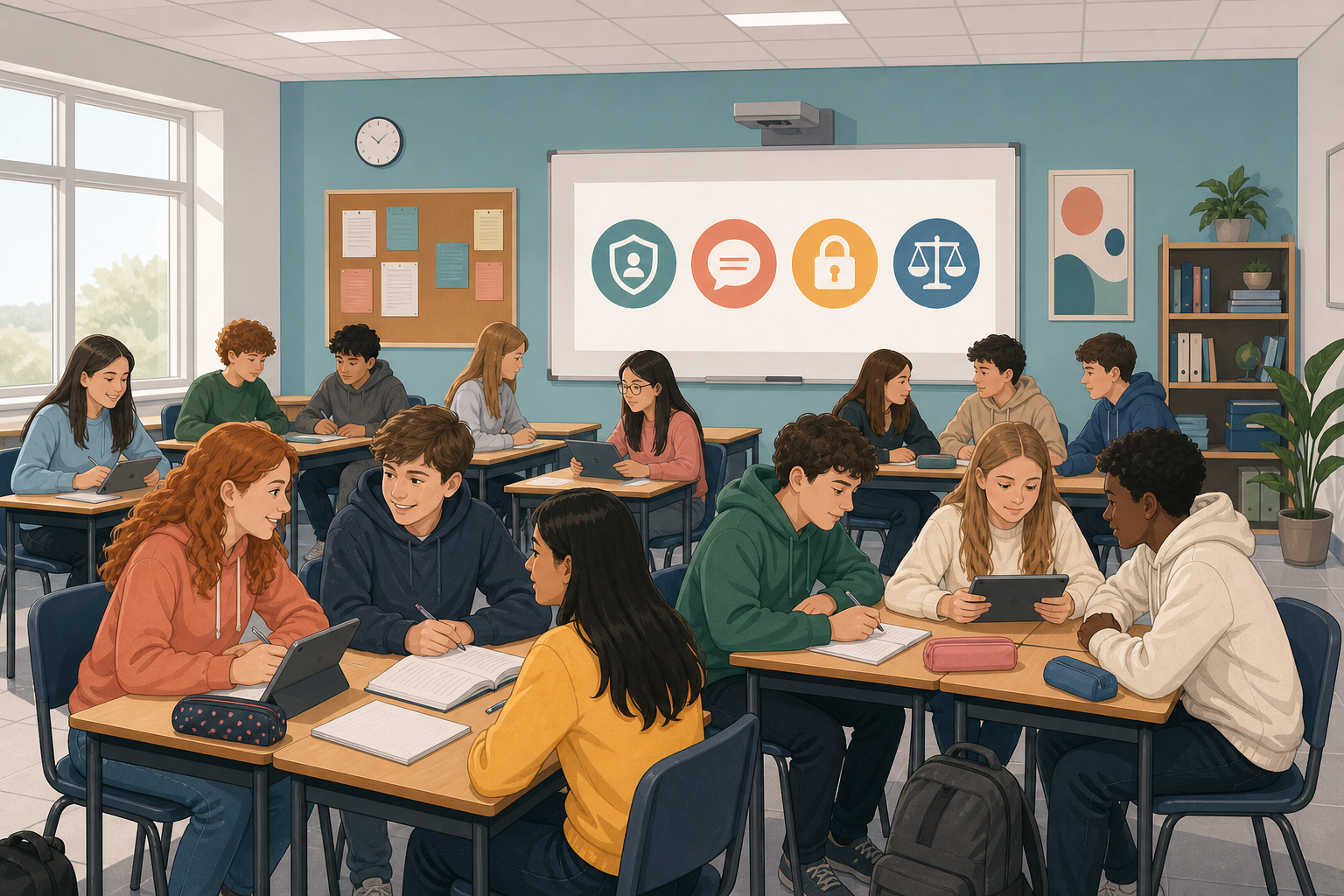
Your class will work through four situations together on the board. For each one, talk it over with a partner before the class shares answers.
There is no score. First, name the right and one sensible thing the young person could do next. Then your teacher will show a feelings check, which asks how the situation might make someone feel, and a short point for you to think about.
Scenario Cards
Work on your own or with a partner, and write your answers in your copy.
- Read Situations A to C below and decide which of the four rights is mainly involved in each one. Use only the four labels information, free expression, protection of minors and data protection.
- For at least two situations, write one clear sentence about what the young person could do next. If you are short on time, just write the right for the third one.
Situation A. A music app shows Róisín a screen of ticked boxes for sharing her listening history with advertisers. The option to say no is tiny and easy to miss. She wants to know what data leaves the app and how to refuse.
Situation B. Tomasz runs a small class podcast review channel. He posts a clip of himself calmly disagreeing with a popular creator. Overnight the app makes the clip age-restricted, which means only older users can watch it, so none of his classmates can open it. The app gives no reason, and there is no way to appeal, which means asking the app to look at its decision again. This situation may seem to fit more than one right, so pick the one that matters most and be ready to say why. Then think about what Tomasz could try next, and what a fair app should do for him, such as tell him the reason.
Situation C. Jamie's school app sends a notice that the bus route is changing "from next week". There is no date, no map of the new stops, and no one named to contact. Jamie needs to know whether the stop near home is still on the route.
When you have finished A to C, write your own situation in two sentences, set in a game, an app or a school post your class would know. Swap with a partner, and they name the right and one next step. If time is tight, you can finish this part for homework.
If you finish early, or for homework, read Situation D. Name the main right and write one next-step sentence.
Sam asked a local sports club not to post photos of them on the club's public social page. After a match, a group photo including Sam is uploaded publicly with first names tagged.
Check that each of A to C has one main right, and that at least two have a next-step sentence about what to do, not just a feeling. If there was time, check that you swapped your own situation with a partner.
Online spaces are full of rules, but you also have rights.
- Each situation had one main right, which was information, free expression, protection of minors or data protection.
- A right is useful when you can name it and take a next step. You could ask clearly, keep evidence, use report tools, check a source you can trust, or talk to a trusted adult.
- In Ireland, laws on personal data and online safety help back up these rights.
Other people have rights too, so using your rights well means respecting theirs.
Unlock the full learning experience
You're previewing this lesson. Get full access to this lesson and hundreds more — each one ready to teach, with interactive activities, printable resources and pupil progress tracking built in.
This lesson is copyright of Coding Ireland 2017 - 2026. Unauthorised use, copying or distribution is not allowed.