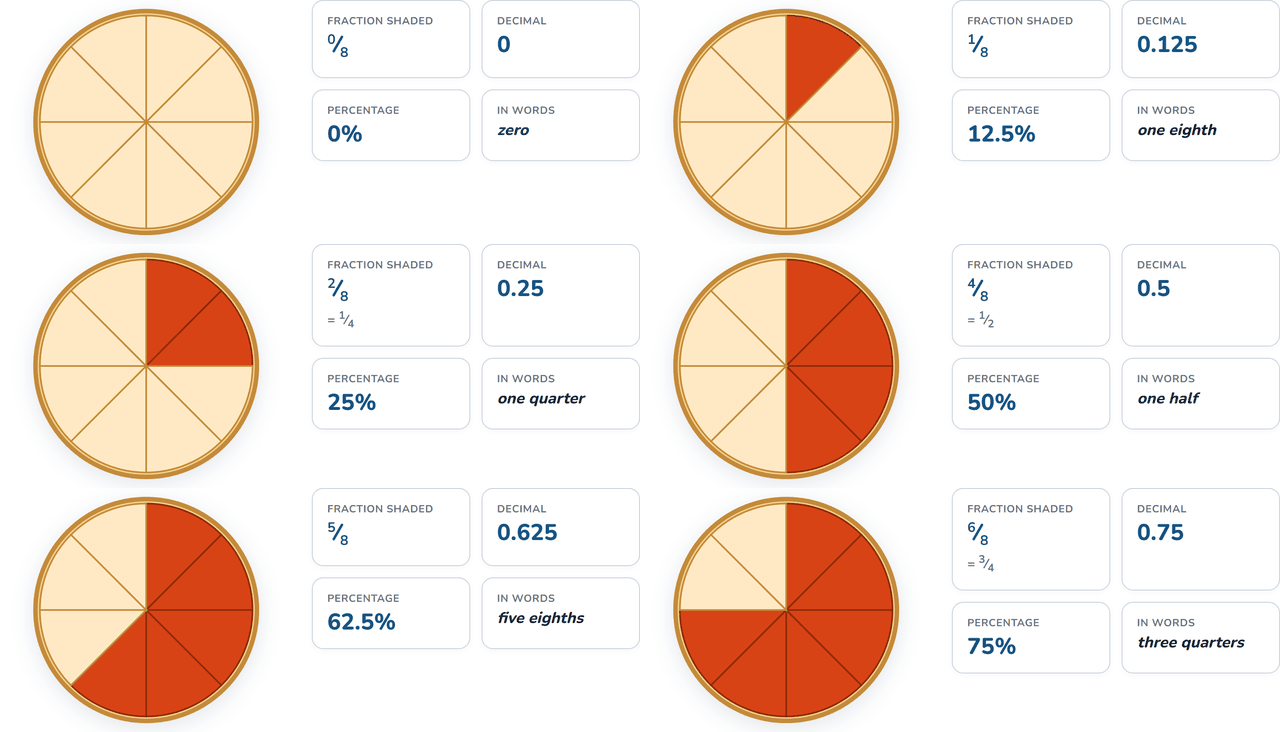
This course delivers a complete 5th Class mathematics curriculum centred on deep understanding of the decimal number system, fluent calculation with whole numbers, decimals and fractions, and confident application of measures, geometry, data, chance, algebra and mathematical modelling. Pupils move fluently between fractions, decimals and percentages, master written and mental strategies, explore shape, symmetry and transformations, interpret data and coordinates, solve equations, and tackle rich, real-world modelling tasks that integrate multiple strands. Its distinctive emphasis on precise place-value reasoning, equivalence and structured problem-solving builds strong conceptual foundations for 6th Class and beyond.
Read more
Everything you need for Maths, all year.

A complete year of Maths, delivered by teacher-led interactive-whiteboard lessons, a printed pupil Activity Book, and a Teacher Resource Book, built to the NCCA Primary Mathematics Curriculum.

Interactive whiteboard lessons
Pupil Activity Book Mathematics 123learn Mata the otter Look inside
Teacher Resource Book Mathematics 123learn Teacher resource books and materials

Explore the Course

Click any lesson with to preview it

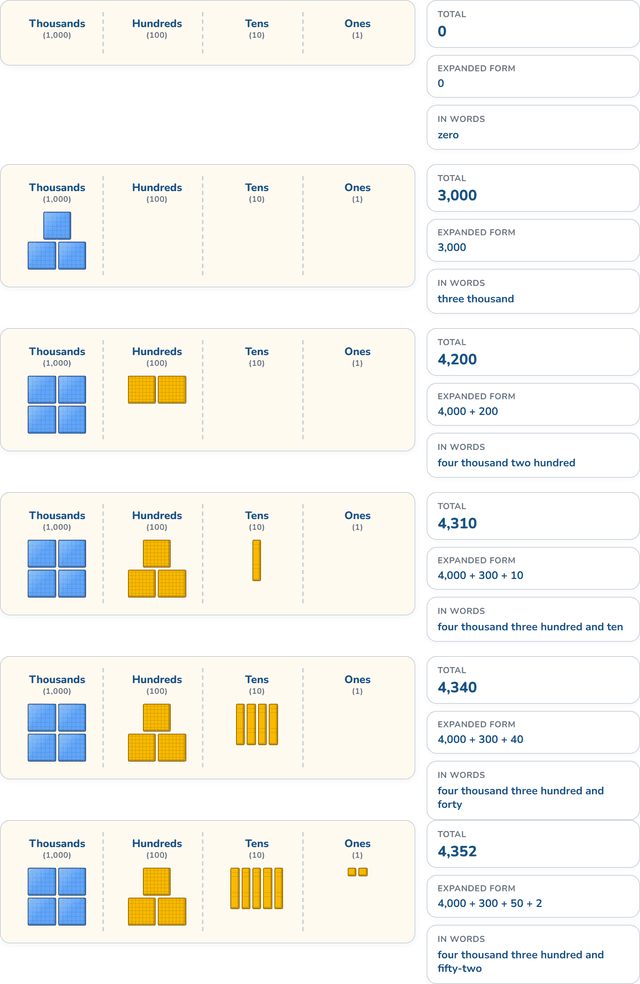
Extend the base-ten system from whole numbers to decimals to thousandths. Build fluency in reading, writing, partitioning and comparing decimals; introduce percentages as related expressions of the same magnitude; first encounter with negative numbers.

What We Already Know: Place Value to Millions Sample Activity Book Extension Sheet Teacher Resources
One Whole, Ten Parts: Introducing Tenths Sample Activity Book Extension Sheet Teacher Resources
Reading Decimals to Tenths and Hundredths Sample Activity Book Extension Sheet Teacher Resources
Decimals on a Number Line
Comparing Two Decimals
Ordering a Set of Decimals
Decimals to Thousandths
Rounding Decimals to the Nearest Whole, Tenth, Hundredth
Money Is Decimal: €1.20 and €1.02 Are Not the Same
Percent as Out of One Hundred
Equivalent Fractions, Decimals, Percents: First Walk
Equivalent Fractions, Decimals, Percents: Independent
Negative Numbers: First Encounter
Comparing Positive and Negative Numbers
Real-life Decimals: Class Survey
Module Assessment: What's My Number?

Extend the four operations to multi-digit whole numbers and one- and two-place decimals. Build operation flexibility: pupils select the most efficient strategy rather than always using the column algorithm. Introduce factors, multiples and prime / composite numbers.

Mental Addition Strategies: Partitioning and Compensating Sample Activity Book Extension Sheet Teacher Resources
Written Addition: Multi-digit Whole Numbers Sample Activity Book Extension Sheet Teacher Resources
Adding Decimals: Line up the Points Sample Activity Book Extension Sheet Teacher Resources
Subtraction Strategies: Counting on, Take Away, Decomposition Sample Activity Book Extension Sheet Teacher Resources
Subtracting Decimals Sample Activity Book Extension Sheet Teacher Resources
Multiplication Facts: Unfinished Business
Multiplying by 10, 100, 1000
Multiplying a Multi-digit Number by a Single Digit
Multiplying Two Two-digit Numbers
Dividing by a Single Digit: the Bus-stop Method
Division with Decimal Answers: Sharing What's Left
Order of Operations: Brackets, Division, Multiplication, Addition, Subtraction
Factors, Multiples, Prime and Composite Numbers
Module Assessment: Operation Toolbox in a Class-trip Plan

Build flexible movement between fractions, decimals and percentages; introduce ratio and proportion. Pupils order, simplify, add and subtract fractions; find a fraction or percent of a quantity; meet ratio and proportional scaling.

What Is a Fraction? Part-whole Review Sample Activity Book Extension Sheet Teacher Resources
Equivalent Fractions Sample Activity Book Extension Sheet Teacher Resources
Simplifying Fractions Sample Activity Book Extension Sheet Teacher Resources
Comparing Two Fractions Sample Activity Book Extension Sheet Teacher Resources
Ordering a Set of Fractions Sample Activity Book Extension Sheet Teacher Resources
Adding and Subtracting Fractions with the Same Denominator
Adding and Subtracting Fractions with Different Denominators
Fraction of a Quantity
Decimals and Fractions: They're the Same Thing
Percent of a Quantity: 10, 25, 50
Discount and Increase: 30 Euro Reduced by 20 Percent
Ratio: the Basic Idea
Sharing in a Ratio
Proportion: Scale up the Recipe
Module Assessment: Fraction Shop

Move pupils from whole-number measures to fractional and decimal measures; develop estimation; introduce area of triangles alongside rectangle and composite area; introduce volume of cuboids.

Estimating Then Measuring: Length Sample Extension Sheet Teacher Resources
Reading Scales to the Nearest Millimetre Sample Extension Sheet Teacher Resources
Converting Length Units Sample Extension Sheet Teacher Resources
Perimeter: Adding Sides up Sample Extension Sheet Teacher Resources
Area of Rectangles Sample Extension Sheet Teacher Resources
Area of Triangles: Half a Rectangle
Composite Shapes: Break It Into Rectangles and Triangles
Mass: Weighing in G and Kg
Converting Mass Units
Capacity: Measuring Jugs
Converting Capacity Units
Volume of Cuboids
Estimation Across Attributes
Solving Real Measurement Problems
Module Assessment: Design a Class Garden Bed

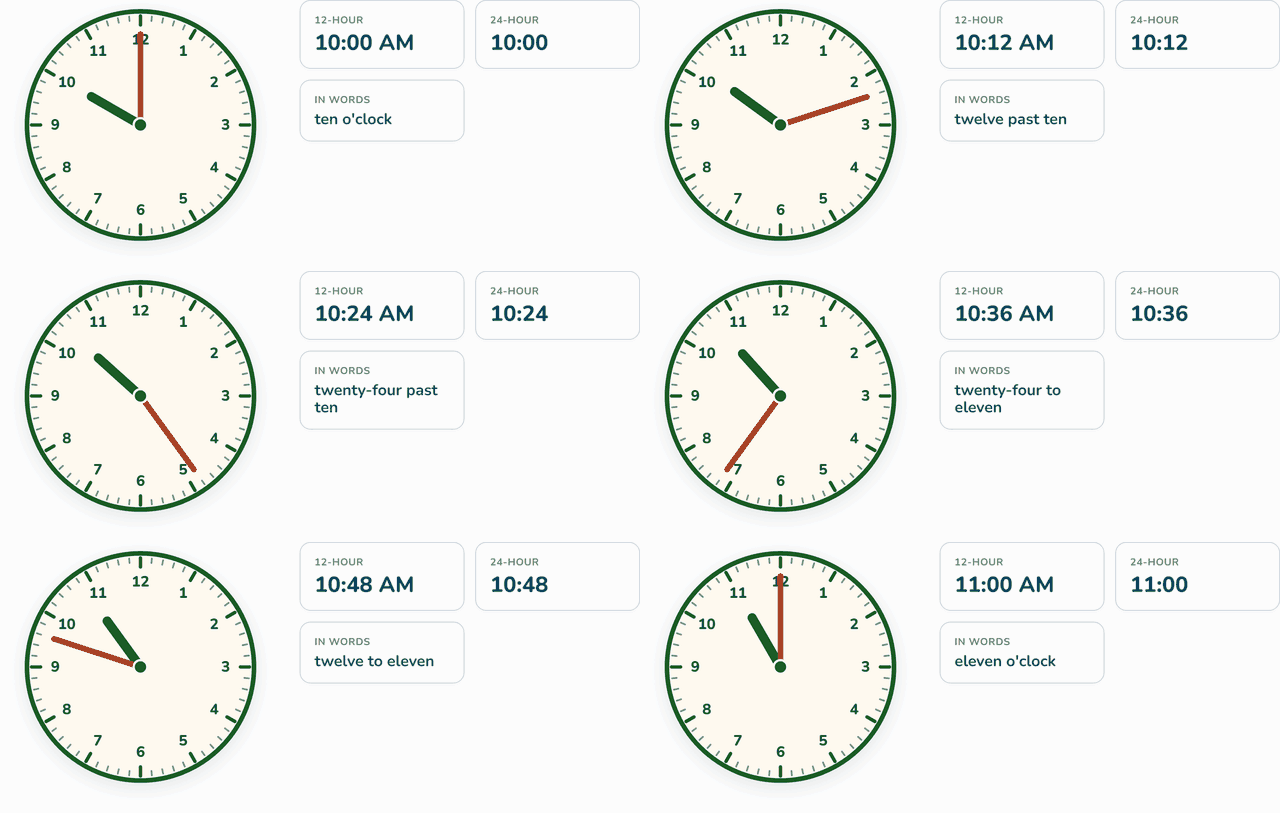
Read, write and reason about time on analog and digital clocks across 12-hour and 24-hour formats; budget and reason about transactions in everyday Irish-shop contexts.

Reading the Analogue Clock: to the Nearest Minute Sample Extension Sheet Teacher Resources
24-hour Time Sample Extension Sheet Teacher Resources
Elapsed Time Within an Hour Sample Extension Sheet Teacher Resources
Elapsed Time Across Hours and Across Midnight
Reading a Real Timetable: Irish Rail Cork to Dublin
Money: Review of Euro and Cent
Adding and Subtracting Money: Written and Mental
Making Change
Comparing Prices: Best Value
Building a Class Budget
Sale Prices in a Shop: Multi-step Money Problems
Module Assessment: Plan a School Trip

Investigate properties of 2D and 3D shapes; introduce angles in shape and angle sums in polygons; introduce circles and compass-and-ruler construction; line and rotational symmetry; transformations including enlargement; tessellation closes the module.

Naming and Sorting 2D and 3D Shapes Sample Extension Sheet Teacher Resources
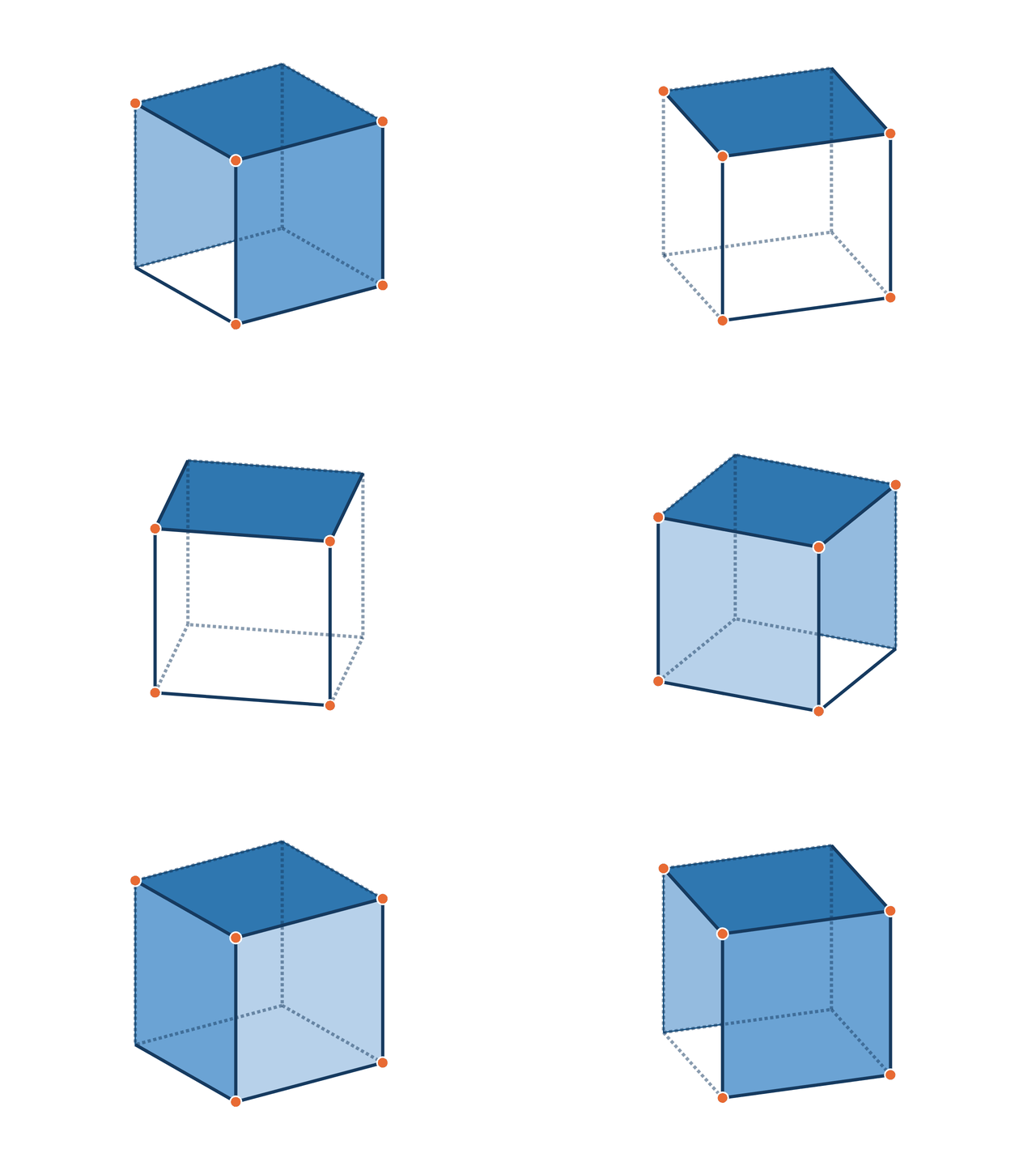
Nets and Isometric Drawing: Flat to 3D and Back Sample Teacher Resources
Angles: What Is an Angle? Sample Extension Sheet Teacher Resources
Measuring Angles with a Protractor Sample Extension Sheet Teacher Resources
Drawing Angles with a Protractor Sample Extension Sheet Teacher Resources
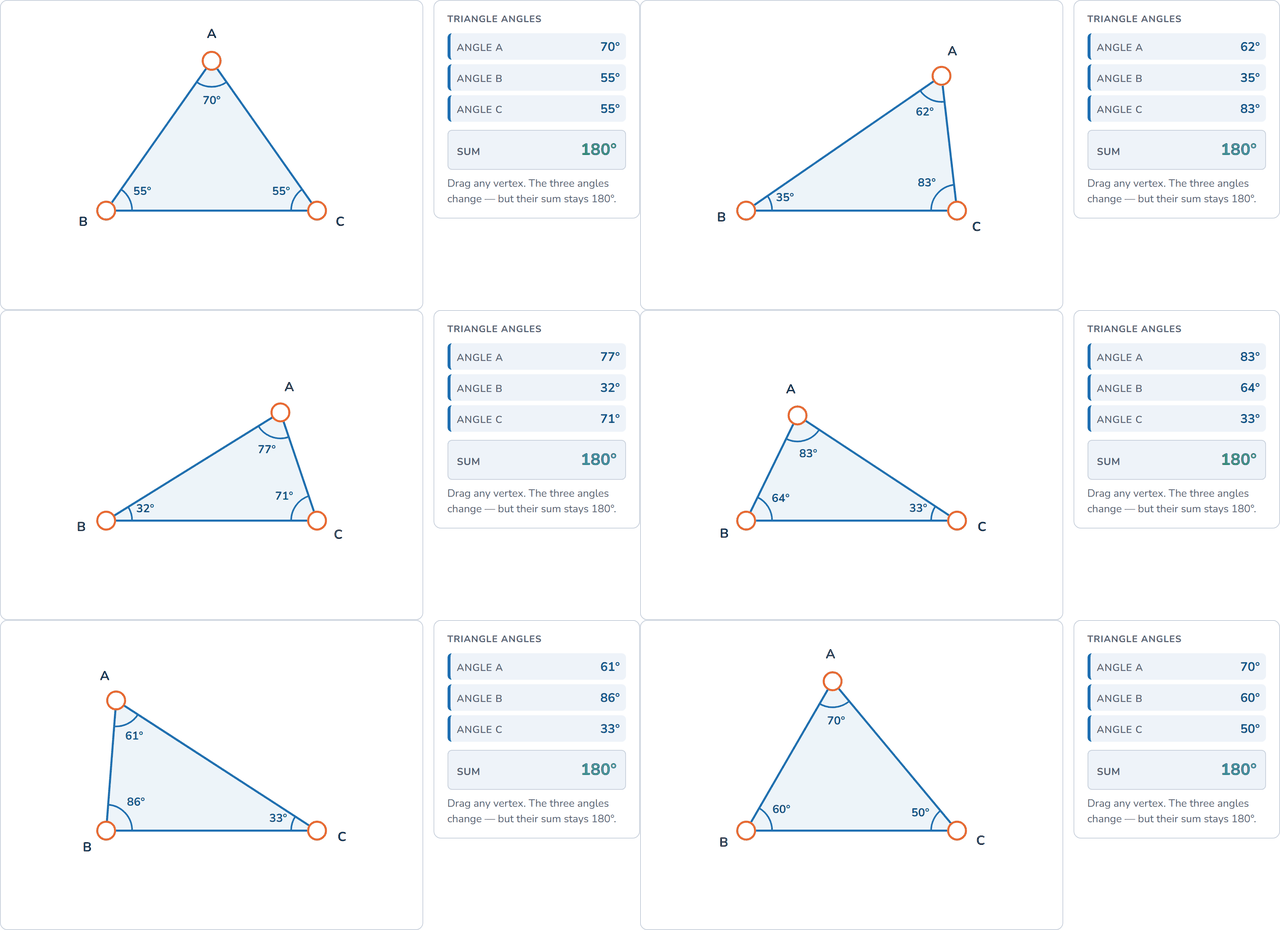
Angle Sums in Triangles and Quadrilaterals: 180 and 360
Parts of a Circle: Centre, Radius, Diameter, Circumference
Drawing Circles with a Compass
Circumference: Measuring Round Things and Meeting Π
Construction: Triangles from Sides, Bisecting Lines and Angles
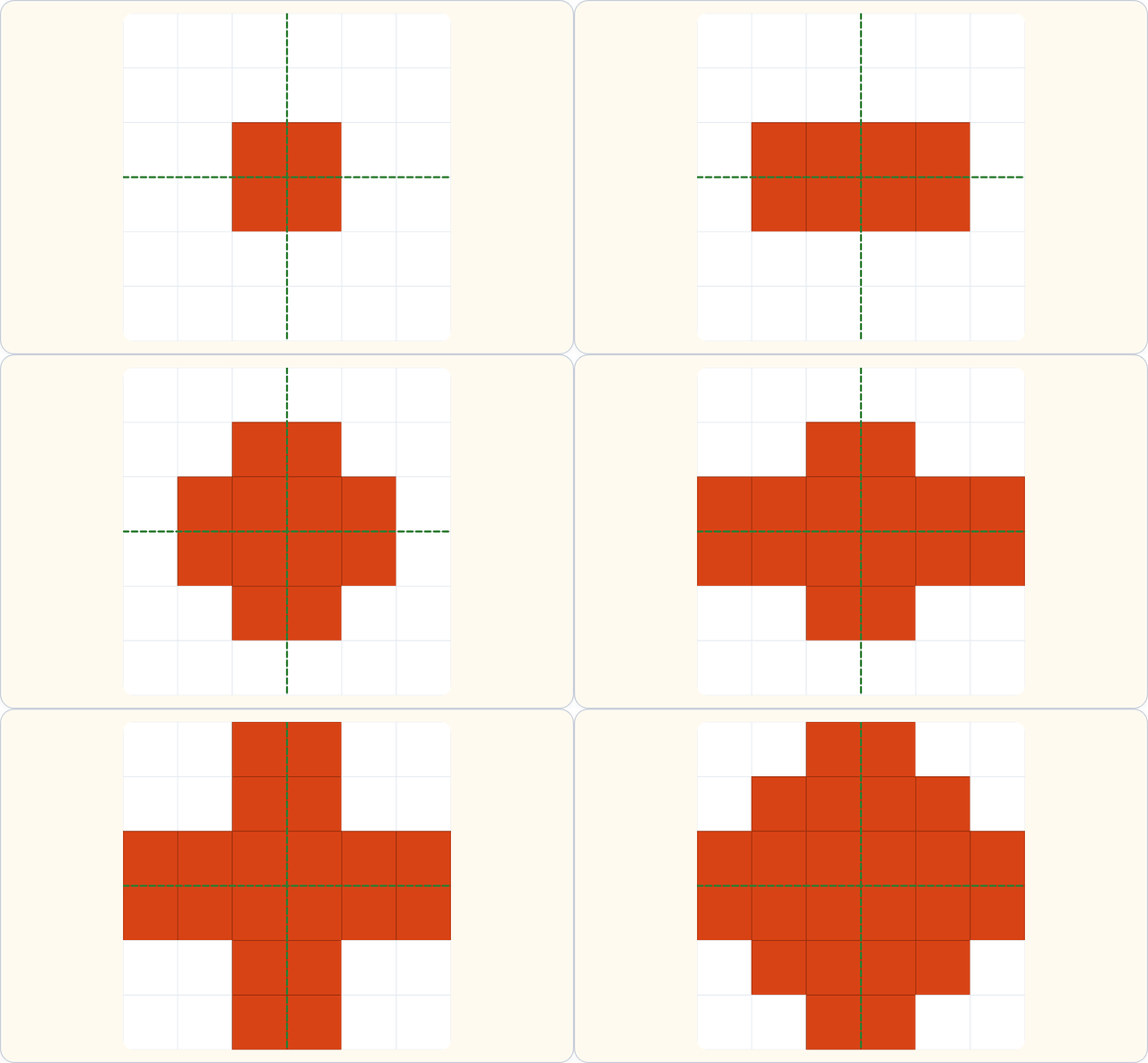
Lines of Symmetry: Finding and Completing
Rotational Symmetry: Order of Rotation
Transformations: Translation, Reflection, Rotation and Enlargement
Module Assessment: Tessellate a Quilt Block

Pose questions; collect, organise and represent data; reason about chance; introduce scale drawings and scale maps; introduce the four-quadrant co-ordinate plane.

Posing a Question and Tallying the Data Sample Extension Sheet Teacher Resources
Scale Drawings and Scale Maps: Small Drawings of Big Things Sample Teacher Resources
Bar Charts: Drawing and Reading Sample Extension Sheet Teacher Resources
Bar Charts: Choosing a Scale Sample Extension Sheet Teacher Resources
Pie Charts: First Encounter Sample Extension Sheet Teacher Resources
Mean, Median, Mode, Range: Measures of Centre and Spread
Class Survey: Pose, Collect, Summarise, Present
Chance: Likely, Unlikely, Certain, Impossible
Probability as a Fraction: Out of Total Outcomes
Probability as a Decimal and Percentage
First Quadrant of the Co-ordinate Plane
All Four Quadrants: First Walk
Drawing a Shape from a List of Co-ordinates
Module Assessment: What Does Our Class Look Like?

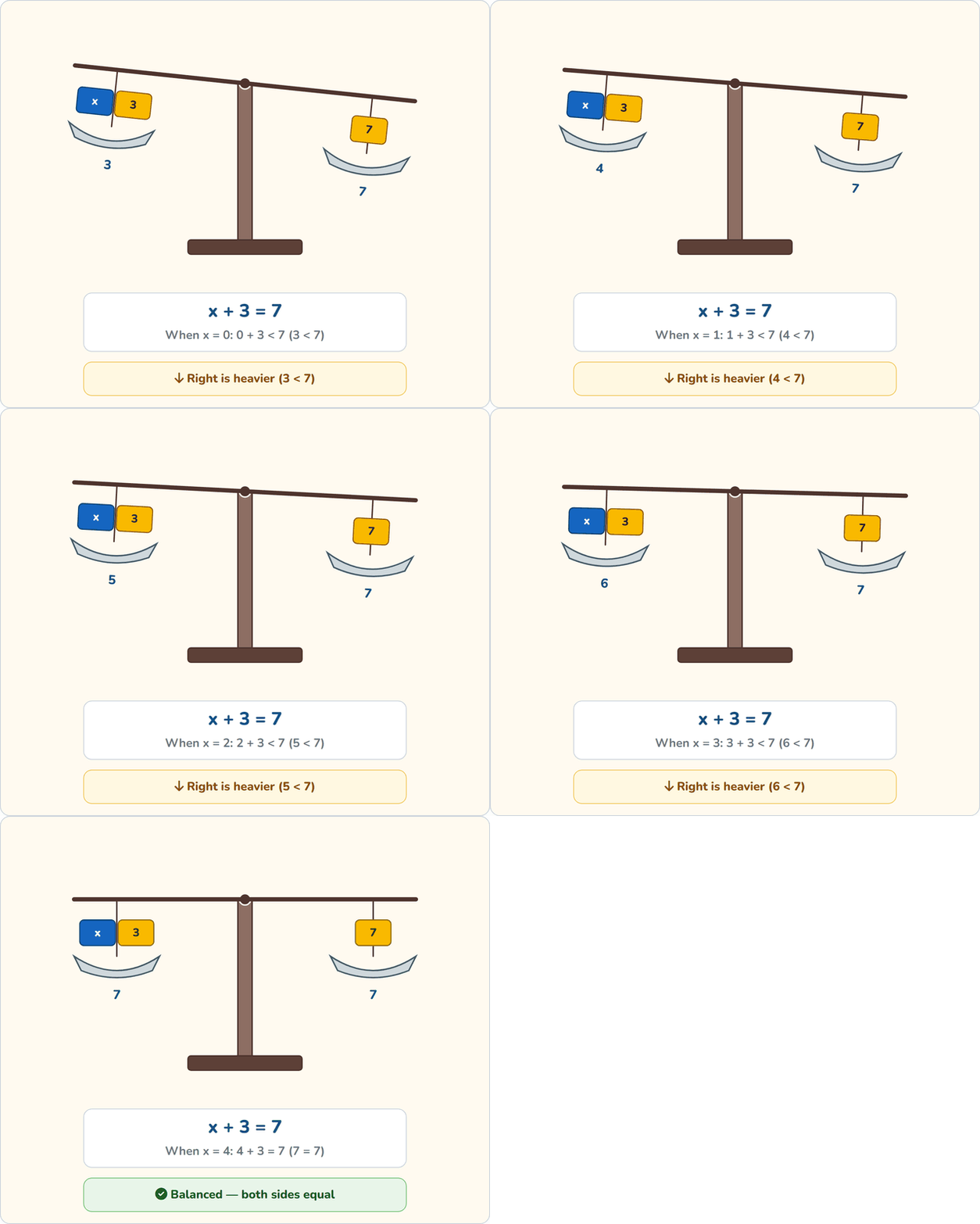
Identify rules in patterns and express them in words / diagrams / letter-symbols; introduce equations with letter-symbols and missing values; build algebraic intuition through balance scales and function machines.

Continuing a Pattern: What Comes Next? Sample Activity Book Extension Sheet Teacher Resources
Describing a Rule in Words Sample Activity Book Extension Sheet Teacher Resources
Tables of Values: Input to Output Sample Activity Book Extension Sheet Teacher Resources
Finding the Rule from a Table
Letter-symbols: Using a Letter for an Unknown
Equality and the Balance
Solving Simple Equations: Find the Missing Value
Forming an Equation from a Story
Two-step Equations: Informal Solving
Investigation: the Staircase Pattern
Properties of Operations: Commutative, Associative, Distributive
Module Assessment: Pattern Hunt

Cap the year with three open-ended modeling tasks, an end-of-year strands recap, a maths journal review and a class maths fair.

End-of-year Strands Recap: Five-strand IWB Tour
Big Investigation: How Tall Is the School?
Class-shop Modeling: Designed by Pupils
Plan Our Class Trip: Glendalough or Newgrange?
Design Our 6th Class Welcome Poster
Predict Next Year's School Enrolment
Maths Journal Review and Self-assessment
Class Maths Fair

Extend the base-ten system from whole numbers to decimals to thousandths. Build fluency in reading, writing, partitioning and comparing decimals; introduce percentages as related expressions of the same magnitude; first encounter with negative numbers.

What We Already Know: Place Value to Millions Sample Activity Book Extension Sheet Teacher Resources
One Whole, Ten Parts: Introducing Tenths Sample Activity Book Extension Sheet Teacher Resources
Reading Decimals to Tenths and Hundredths Sample Activity Book Extension Sheet Teacher Resources
Decimals on a Number Line
Comparing Two Decimals
Ordering a Set of Decimals
Decimals to Thousandths
Rounding Decimals to the Nearest Whole, Tenth, Hundredth
Money Is Decimal: €1.20 and €1.02 Are Not the Same
Percent as Out of One Hundred
Equivalent Fractions, Decimals, Percents: First Walk
Equivalent Fractions, Decimals, Percents: Independent
Negative Numbers: First Encounter
Comparing Positive and Negative Numbers
Real-life Decimals: Class Survey
Module Assessment: What's My Number?

Extend the four operations to multi-digit whole numbers and one- and two-place decimals. Build operation flexibility: pupils select the most efficient strategy rather than always using the column algorithm. Introduce factors, multiples and prime / composite numbers.

Mental Addition Strategies: Partitioning and Compensating Sample Activity Book Extension Sheet Teacher Resources
Written Addition: Multi-digit Whole Numbers Sample Activity Book Extension Sheet Teacher Resources
Adding Decimals: Line up the Points Sample Activity Book Extension Sheet Teacher Resources
Subtraction Strategies: Counting on, Take Away, Decomposition Sample Activity Book Extension Sheet Teacher Resources
Subtracting Decimals Sample Activity Book Extension Sheet Teacher Resources
Multiplication Facts: Unfinished Business
Multiplying by 10, 100, 1000
Multiplying a Multi-digit Number by a Single Digit
Multiplying Two Two-digit Numbers
Dividing by a Single Digit: the Bus-stop Method
Division with Decimal Answers: Sharing What's Left
Order of Operations: Brackets, Division, Multiplication, Addition, Subtraction
Factors, Multiples, Prime and Composite Numbers
Module Assessment: Operation Toolbox in a Class-trip Plan

Build flexible movement between fractions, decimals and percentages; introduce ratio and proportion. Pupils order, simplify, add and subtract fractions; find a fraction or percent of a quantity; meet ratio and proportional scaling.

What Is a Fraction? Part-whole Review Sample Activity Book Extension Sheet Teacher Resources
Equivalent Fractions Sample Activity Book Extension Sheet Teacher Resources
Simplifying Fractions Sample Activity Book Extension Sheet Teacher Resources
Comparing Two Fractions Sample Activity Book Extension Sheet Teacher Resources
Ordering a Set of Fractions Sample Activity Book Extension Sheet Teacher Resources
Adding and Subtracting Fractions with the Same Denominator
Adding and Subtracting Fractions with Different Denominators
Fraction of a Quantity
Decimals and Fractions: They're the Same Thing
Percent of a Quantity: 10, 25, 50
Discount and Increase: 30 Euro Reduced by 20 Percent
Ratio: the Basic Idea
Sharing in a Ratio
Proportion: Scale up the Recipe
Module Assessment: Fraction Shop

Move pupils from whole-number measures to fractional and decimal measures; develop estimation; introduce area of triangles alongside rectangle and composite area; introduce volume of cuboids.

Estimating Then Measuring: Length Sample Extension Sheet Teacher Resources
Reading Scales to the Nearest Millimetre Sample Extension Sheet Teacher Resources
Converting Length Units Sample Extension Sheet Teacher Resources
Perimeter: Adding Sides up Sample Extension Sheet Teacher Resources
Area of Rectangles Sample Extension Sheet Teacher Resources
Area of Triangles: Half a Rectangle
Composite Shapes: Break It Into Rectangles and Triangles
Mass: Weighing in G and Kg
Converting Mass Units
Capacity: Measuring Jugs
Converting Capacity Units
Volume of Cuboids
Estimation Across Attributes
Solving Real Measurement Problems
Module Assessment: Design a Class Garden Bed

Read, write and reason about time on analog and digital clocks across 12-hour and 24-hour formats; budget and reason about transactions in everyday Irish-shop contexts.

Reading the Analogue Clock: to the Nearest Minute Sample Extension Sheet Teacher Resources
24-hour Time Sample Extension Sheet Teacher Resources
Elapsed Time Within an Hour Sample Extension Sheet Teacher Resources
Elapsed Time Across Hours and Across Midnight
Reading a Real Timetable: Irish Rail Cork to Dublin
Money: Review of Euro and Cent
Adding and Subtracting Money: Written and Mental
Making Change
Comparing Prices: Best Value
Building a Class Budget
Sale Prices in a Shop: Multi-step Money Problems
Module Assessment: Plan a School Trip

Investigate properties of 2D and 3D shapes; introduce angles in shape and angle sums in polygons; introduce circles and compass-and-ruler construction; line and rotational symmetry; transformations including enlargement; tessellation closes the module.

Naming and Sorting 2D and 3D Shapes Sample Extension Sheet Teacher Resources
Nets and Isometric Drawing: Flat to 3D and Back Sample Teacher Resources
Angles: What Is an Angle? Sample Extension Sheet Teacher Resources
Measuring Angles with a Protractor Sample Extension Sheet Teacher Resources
Drawing Angles with a Protractor Sample Extension Sheet Teacher Resources
Angle Sums in Triangles and Quadrilaterals: 180 and 360
Parts of a Circle: Centre, Radius, Diameter, Circumference
Drawing Circles with a Compass
Circumference: Measuring Round Things and Meeting Π
Construction: Triangles from Sides, Bisecting Lines and Angles
Lines of Symmetry: Finding and Completing
Rotational Symmetry: Order of Rotation
Transformations: Translation, Reflection, Rotation and Enlargement
Module Assessment: Tessellate a Quilt Block

Pose questions; collect, organise and represent data; reason about chance; introduce scale drawings and scale maps; introduce the four-quadrant co-ordinate plane.

Posing a Question and Tallying the Data Sample Extension Sheet Teacher Resources
Scale Drawings and Scale Maps: Small Drawings of Big Things Sample Teacher Resources
Bar Charts: Drawing and Reading Sample Extension Sheet Teacher Resources
Bar Charts: Choosing a Scale Sample Extension Sheet Teacher Resources
Pie Charts: First Encounter Sample Extension Sheet Teacher Resources
Mean, Median, Mode, Range: Measures of Centre and Spread
Class Survey: Pose, Collect, Summarise, Present
Chance: Likely, Unlikely, Certain, Impossible
Probability as a Fraction: Out of Total Outcomes
Probability as a Decimal and Percentage
First Quadrant of the Co-ordinate Plane
All Four Quadrants: First Walk
Drawing a Shape from a List of Co-ordinates
Module Assessment: What Does Our Class Look Like?

Identify rules in patterns and express them in words / diagrams / letter-symbols; introduce equations with letter-symbols and missing values; build algebraic intuition through balance scales and function machines.

Continuing a Pattern: What Comes Next? Sample Activity Book Extension Sheet Teacher Resources
Describing a Rule in Words Sample Activity Book Extension Sheet Teacher Resources
Tables of Values: Input to Output Sample Activity Book Extension Sheet Teacher Resources
Finding the Rule from a Table
Letter-symbols: Using a Letter for an Unknown
Equality and the Balance
Solving Simple Equations: Find the Missing Value
Forming an Equation from a Story
Two-step Equations: Informal Solving
Investigation: the Staircase Pattern
Properties of Operations: Commutative, Associative, Distributive
Module Assessment: Pattern Hunt

Cap the year with three open-ended modeling tasks, an end-of-year strands recap, a maths journal review and a class maths fair.

End-of-year Strands Recap: Five-strand IWB Tour
Big Investigation: How Tall Is the School?
Class-shop Modeling: Designed by Pupils
Plan Our Class Trip: Glendalough or Newgrange?
Design Our 6th Class Welcome Poster
Predict Next Year's School Enrolment
Maths Journal Review and Self-assessment
Class Maths Fair

Curriculum Mapping

See exactly how this course maps to official curriculum specifications

Curriculum Area
Outcomes
Algebra
Patterns, rules and relationships
ALG.PRR.1 ALG.PRR.2 ALG.PRR.3a ALG.PRR.3b ALG.PRR.4a ALG.PRR.4b
Expressions and equations
ALG.EXP.2 ALG.EXP.3 ALG.EXP.4
Data and chance
Data
DAT.DAT.1 DAT.DAT.2 DAT.DAT.3 DAT.DAT.4a DAT.DAT.4b
Chance
DAT.CHN.3 DAT.CHN.4a DAT.CHN.4b
Measures
Measuring
MEA.MSR.1 MEA.MSR.2 MEA.MSR.3a MEA.MSR.3b MEA.MSR.4a MEA.MSR.4b
Time
MEA.TIM.1 MEA.TIM.2a MEA.TIM.2b MEA.TIM.3a MEA.TIM.3b MEA.TIM.4
Money
MEA.MON.1 MEA.MON.2 MEA.MON.3 MEA.MON.4
Number
Uses of number
NUM.USE.1
Numeration and counting
NUM.NCT.1a NUM.NCT.1b NUM.NCT.2
Place value and base ten
NUM.PVT.1 NUM.PVT.2a NUM.PVT.2b NUM.PVT.3 NUM.PVT.4
Sets and operations
NUM.OPS.1 NUM.OPS.2 NUM.OPS.3 NUM.OPS.4
Fractions
NUM.FRC.1 NUM.FRC.2a NUM.FRC.2b NUM.FRC.3a NUM.FRC.3b NUM.FRC.4a NUM.FRC.4b
Shape and space
Spatial awareness and location
SHA.SAL.1a SHA.SAL.1b SHA.SAL.2a SHA.SAL.2b SHA.SAL.3a SHA.SAL.3b SHA.SAL.4a SHA.SAL.4b
Shape
SHA.SHP.1 SHA.SHP.2 SHA.SHP.3a SHA.SHP.3b SHA.SHP.4a SHA.SHP.4b
Transformation
SHA.TRN.1 SHA.TRN.2 SHA.TRN.3 SHA.TRN.4a SHA.TRN.4b

The curriculum does not include official reference codes for individual learning outcomes, so we have assigned a code scheme to make it easier to identify and track coverage.

What Students Will Learn

Learning Goals

  1. Master place value in whole numbers, decimals to thousandths, negative numbers and percentages, and fluently read, compare, order, round and convert between equivalent forms.
  2. Develop computational fluency with all four operations on whole numbers and decimals, applying mental strategies, written algorithms, order of operations and knowledge of factors, multiples and primes.
  3. Work confidently with fractions, decimals and percentages: simplify, compare, order, add, subtract, find fractions and percentages of quantities, solve ratio and proportion problems, and convert flexibly between the three forms.
  4. Measure and calculate accurately using units of length, mass, capacity, area and volume; convert between units; solve problems involving perimeter, area of rectangles and triangles, and volume of cuboids.
  5. Apply mathematical skills to real-life contexts involving time, money, 2D and 3D shape, angles, symmetry, data handling, probability, coordinates, patterns, expressions, equations and mathematical modelling.

Learning Outcomes

  1. Read, compare, order and round decimals up to thousandths using place-value columns and number lines.
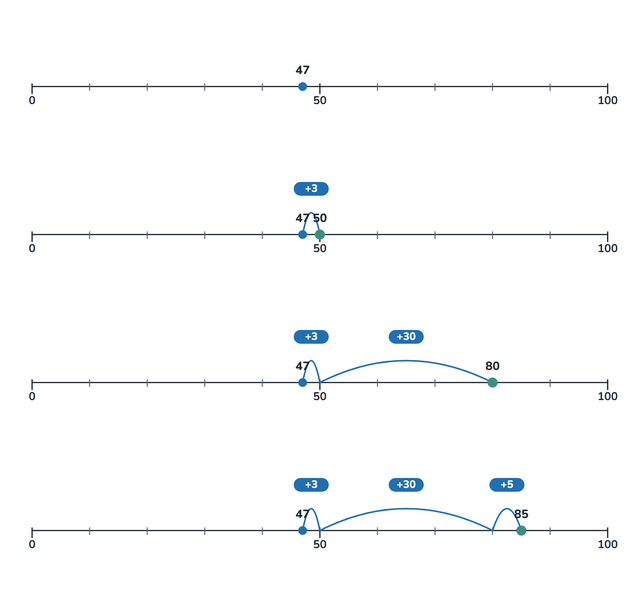
  2. Add, subtract, multiply and divide whole numbers and decimals using mental strategies, column methods and the bus-stop algorithm.
  3. Simplify, compare, add and subtract fractions with related and unrelated denominators, and find fractions and percentages of quantities.
  4. Convert between units of length, mass and capacity, calculate perimeters, areas of rectangles and triangles, and volumes of cuboids.
  5. Read analogue and 24-hour clocks, calculate elapsed time, and solve multi-step problems involving money, best value and budgeting.

What You'll Need

Required Equipment

Equipment used in some of the lessons in this course. Items can be shared among students.

IWB/Projector/Large Screen
Metre stick
paper-strip angle maker
Polydron
Protractor
Tape measure

Ready to bring this course to your school?

Get in touch to discuss pricing and ordering for your school.

Ready to get started?
Pricing & Ordering Contact Us
🍪 Our website uses cookies to make your browsing experience better. By using our website you agree to our use of cookies. Learn more